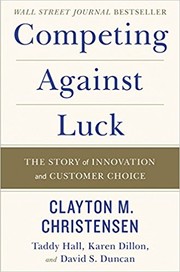
Competing Against Luck
Customers hire products to do a job; innovate by finding the job, not the buyer type.
Summary
Christensen, Hall, Dillon and Duncan set out the jobs to be done theory of innovation, arguing that customers do not buy products because of who they are demographically or what attributes the product has, but because they have a job arising in their circumstances and they hire something to get it done.
The definition is specific. A job is the progress a person is trying to make in a particular circumstance, and it has functional, social and emotional dimensions. The circumstance is the unit of analysis rather than the customer, so segmenting by demographics or by product category misses the actual competitive set. The authors' recurring example is a fast-food company's milkshake sales, where research found that morning purchasers were hiring the milkshake to make a long dull commute tolerable and to stave off hunger until lunch, competing against bananas, bagels and doughnuts rather than against other milkshakes.
The methodological content concerns how to find jobs. The authors argue for studying non-consumption, meaning situations where people cope with a problem by doing nothing or by improvising, for examining what customers actually did before and after the purchase, and for understanding the forces that push and pull people toward change against the anxieties and habits that hold them in place. They also argue that once a job is understood, the organisation must integrate its processes around delivering the whole experience of getting that job done, because competitors can copy features but not integrated processes.
The theory is difficult to test. A job can be defined at almost any level of abstraction, and critics point out that identifying the correct job is usually done after a product succeeds. The milkshake example has been repeated so often that its evidentiary basis, a single unpublished consulting engagement, is easy to overlook. The framework's value is as a research discipline rather than as a predictive theory.
Key takeaways 7
- Customers hire products to make progress in a specific circumstance, so the circumstance rather than the customer is the unit of analysis.
- Correlations between customer attributes and purchases do not establish causation and cannot direct product development.
- A job has functional, social and emotional dimensions, and products that address only the functional one lose to those that address all three.
- The competitive set is defined by what else could do the job, which usually includes products from entirely different categories.
- Studying non-consumption, meaning people who cope by improvising or doing nothing, reveals jobs that market research on existing customers cannot.
- Progress toward change requires push and pull forces to exceed the anxiety of the new and the habit of the present.
- Competitors can copy product features but not the integrated processes that deliver a complete experience of the job being done.
Who should read it
Founders and product leaders who need a research discipline for understanding why customers actually buy, particularly before building new products.
About Clayton Christensen
Kim B. Clark Professor of Business Administration, Harvard Business School 1992-2020; co-founder of Innosight, Rose Park Advisors and the Clayton Christensen Institute; died 23 January 2020
The Innovator's Dilemma turned disruption into a primary framework that the rest of the strategy and innovation literature argues with rather than around.
Who recommended it 1 · 1 direct
“Clayton M. Christensen, Taddy Hall, Karen Dillon, and David S. Duncan, Competing Against Luck: The Story of Innovation and Customer Choice (New York: HarperBusiness, 2016)”
Similar books 6
Chosen by shared topics, the entries that hold them, and the people who recommended both.
Disruption theory used to forecast how industries will change.
“also Clayton M. Christensen, Scott D. Anthony, and Erik A. Roth, Seeing What’s Next: Using the Theories of Innovation to Predict Industry Change (Boston, MA: Harvard Business School Press, 2004)” — Michael Mauboussin
Source: Untangling Skill and Luck: How to Think About Outcomes - Past, Present, and Future, page 31
Recommended by: Michael Mauboussin, Ev Williams
Why well-run firms lose to cheaper, worse products that enter at the market's bottom.
“Clayton Christensen's big "aha" in Innovator's Dilemma is that eventually a product will become over-featured and as a result feature growth will slow, and along with it innovation.” — Bill Gurley
Source: Picture Proof of the Innovator’s Dilemma: SlideRocket
Recommended by: Bill Gurley, Drew Houston, Jim Collins and 29 others
How a company can build new businesses through low-end and new-market disruption.
“Required reading for business-owners and investors. Shows how technology improves faster than people's ability to use it, so when someone says a technology is “not good enough”, add “yet” and prepare for disruption.” — Derek Sivers
Source: Derek Sivers book notes (primary, rated list) · Rating: 8/10
Recommended by: Derek Sivers, Keith Rabois and 3 others

Harvard teaching cases on managing innovation and new products.
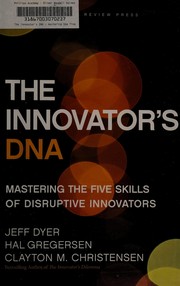
What innovative entrepreneurs and executives do differently from other managers.
Disruptive innovation applied to health care.
Where it sits in the reference 4
Topics 3
As an Amazon Associate I earn from qualifying purchases.