Updates

  1. Person pages list letters, writing, profiles and links as sortable tables with filters, and show each person's companies as links; Fund letters show each letter's description in its own column.
  2. Experts show a checked job title and a short description of each person; 30 more people have photographs.
  3. Every company, fund, university and publication the experts work for has a page listing the people there.
  4. Fund letters show each letter's thesis and filter by it; 225 person pages list the essays, columns and newsletter issues the person wrote.
  5. Person pages list every essay and newsletter issue a person wrote, and their own books as a table in List view.
  6. Recommends shows the five largest kinds of book and the rest under More; browse pictures load sooner.
  7. Podcasts and talks link the original episode, filter by Audio and video or Press, and list each publisher once.
  8. Pages are wider, Recommends has List and Grid, and a filter clicked again turns off.
  9. Book cards sit in a ruled grid with Open Library and Goodreads links and each book's one-line note.
  10. Funds is now Investors; each investor's styles are buttons that filter the table.
  11. Podcasts and talks on a person's page filter by year and publisher and show as a list or a grid of pictures.
  12. Quotes show only people's own words: 472 summaries written by list sites are gone.
  13. Country pages open from Browse again, and every link on the shelf lands on a page.
  14. Subject and person pages show their sections as tabs, and each book appears once on a person's page.
  15. Book cards show the quote, who said it and the source; grids show five cards to a row.
  16. On a phone, a menu holds the sections, search, Updates, Feedback and dark mode.
  17. Feedback takes a screenshot of the page with no browser prompt, opens a screenshot full size when you click it, and clears itself once sent.
  18. Book cards are centred, search names the topic each book sits in, and any text cut short shows whole on hover.
  19. Search groups its results by kind: people, companies, geographies, subjects, topics, books, funds, fund letters and papers.
  20. The Books table lists who recommended each book by name, and the browser tab names the section you are in.
  21. Feedback can take a screenshot of the page, or one you paste or choose, and opens in the corner beside Updates.
  22. Each rail button reopens its section where you left it, and Browse, Table and People show on every book and subject page.
  23. Filters grey out choices that hold nothing instead of hiding them, and Books › People filters by authors or recommenders.
  24. Feedback takes a subject line and up to three screenshots.
  25. Biographies are grouped by the person they are about: 41 new pages, from Abraham Lincoln to Lee Kuan Yew.
  26. Sport splits into 23 sports, and Religion into one topic per faith.
  27. Book lists show as cards: the cover, one recommendation quote and every recommender by name.
  28. Seventeen subjects that had two or three pages under different names now have one page each.
  29. Every page lists its Experts as authors and recommenders, with a link to them on the Experts tab.
  30. Economics, Financial history, Financial panics and Accounting are subjects of their own, with one page per financial crisis.
  31. Book, person and subject pages open inside the app, so the tabs stay in view.
  32. 996 more book covers, and photographs or logos for 227 more people and companies.
  33. Books › Browse shows every subject as cards, and the rail holds Fund letters, Papers, Experts, Books and Funds.
  34. Every topic over 150 books splits into narrower topics, each with a page of its own.

Send feedback

What is it?
Screenshots, up to 3 (optional)
or paste one with Ctrl+V

We use your email only to reply to you.

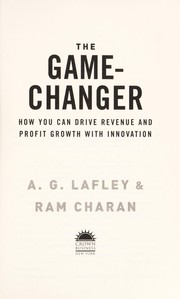
The Game-Changer

The Game-Changer

A. G. Lafley, Ram Charan
2008
T3 336 pages · about 5h 36m to read Open Librarygoodreads

Insider account: Lafley on making innovation a routine process.

Summary

A. G. Lafley ran Procter and Gamble from 2000 to 2010 and wrote this with Ram Charan about making innovation a systematic and repeatable process rather than an occasional achievement.

The organising claim is that the consumer is boss, meaning that innovation begins with a specific understanding of what people do and want rather than with technology. Lafley describes the research methods P and G used, including extended observation in homes and stores rather than focus groups, and the two moments of truth: when a shopper chooses the product on the shelf and when they use it at home.

The operational content covers Connect and Develop, the programme through which P and G sourced roughly half its innovation from outside the company, reversing a research culture that had prized internal invention. Lafley describes the mechanisms: technology briefs published externally, relationships with suppliers and universities, and networks of retired scientists. He also covers the integration of innovation into the strategy and budgeting process, the portfolio approach balancing incremental with transformational projects, the organisational structures that support each, and the treatment of innovation as a social process requiring cross-functional teams rather than an isolated research function. The book is a chief executive's account and does not examine failures rigorously. The Connect and Develop material is the most transferable content.

Key takeaways 7

  1. Innovation should begin with observed consumer behaviour rather than with available technology.
  2. Lafley identifies two moments of truth, the shelf decision and the use at home, and argues that products must win both.
  3. Connect and Develop sourced roughly half of P and G's innovation externally, which required abandoning a research culture that valued internal invention.
  4. Innovation must be integrated into the strategy and budgeting process rather than run as a separate function.
  5. A portfolio balancing incremental with transformational projects prevents an organisation from funding only the safe ones.
  6. Different types of innovation require different organisational structures, and forcing all of them through one process kills the disruptive ones.
  7. Lafley argues that innovation is a social process requiring cross-functional teams rather than an activity of specialists.

Who should read it

Executives in consumer businesses who want a chief executive's account of making innovation repeatable, particularly the external sourcing model.

Similar books 6

Chosen by shared topics, the entries that hold them, and the people who recommended both.

Stan Davis, Bill Davidson · 1991

Recommended by: Mohnish Pabrai

Joe Weinman · 2012

The maths of pay-per-use versus owned capacity.

Clayton Christensen, Taddy Hall, Karen Dillon, David S. Duncan · 2016

Customers hire products to do a job; innovate by finding the job, not the buyer type.

Where it sits in the reference 3

Companies
Business themes
Business themes

Topics

Business and Management