Updates

  1. Person pages list letters, writing, profiles and links as sortable tables with filters, and show each person's companies as links; Fund letters show each letter's description in its own column.
  2. Experts show a checked job title and a short description of each person; 30 more people have photographs.
  3. Every company, fund, university and publication the experts work for has a page listing the people there.
  4. Fund letters show each letter's thesis and filter by it; 225 person pages list the essays, columns and newsletter issues the person wrote.
  5. Person pages list every essay and newsletter issue a person wrote, and their own books as a table in List view.
  6. Recommends shows the five largest kinds of book and the rest under More; browse pictures load sooner.
  7. Podcasts and talks link the original episode, filter by Audio and video or Press, and list each publisher once.
  8. Pages are wider, Recommends has List and Grid, and a filter clicked again turns off.
  9. Book cards sit in a ruled grid with Open Library and Goodreads links and each book's one-line note.
  10. Funds is now Investors; each investor's styles are buttons that filter the table.
  11. Podcasts and talks on a person's page filter by year and publisher and show as a list or a grid of pictures.
  12. Quotes show only people's own words: 472 summaries written by list sites are gone.
  13. Country pages open from Browse again, and every link on the shelf lands on a page.
  14. Subject and person pages show their sections as tabs, and each book appears once on a person's page.
  15. Book cards show the quote, who said it and the source; grids show five cards to a row.
  16. On a phone, a menu holds the sections, search, Updates, Feedback and dark mode.
  17. Feedback takes a screenshot of the page with no browser prompt, opens a screenshot full size when you click it, and clears itself once sent.
  18. Book cards are centred, search names the topic each book sits in, and any text cut short shows whole on hover.
  19. Search groups its results by kind: people, companies, geographies, subjects, topics, books, funds, fund letters and papers.
  20. The Books table lists who recommended each book by name, and the browser tab names the section you are in.
  21. Feedback can take a screenshot of the page, or one you paste or choose, and opens in the corner beside Updates.
  22. Each rail button reopens its section where you left it, and Browse, Table and People show on every book and subject page.
  23. Filters grey out choices that hold nothing instead of hiding them, and Books › People filters by authors or recommenders.
  24. Feedback takes a subject line and up to three screenshots.
  25. Biographies are grouped by the person they are about: 41 new pages, from Abraham Lincoln to Lee Kuan Yew.
  26. Sport splits into 23 sports, and Religion into one topic per faith.
  27. Book lists show as cards: the cover, one recommendation quote and every recommender by name.
  28. Seventeen subjects that had two or three pages under different names now have one page each.
  29. Every page lists its Experts as authors and recommenders, with a link to them on the Experts tab.
  30. Economics, Financial history, Financial panics and Accounting are subjects of their own, with one page per financial crisis.
  31. Book, person and subject pages open inside the app, so the tabs stay in view.
  32. 996 more book covers, and photographs or logos for 227 more people and companies.
  33. Books › Browse shows every subject as cards, and the rail holds Fund letters, Papers, Experts, Books and Funds.
  34. Every topic over 150 books splits into narrower topics, each with a page of its own.

Send feedback

What is it?
Screenshots, up to 3 (optional)
or paste one with Ctrl+V

We use your email only to reply to you.

Competing Against Luck

Competing Against Luck

Clayton Christensen, Taddy Hall, Karen Dillon, David S. Duncan
2016
T2 288 pages · about 4h 48m to read Open Librarygoodreads

Summary

Christensen, Hall, Dillon and Duncan set out the jobs to be done theory of innovation, arguing that customers do not buy products because of who they are demographically or what attributes the product has, but because they have a job arising in their circumstances and they hire something to get it done.

The definition is specific. A job is the progress a person is trying to make in a particular circumstance, and it has functional, social and emotional dimensions. The circumstance is the unit of analysis rather than the customer, so segmenting by demographics or by product category misses the actual competitive set. The authors' recurring example is a fast-food company's milkshake sales, where research found that morning purchasers were hiring the milkshake to make a long dull commute tolerable and to stave off hunger until lunch, competing against bananas, bagels and doughnuts rather than against other milkshakes.

The methodological content concerns how to find jobs. The authors argue for studying non-consumption, meaning situations where people cope with a problem by doing nothing or by improvising, for examining what customers actually did before and after the purchase, and for understanding the forces that push and pull people toward change against the anxieties and habits that hold them in place. They also argue that once a job is understood, the organisation must integrate its processes around delivering the whole experience of getting that job done, because competitors can copy features but not integrated processes.

The theory is difficult to test. A job can be defined at almost any level of abstraction, and critics point out that identifying the correct job is usually done after a product succeeds. The milkshake example has been repeated so often that its evidentiary basis, a single unpublished consulting engagement, is easy to overlook. The framework's value is as a research discipline rather than as a predictive theory.

Key takeaways 7

  1. Customers hire products to make progress in a specific circumstance, so the circumstance rather than the customer is the unit of analysis.
  2. Correlations between customer attributes and purchases do not establish causation and cannot direct product development.
  3. A job has functional, social and emotional dimensions, and products that address only the functional one lose to those that address all three.
  4. The competitive set is defined by what else could do the job, which usually includes products from entirely different categories.
  5. Studying non-consumption, meaning people who cope by improvising or doing nothing, reveals jobs that market research on existing customers cannot.
  6. Progress toward change requires push and pull forces to exceed the anxiety of the new and the habit of the present.
  7. Competitors can copy product features but not the integrated processes that deliver a complete experience of the job being done.

Who should read it

Founders and product leaders who need a research discipline for understanding why customers actually buy, particularly before building new products.

About Clayton Christensen

Kim B. Clark Professor of Business Administration, Harvard Business School 1992-2020; co-founder of Innosight, Rose Park Advisors and the Clayton Christensen Institute; died 23 January 2020

The Innovator's Dilemma turned disruption into a primary framework that the rest of the strategy and innovation literature argues with rather than around.

Harvard Business School, Innosight, Rose Park Advisors, Clayton Christensen Institute

Similar books 6

Chosen by shared topics, the entries that hold them, and the people who recommended both.

Clayton Christensen · 1999

Irwin/McGraw-Hill case textbook

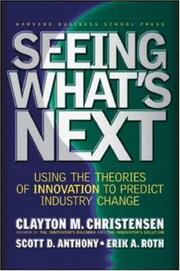
Clayton Christensen, Scott D. Anthony, Erik A. Roth · 2004

Disruption theory used to forecast how industries will change.

Recommended by: Ev Williams
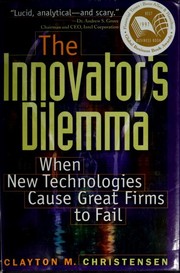
Clayton Christensen · 1997

Why well-run firms lose to cheaper, worse products that enter at the market's bottom.

“Awesome book. May move soon to my Top Ten List. If anything will keep CEOs awake at night, reading this book certainly will.” — Mohnish Pabrai

Source: Mohnish's Bookshelf — Books on Sales & Marketing, entry 66

Recommended by: Jim Collins, Mohnish Pabrai, Aaron Levie and 27 others
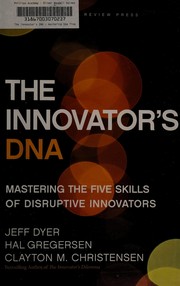
Clayton Christensen, Jeff Dyer, Hal Gregersen · 2011
Clayton Christensen, Jerome H. Grossman, Jason Hwang · 2009
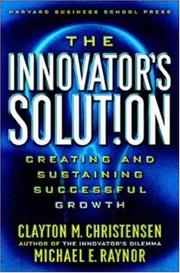
Clayton Christensen, Michael E. Raynor · 2003

How a company can build new businesses through low-end and new-market disruption.

Recommended by: Jeff Bezos, Keith Rabois

Where it sits in the reference 4

Strategists
Business models
Business themes
Business themes

Topics

Business and ManagementSales and MarketingGrowth, pricing and channels