Updates

  1. Person pages list letters, writing, profiles and links as sortable tables with filters, and show each person's companies as links; Fund letters show each letter's description in its own column.
  2. Experts show a checked job title and a short description of each person; 30 more people have photographs.
  3. Every company, fund, university and publication the experts work for has a page listing the people there.
  4. Fund letters show each letter's thesis and filter by it; 225 person pages list the essays, columns and newsletter issues the person wrote.
  5. Person pages list every essay and newsletter issue a person wrote, and their own books as a table in List view.
  6. Recommends shows the five largest kinds of book and the rest under More; browse pictures load sooner.
  7. Podcasts and talks link the original episode, filter by Audio and video or Press, and list each publisher once.
  8. Pages are wider, Recommends has List and Grid, and a filter clicked again turns off.
  9. Book cards sit in a ruled grid with Open Library and Goodreads links and each book's one-line note.
  10. Funds is now Investors; each investor's styles are buttons that filter the table.
  11. Podcasts and talks on a person's page filter by year and publisher and show as a list or a grid of pictures.
  12. Quotes show only people's own words: 472 summaries written by list sites are gone.
  13. Country pages open from Browse again, and every link on the shelf lands on a page.
  14. Subject and person pages show their sections as tabs, and each book appears once on a person's page.
  15. Book cards show the quote, who said it and the source; grids show five cards to a row.
  16. On a phone, a menu holds the sections, search, Updates, Feedback and dark mode.
  17. Feedback takes a screenshot of the page with no browser prompt, opens a screenshot full size when you click it, and clears itself once sent.
  18. Book cards are centred, search names the topic each book sits in, and any text cut short shows whole on hover.
  19. Search groups its results by kind: people, companies, geographies, subjects, topics, books, funds, fund letters and papers.
  20. The Books table lists who recommended each book by name, and the browser tab names the section you are in.
  21. Feedback can take a screenshot of the page, or one you paste or choose, and opens in the corner beside Updates.
  22. Each rail button reopens its section where you left it, and Browse, Table and People show on every book and subject page.
  23. Filters grey out choices that hold nothing instead of hiding them, and Books › People filters by authors or recommenders.
  24. Feedback takes a subject line and up to three screenshots.
  25. Biographies are grouped by the person they are about: 41 new pages, from Abraham Lincoln to Lee Kuan Yew.
  26. Sport splits into 23 sports, and Religion into one topic per faith.
  27. Book lists show as cards: the cover, one recommendation quote and every recommender by name.
  28. Seventeen subjects that had two or three pages under different names now have one page each.
  29. Every page lists its Experts as authors and recommenders, with a link to them on the Experts tab.
  30. Economics, Financial history, Financial panics and Accounting are subjects of their own, with one page per financial crisis.
  31. Book, person and subject pages open inside the app, so the tabs stay in view.
  32. 996 more book covers, and photographs or logos for 227 more people and companies.
  33. Books › Browse shows every subject as cards, and the rail holds Fund letters, Papers, Experts, Books and Funds.
  34. Every topic over 150 books splits into narrower topics, each with a page of its own.

Send feedback

What is it?
Screenshots, up to 3 (optional)
or paste one with Ctrl+V

We use your email only to reply to you.

The Innovator's Prescription

The Innovator's Prescription

Clayton Christensen, Jerome H. Grossman, Jason Hwang
2009
T4 Open Librarygoodreads

Summary

Clayton Christensen, with physician Jerome Grossman and Jason Hwang, applies disruptive innovation theory to health care. The book is the most systematic attempt to explain why medical costs rise and what would change that.

The analytical core is a distinction between three business models that health care institutions mix and should not. Solution shops diagnose problems whose causes are unknown, are paid on a fee-for-service basis, and cannot be measured on outcomes because the work is unstructured. Value-adding process businesses perform defined procedures where the diagnosis is known, can be measured on outcomes, and should be paid a fixed price per case. Facilitated networks connect participants who help each other, which suits chronic disease management. General hospitals combine all three under one roof and one overhead structure, which the authors argue makes every activity expensive.

The disruption argument holds that medical care becomes cheaper when a condition moves from intuitive medicine, requiring expert judgement, to precision medicine, where the diagnosis is definitive and the treatment rule-based, and that when this happens the care can move to a lower-cost provider and setting: from specialist to general physician, from physician to nurse, from hospital to clinic to home. They argue that regulation, professional licensing and reimbursement structures block this movement. The framework is powerful and the specific predictions about retail clinics and about disruptive business models have been partly realised. Critics argue that the authors understate the complexity of comorbid patients and that disruption theory transfers imperfectly to a market where the customer does not pay.

Key takeaways 7

  1. Health care institutions mix three incompatible business models, and general hospitals combine all of them under one overhead structure.
  2. Solution shops diagnose unknown problems and must be paid for effort, while value-adding process businesses should be paid a fixed price per case.
  3. Care becomes cheaper when a condition moves from requiring expert judgement to being definitively diagnosable and rule-based.
  4. When diagnosis becomes precise, care can move to a lower-cost provider and setting, and regulation is what usually prevents it.
  5. Professional licensing and reimbursement rules block the movement of care down the cost curve.
  6. Chronic disease management suits a facilitated network model in which patients contribute to each other's care.
  7. Employers rather than providers or insurers have the strongest incentive to disrupt health care, since they bear the cost.

Who should read it

Health care executives and investors who want a business model framework explaining why costs rise and what structural changes would reduce them.

About Clayton Christensen

Kim B. Clark Professor of Business Administration, Harvard Business School 1992-2020; co-founder of Innosight, Rose Park Advisors and the Clayton Christensen Institute; died 23 January 2020

The Innovator's Dilemma turned disruption into a primary framework that the rest of the strategy and innovation literature argues with rather than around.

Harvard Business School, Innosight, Rose Park Advisors, Clayton Christensen Institute

Similar books 6

Chosen by shared topics, the entries that hold them, and the people who recommended both.

Clayton Christensen, Taddy Hall, Karen Dillon, David S. Duncan · 2016

Customers hire products to do a job; innovate by finding the job, not the buyer type.
Clayton Christensen · 1999

Irwin/McGraw-Hill case textbook

Clayton Christensen, Scott D. Anthony, Erik A. Roth · 2004

Disruption theory used to forecast how industries will change.

Recommended by: Ev Williams
Clayton Christensen · 1997

Why well-run firms lose to cheaper, worse products that enter at the market's bottom.

“Awesome book. May move soon to my Top Ten List. If anything will keep CEOs awake at night, reading this book certainly will.” — Mohnish Pabrai

Source: Mohnish's Bookshelf — Books on Sales & Marketing, entry 66

Recommended by: Jim Collins, Mohnish Pabrai, Aaron Levie and 27 others
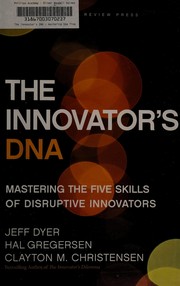
Clayton Christensen, Jeff Dyer, Hal Gregersen · 2011
Clayton Christensen, Michael E. Raynor · 2003

How a company can build new businesses through low-end and new-market disruption.

Recommended by: Jeff Bezos, Keith Rabois

Where it sits in the reference 3

Strategists
Business themes
Business themes

Topics

Business and ManagementMedicine and BiologyDoctors, drugs and health care