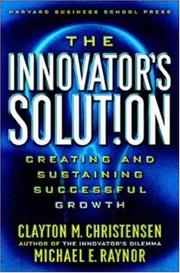
The Innovator's Solution
Summary
Christensen and Raynor wrote this as the prescriptive follow-up to The Innovator's Dilemma, addressing how a company should create disruptive growth businesses rather than only how incumbents fail. They distinguish two forms of disruption. Low-end disruption enters at the bottom of an existing market with a cheaper offering that serves overserved customers adequately. New-market disruption competes against non-consumption, serving people who previously lacked the skill, wealth or access to use the product at all, which they argue is the safer route because incumbents have no incentive to respond.
The jobs to be done framework appears here in its most complete form. Customers hire products to accomplish a job that arises in their circumstances, and market segmentation by customer demographics or product category misdescribes the actual competition, since the alternatives a customer considers are whatever else could do the job.
They also develop the theory of interdependence and modularity, arguing that integrated architectures win when products are not yet good enough on the primary performance dimension, and that modular architectures win once performance overshoots, at which point profit migrates to whichever component is still not good enough. This is their law of conservation of attractive profits.
Other material covers which customers to avoid, the role of the core business in strangling new ventures, the distinction between good money and bad money in funding new growth, and the role of senior management. The theory retains the falsifiability problems of the original and the prescriptions are harder to apply than to state. The jobs to be done framework and the modularity argument have both had substantial influence independent of disruption theory.
Key takeaways 8
- New-market disruption competes against non-consumption and is safer than low-end disruption, because incumbents have no incentive to respond to it.
- Customers hire products to accomplish a job arising in their circumstances, so segmentation by demographics or product category misdescribes the competition.
- Integrated architectures win when a product is not yet good enough on the primary performance dimension, because the interfaces must be optimised jointly.
- Modular architectures win once performance overshoots what customers need, at which point the industry disintegrates into specialised layers.
- Profit migrates to whichever component in a value chain is still not good enough, which is the law of conservation of attractive profits.
- A new growth business should be funded with capital that is patient for growth and impatient for profit, which reverses the usual arrangement.
- The core business will strangle a new venture through resource allocation unless the venture is structurally separated with its own cost structure.
- Customers a company should avoid are those whose requirements would pull the new venture back toward the existing business.
Who should read it
Executives trying to build new growth businesses inside an established company, and product teams wanting the fullest statement of jobs to be done.
About Clayton Christensen
Kim B. Clark Professor of Business Administration, Harvard Business School 1992-2020; co-founder of Innosight, Rose Park Advisors and the Clayton Christensen Institute; died 23 January 2020
The Innovator's Dilemma turned disruption into a primary framework that the rest of the strategy and innovation literature argues with rather than around.
Harvard Business School, Innosight, Rose Park Advisors, Clayton Christensen Institute
Who recommended it 2
Similar books 6
Chosen by shared topics, the entries that hold them, and the people who recommended both.
Why well-run firms lose to cheaper, worse products that enter at the market's bottom.
“Awesome book. May move soon to my Top Ten List. If anything will keep CEOs awake at night, reading this book certainly will.” — Mohnish Pabrai
Source: Mohnish's Bookshelf — Books on Sales & Marketing, entry 66
Recommended by: Jim Collins, Mohnish Pabrai, Aaron Levie and 27 others
Disruption theory used to forecast how industries will change.
Recommended by: Ev Williams

Recommended by: Ev Williams, Keith Rabois

Why organisations kill breakthrough projects, and how structure can protect them.
Recommended by: Arianna Huffington, Bill Gates and 8 others

Why imitating others' innovations matters as much as innovating.
Recommended by: Mohnish Pabrai
Where it sits in the reference 7
Topics