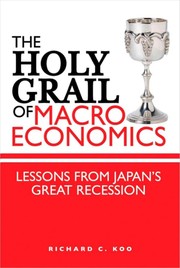
The Holy Grail of Macroeconomics
Balance-sheet recessions: firms repay debt instead of borrowing, so rate cuts fail.
Koo's balance-sheet recession thesis, drawn from Japan's lost decades.
Summary
Koo, chief economist at Nomura Research Institute, developed the concept of a balance sheet recession from Japan's experience after 1990 and argues it explains why conventional monetary policy failed there and would fail elsewhere in similar conditions.
His mechanism is specific. When an asset price bubble collapses, the assets purchased with debt lose value while the debt remains, leaving firms and households technically insolvent on a mark-to-market basis but still generating cash flow. Their rational response is to direct all available cash to debt repayment rather than to investment, and to continue doing so until balance sheets are repaired. Because this happens simultaneously across the entire private sector, aggregate demand collapses. Monetary policy cannot help, because the problem is not the price of credit but that nobody wants to borrow at any price. Koo documents that Japanese corporate borrowing was negative for years despite zero interest rates.
His policy conclusion is that only sustained government deficit spending can offset the private sector's simultaneous deleveraging, and that Japan's repeated attempts to reduce the deficit prematurely, particularly in 1997, caused the relapses that made the period appear to be a failure of stimulus rather than a failure to sustain it.
The framework was substantially applied by others after 2008. Critics argue Koo underweights structural problems in Japan, understates the costs of accumulated public debt, and treats his own diagnosis as more complete than it is.
Key takeaways 7
- After an asset bubble collapses, firms with intact cash flow but impaired balance sheets rationally direct all cash to debt repayment rather than investment.
- When the entire private sector deleverages simultaneously, aggregate demand collapses regardless of the price of credit.
- Monetary policy cannot help in a balance sheet recession, because the problem is that nobody wants to borrow at any interest rate.
- Japanese corporate borrowing was negative for years despite zero interest rates, which is the evidence the mechanism rests on.
- Only sustained government deficit spending can offset simultaneous private sector deleveraging, since it is the only remaining borrower.
- Japan's premature attempts to reduce the deficit, particularly in 1997, caused relapses that made the period look like a failure of stimulus rather than of sustaining it.
- A balance sheet recession requires a different policy response from an ordinary recession, and applying the ordinary response prolongs it.
Who should read it
Macro investors who need the balance sheet recession framework and the Japanese evidence behind it.
Who recommended it 1 · 1 direct
Similar books 6
Chosen by shared topics, the entries that hold them, and the people who recommended both.

How a Fed credit boom led to the Depression, and how policy prolonged it.
“It's a timeless and timely classic.” — Christopher Bloomstran
Source: Semper Augustus 2020 Letter to Clients, 'To Read or Not to Read', p. 57
Recommended by: Christopher Bloomstran, Mohnish Pabrai
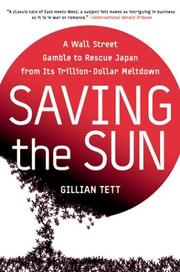
Japan's banking collapse told through Long-Term Credit Bank's failure and sale.
“Their remarkable experience, as unwelcome foreigners in Tokyo doing an LBO and then restructuring a prominent Japanese commercial bank is well chronicled in a wonderful book called Saving the Sun by Gillian Tett.” — Mohnish Pabrai
Source: Pabrai Investment Funds Annual Report 2011, page 13
Recommended by: Mohnish Pabrai
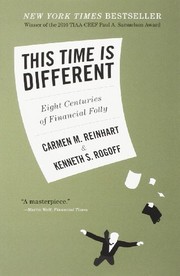
Eight centuries of defaults and banking crises show the same patterns recurring.
“Every one of these books changed my worldview, and I highly recommend them if you're looking for inspiring reading.” — Bill Gates
Source: My top reads of 2012 — Gates Notes
Recommended by: Bill Gates, Mohnish Pabrai and 2 others
The financial crisis as the first of globalisation, and how leaders should respond.
Recommended by: Bill Gates
A template for how big debt crises unfold, with detailed case studies.
The history of business cycle theory and how credit cycles drive asset prices.
Where it sits in the reference 2
Topics 2
As an Amazon Associate I earn from qualifying purchases.