The Missing Risk Premium: Why Low Volatility Investing Works
Why volatile assets earn no premium and low-volatility investing works.
Who recommended it 1 · 1 direct
Similar books 6
Chosen by shared topics, the entries that hold them, and the people who recommended both.
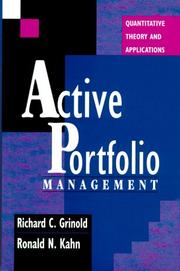
The quantitative method for building active portfolios against a benchmark.
“Richard C. Grinold and Ronald N. Kahn, Active Portfolio Management: A Quantitative Approach for Producing Superior Returns and Controlling Risk, Second Edition (New York: McGraw-Hill, 2000), 480” — Michael Mauboussin
Source: The Coffee Can Approach: Why Doing Less Can Leave You with More, page 9
Recommended by: Michael Mauboussin
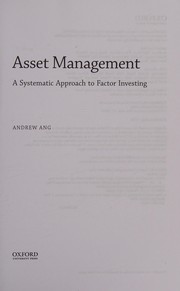
Factor investing for asset owners: factors as the nutrients inside assets.
“In his 2014 text Asset Management, for example, Columbia Professor Andrew Ang opens his chapter on mutual funds with this pungent summary.” — John C. Bogle
Source: The Road Less Traveled, page 13
Recommended by: John C. Bogle, Michael Mauboussin and 1 other
Markets pay skilled active managers; a survey of the strategies they run.
“Now another outstanding Nordic researcher (and AQR partner), Lasse Heje Pedersen, presents me with the same dilemma: His new book, Efficiently Inefficient (Princeton University Press), is fantastic — almost too good at laying out how successful professional asset managers think and act.” — Clifford Asness
Source: Efficient Inefficiency: The Oxymoron That Explains the Investing World
Recommended by: Clifford Asness, Michael Mauboussin
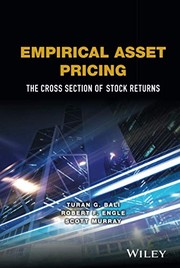
Portfolio sorts and cross-sectional regressions: how to test what predicts returns.
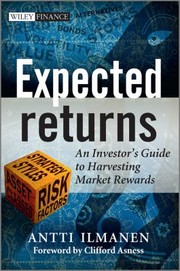
The evidence on what drives returns across asset classes: risk factors and behaviour.
“Ilmanen, Antti, Expected Returns: An Investor’s Guide to Harvesting Market Rewards (Hoboken, NJ: John Wiley & Sons, 2011)” — Michael Mauboussin
Source: Who Is On the Other Side? You Need Good BAIT to Land a Winner, page 40
Recommended by: Michael Mauboussin
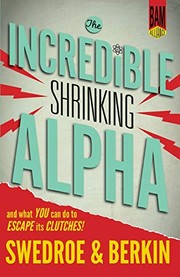
Why the alpha left for active managers keeps shrinking, and where it went.