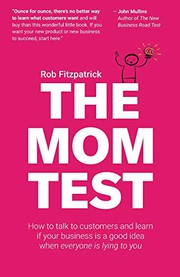
The Mom Test
How founders can ask customers questions that get true answers, not polite praise.
Short, sharp, and corrective. Fitzpatrick diagnoses why customer interviews so often produce false positives: people are polite and will validate almost any idea you present with sufficient enthusiasm. The fix is asking about past behavior, not hypothetical futures. A genuinely useful retraining of interview instincts.
Summary
Fitzpatrick wrote a short practical manual on customer conversations for founders. The title names his test: a good question is one you could ask your mother and still get a truthful answer, because it does not depend on her opinion of you or of your idea.
The method rests on three rules. Talk about the customer's life rather than your idea. Ask about specifics in the past instead of generics or opinions about the future. Talk less and listen more. Fitzpatrick argues that compliments, generic claims of enthusiasm and hypothetical future commitments are worthless data, and he calls them fluff. He distinguishes these from useful signals, which are concrete facts about what someone has already done, how they currently solve the problem, what it costs them, and what they have already spent money on.
His test of genuine interest is commitment and advancement, meaning that the prospect gives up something they value: time in a scheduled follow-up, reputation through an introduction to a colleague or superior, or money through a deposit or a letter of intent. A conversation that ends with encouragement but no commitment counts as a failure. He also covers how to run these conversations informally rather than as scheduled interviews, how to keep notes, and how to avoid asking a whole room the same question.
The book has no research base and does not claim one. It is craft advice from a founder who ran the process badly and then improved it. Its limits show in enterprise sales with long committee-driven cycles, where the individual conversation carries less signal.
Key takeaways 7
- Compliments and expressions of enthusiasm about your idea contain no information and should be discarded.
- Ask what someone has already done about a problem rather than what they would do about your solution.
- Anyone who says they would definitely buy is giving you a hypothetical, which is not evidence.
- A conversation is only useful if it ends with a commitment of time, reputation or money.
- Mentioning your idea at all corrupts the conversation, so avoid pitching until you have the facts.
- If a customer has not already built a workaround or paid for a partial fix, the problem is not painful enough.
- Customer conversations should happen informally and constantly rather than as a discrete research phase.
Who should read it
Founders doing customer discovery who keep coming away from meetings encouraged and no better informed.
Similar books 6
Chosen by shared topics, the entries that hold them, and the people who recommended both.
How product teams build a weekly habit of customer interviews and assumption tests.
How leaders turn feature teams into empowered product teams.
How to discover products that are valuable, usable and feasible before building.
Recommended by: Anna Cheng, Marty Cagan
A four-step model for habit-forming products: trigger, action, reward, investment.
Recommended by: David Cancel, Nat Eliason, Nir Eyal and 6 others
A five-day process for answering a business question by prototyping and testing.
Recommended by: Andy Budd, Jessica Hische, Marty Cagan and 1 other
Recommended by: Mohnish Pabrai