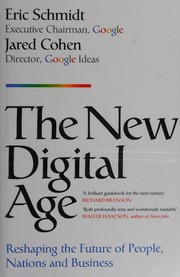
The New Digital Age
A forecast of a hugely connected future world, with its challenges and benefits.
Summary
Schmidt, who with Larry Page and Sergey Brin led Google, and Jared Cohen, director of Google Ideas and a former adviser to Secretaries of State Condoleezza Rice and Hillary Clinton, describe a future world far more connected than today's, with its benefits and its dangers. They write for governments, businesses and individuals alike, arguing that understanding technology is the way to understand the future.
The authors cover technologies that will change lives: information systems that raise productivity, safety and quality of life, motion controlled by thought that could change medical procedures, and near-perfect translation. They discuss how people will manage their online identities and fight those who misuse them. They foresee political change in the form of new kinds of conflict, more active and global citizens, a new wave of cyber-terrorism and states that operate in physical and virtual space at once, and they examine the constant threats to privacy and security.
Key takeaways 4
- Near-universal connectivity will bring both large benefits and new dangers.
- People will need to manage their online identities as carefully as their physical ones.
- States will act in virtual space as well as physical space, and conflict will change with them.
- Privacy and security face continuing threats in a connected world.
Who should read it
Readers who want Google leaders' view of how connectivity will change politics, business and daily life.
About Eric Schmidt
Former chief executive and executive chairman of Google and Alphabet; earlier chief executive of Novell and CTO of Sun Microsystems.
How Google Works describes the management model Google ran at scale - hiring for learning rate, small engineering teams holding decision rights, and strategy derived from a technical insight rather than from market research. Trillion Dollar Coach records the specific coaching method Bill Campbell used with executives at Google, Apple and Intuit, including how he ran meetings and handled founder-CEO conflict.
Who recommended it 2 · 1 direct
Similar books 6
Chosen by shared topics, the entries that hold them, and the people who recommended both.
Bandwidth, multimedia, virtual reality and the internet, explained without hype.
“Technology is transforming society as the computer moves from a business tool to a home appliance, and as the effects and implications of Being Digital, as Nicholas Negroponte’s new book has it, come to be instantiated.” — Bill Miller
Source: 1995 Q2 Market Commentary
Recommended by: Bill Miller, Mohnish Pabrai

What the data people leave online reveal about human nature.
Recommended by: Mohnish Pabrai
Why people long for human contact in a world full of technology, and its dangers.
Recommended by: Mohnish Pabrai
How the problem-solving and teamwork of games could solve real-world problems.
“While this book was not out at the time of this writing, this is likely another useful resource: Jane McGonigal, Reality is Broken: Why Games Make Us Better and How They Can Change the World (New York: Penguin Press, 2011).” — Michael Mauboussin
Source: Blaming the Rat: Incentives, Motivation, and How They Interact, page 14
Recommended by: Michael Mauboussin, Mohnish Pabrai
How right-wing extremists used social media to move into American politics.
Recommended by: Kara Swisher
Twenty essays on the observation that software is eating the world.
Recommended by: David Perell, Patrick O'Shaughnessy