The Philippine Economy: Development, Policies, and Challenges
The standard economics volume: trade, banking, land and industrial policy.
Summary
Arsenio Balisacan and Hal Hill edited this volume on the Philippine economy, with contributions from Filipino and international economists covering the country's development record and policy areas.
The organising question is why the Philippines fell behind its Southeast Asian neighbours. Having been among the wealthier economies in the region in the 1950s, it grew more slowly than Thailand, Malaysia and Indonesia over the following decades. The contributors examine the explanations: macroeconomic instability and repeated balance of payments crises; the political economy of the Marcos period, in which state resources and monopoly rights were distributed to associates; the persistence of concentrated economic and political power in a small number of families after 1986; the failure of agricultural reform; trade and industrial policy that protected inefficient producers; and the weakness of infrastructure and of state capacity generally.
The volume also covers the sectors and the questions of poverty, inequality and the enormous overseas worker population whose remittances have become central to the economy. It is academic and empirical. Published in 2003, it predates the business process outsourcing sector's growth, the improved macroeconomic performance of the following decade and the Duterte period. Its diagnosis of the institutional and political constraints has largely held.
Key takeaways 7
- The Philippines was among the wealthier Southeast Asian economies in the 1950s and grew more slowly than its neighbours thereafter.
- State resources and monopoly rights during the Marcos period were distributed to associates, which shaped the economy that followed.
- Concentrated economic and political power in a small number of families persisted after the political transition in 1986.
- Repeated balance of payments crises produced macroeconomic instability that deterred the investment other countries in the region attracted.
- Trade and industrial policy protected inefficient domestic producers rather than disciplining them through export requirements.
- Overseas worker remittances became central to the economy, which supports consumption while doing little for domestic productive capacity.
- The contributors locate the constraint in institutions and political structure rather than in resources or geography.
Who should read it
Investors and analysts working on the Philippines who want a comparative diagnosis of why it diverged from its neighbours.
Similar books 6
Chosen by shared topics, the entries that hold them, and the people who recommended both.
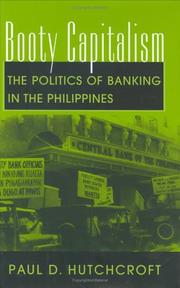
Why oligarch families captured the banks rather than the state capturing business.
Why similar corruption in South Korea and the Philippines led to different results.
John Cowperthwaite, Hong Kong's Financial Secretary in the 1960s, and his policies.
Insider memoir by the architect of much of the reform programme.
The one readable overview of how the state, NGOs and business interlock.
The founding pessimist study; useful baseline for what was later beaten.
Where it sits in the reference 2
Topics