The Prince
How rulers acquire and hold power, judged by effect rather than by morality.
Machiavelli's handbook on political strategy remains disturbing because it separates effectiveness from morality — a distinction every strategic thinker eventually has to confront. His analysis of how new rulers consolidate power is still the sharpest treatment of legitimacy under conditions of uncertainty.
Summary
Machiavelli wrote The Prince in 1513 after losing his position in the Florentine republic, as a treatise on acquiring and holding political power addressed to Lorenzo de Medici. Its method separates it from the political writing that preceded it: he describes how rulers actually behave rather than how they should behave, and states explicitly that a ruler who acts as morality prescribes among people who do not will be destroyed.
His practical positions include that it is safer to be feared than loved if you cannot be both, since love depends on the other party and fear depends on you; that a ruler must nonetheless avoid being hated, which comes from taking property and women rather than from severity; that cruelties should be committed all at once and benefits distributed gradually; that a new ruler must either conciliate or destroy those he displaces, since a wounded opponent takes revenge; that mercenaries and auxiliaries are useless because their interests are not aligned; and that a ruler must have his own arms.
He also discusses fortune and virtue, arguing that fortune governs roughly half of human affairs and that the remainder is available to a ruler who prepares in advance rather than responding to events.
The book's status is disputed. Some read it as a straightforward manual, some as satire, and some, following Rousseau, as a warning to republics disguised as advice to princes. Machiavelli's Discourses on Livy argues for republican government, which complicates any simple reading. Its business use is generally superficial. The genuinely useful element is the method of describing behaviour as it is rather than as it ought to be.
Key takeaways 8
- A ruler who acts as morality prescribes among people who do not will be destroyed, which is the premise the entire argument rests on.
- Being feared is safer than being loved, because love depends on the other party's disposition and fear depends on your own conduct.
- A ruler must avoid being hated, which comes from taking property and from interfering with families rather than from severity itself.
- Cruelties should be committed all at once and benefits distributed gradually, since injuries are resented in proportion to their duration.
- A wounded opponent takes revenge, so a ruler must either conciliate people or remove them entirely rather than half-measures.
- Mercenaries and borrowed forces are useless because their interests are not aligned with the ruler who employs them.
- Fortune governs roughly half of human affairs, and the remainder belongs to whoever has prepared in advance rather than responding to events.
- The book describes how people behave rather than how they should, which was its methodological break with earlier political writing.
Who should read it
Readers who want the original text on power as practised rather than as justified, aware that its interpretation has been disputed for five centuries.
Who recommended it 8 · 3 direct
Similar books 6
Chosen by shared topics, the entries that hold them, and the people who recommended both.
War as a continuation of politics, shaped by friction and the fog of uncertainty.
Recommended by: Ryan Holiday, Elon Musk, Marc Andreessen and 1 other

The life of John Boyd, the pilot behind the OODA loop and the F-15 and F-16.
Recommended by: Morgan Housel, Patrick O'Shaughnessy and 2 others
Campaigns showing that striking an enemy's balance beats meeting its strength.
Recommended by: Ryan Holiday
How the US special operations command was rebuilt to make decisions faster.
“You need to understand what you're up against. But Team of Teams has been huge. I'm still giving that one out.” — Doug McMillon
Source: The Tim Ferriss Show Transcripts: Doug McMillon (#345)
Recommended by: Doug McMillon, Patrick Collison and 2 others
An ancient Chinese treatise on war: position, deception and choosing when to fight.
Recommended by: Mohnish Pabrai, Evan Spiegel, Fred Wilson and 4 others
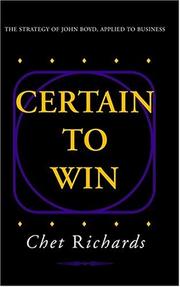
John Boyd's military strategy, including the OODA loop, applied to business.
Recommended by: Ryan Peterson