Updates

  1. Person pages list letters, writing, profiles and links as sortable tables with filters, and show each person's companies as links; Fund letters show each letter's description in its own column.
  2. Experts show a checked job title and a short description of each person; 30 more people have photographs.
  3. Every company, fund, university and publication the experts work for has a page listing the people there.
  4. Fund letters show each letter's thesis and filter by it; 225 person pages list the essays, columns and newsletter issues the person wrote.
  5. Person pages list every essay and newsletter issue a person wrote, and their own books as a table in List view.
  6. Recommends shows the five largest kinds of book and the rest under More; browse pictures load sooner.
  7. Podcasts and talks link the original episode, filter by Audio and video or Press, and list each publisher once.
  8. Pages are wider, Recommends has List and Grid, and a filter clicked again turns off.
  9. Book cards sit in a ruled grid with Open Library and Goodreads links and each book's one-line note.
  10. Funds is now Investors; each investor's styles are buttons that filter the table.
  11. Podcasts and talks on a person's page filter by year and publisher and show as a list or a grid of pictures.
  12. Quotes show only people's own words: 472 summaries written by list sites are gone.
  13. Country pages open from Browse again, and every link on the shelf lands on a page.
  14. Subject and person pages show their sections as tabs, and each book appears once on a person's page.
  15. Book cards show the quote, who said it and the source; grids show five cards to a row.
  16. On a phone, a menu holds the sections, search, Updates, Feedback and dark mode.
  17. Feedback takes a screenshot of the page with no browser prompt, opens a screenshot full size when you click it, and clears itself once sent.
  18. Book cards are centred, search names the topic each book sits in, and any text cut short shows whole on hover.
  19. Search groups its results by kind: people, companies, geographies, subjects, topics, books, funds, fund letters and papers.
  20. The Books table lists who recommended each book by name, and the browser tab names the section you are in.
  21. Feedback can take a screenshot of the page, or one you paste or choose, and opens in the corner beside Updates.
  22. Each rail button reopens its section where you left it, and Browse, Table and People show on every book and subject page.
  23. Filters grey out choices that hold nothing instead of hiding them, and Books › People filters by authors or recommenders.
  24. Feedback takes a subject line and up to three screenshots.
  25. Biographies are grouped by the person they are about: 41 new pages, from Abraham Lincoln to Lee Kuan Yew.
  26. Sport splits into 23 sports, and Religion into one topic per faith.
  27. Book lists show as cards: the cover, one recommendation quote and every recommender by name.
  28. Seventeen subjects that had two or three pages under different names now have one page each.
  29. Every page lists its Experts as authors and recommenders, with a link to them on the Experts tab.
  30. Economics, Financial history, Financial panics and Accounting are subjects of their own, with one page per financial crisis.
  31. Book, person and subject pages open inside the app, so the tabs stay in view.
  32. 996 more book covers, and photographs or logos for 227 more people and companies.
  33. Books › Browse shows every subject as cards, and the rail holds Fund letters, Papers, Experts, Books and Funds.
  34. Every topic over 150 books splits into narrower topics, each with a page of its own.

Send feedback

What is it?
Screenshots, up to 3 (optional)
or paste one with Ctrl+V

We use your email only to reply to you.

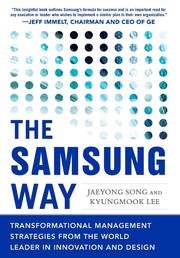
The Samsung Way

The Samsung Way

Jaeyong Song, Kyungmook Lee
2014
T3 346 pages · about 5h 46m to read Open Librarygoodreads

Insider-access management study of Lee Kun-hee's reforms

Summary

Jaeyong Song and Kyungmook Lee, both professors at Seoul National University, had extensive access to Samsung and wrote this academic analysis of the management system behind the company's transformation after 1993.

Their organising concept is what they call paradox management: Samsung's system combines elements that management theory treats as incompatible. It achieves the scale economies of a large diversified conglomerate together with the speed of a smaller firm. It combines Japanese-style long-term orientation and manufacturing discipline with American-style performance-based compensation and external hiring. It maintains centralised control through the owner family and the corporate strategy office while granting operating autonomy to business units. It pursues both cost leadership and differentiation in the same products.

The authors document the mechanisms: the recruitment and development of core personnel, the regional specialist programme sending employees abroad for a year without duties other than learning a country, the compensation system with large performance bonuses, the design investment made from the 1990s, the speed of decision-making enabled by owner authority, and the vertical integration across components and finished goods. They also cover Lee Kun-hee's 1993 Frankfurt declaration and the cultural change it initiated. The book is admiring and was written with company cooperation, which readers should weigh. Its account of the specific management mechanisms is more detailed than any journalistic treatment.

Key takeaways 7

  1. Samsung's system combines large-firm scale economies with the decision speed usually available only to smaller companies.
  2. Owner authority permits investment decisions of a size and speed that a professionally managed public company could not make.
  3. The regional specialist programme sent employees abroad for a year with no duties other than learning a country and its market.
  4. Compensation combines Japanese-style long-term employment with American-style performance bonuses that vary enormously by unit result.
  5. Vertical integration across components and finished products supplies cost information and supply security competitors lack.
  6. Design investment beginning in the 1990s converted Samsung from a component supplier into a consumer brand.
  7. The book was written with company cooperation and is admiring, which readers should weigh against its conclusions.

Who should read it

Executives and investors who want the detailed management mechanisms behind Samsung's transformation, from academics with company access.

Similar books 6

Chosen by shared topics, the entries that hold them, and the people who recommended both.

Bryce G. Hoffman · 2012

The 2006-2010 turnaround told with close management access.

Recommended by: Mohnish Pabrai
Dieter Brandes · 2004

Aldi's hard-discount method: radical simplicity as the way to keep costs low.

Where it sits in the reference 3

Companies
Business themes
Business themes

Topics

Company HistoriesBusiness and Management