Updates

  1. Person pages list letters, writing, profiles and links as sortable tables with filters, and show each person's companies as links; Fund letters show each letter's description in its own column.
  2. Experts show a checked job title and a short description of each person; 30 more people have photographs.
  3. Every company, fund, university and publication the experts work for has a page listing the people there.
  4. Fund letters show each letter's thesis and filter by it; 225 person pages list the essays, columns and newsletter issues the person wrote.
  5. Person pages list every essay and newsletter issue a person wrote, and their own books as a table in List view.
  6. Recommends shows the five largest kinds of book and the rest under More; browse pictures load sooner.
  7. Podcasts and talks link the original episode, filter by Audio and video or Press, and list each publisher once.
  8. Pages are wider, Recommends has List and Grid, and a filter clicked again turns off.
  9. Book cards sit in a ruled grid with Open Library and Goodreads links and each book's one-line note.
  10. Funds is now Investors; each investor's styles are buttons that filter the table.
  11. Podcasts and talks on a person's page filter by year and publisher and show as a list or a grid of pictures.
  12. Quotes show only people's own words: 472 summaries written by list sites are gone.
  13. Country pages open from Browse again, and every link on the shelf lands on a page.
  14. Subject and person pages show their sections as tabs, and each book appears once on a person's page.
  15. Book cards show the quote, who said it and the source; grids show five cards to a row.
  16. On a phone, a menu holds the sections, search, Updates, Feedback and dark mode.
  17. Feedback takes a screenshot of the page with no browser prompt, opens a screenshot full size when you click it, and clears itself once sent.
  18. Book cards are centred, search names the topic each book sits in, and any text cut short shows whole on hover.
  19. Search groups its results by kind: people, companies, geographies, subjects, topics, books, funds, fund letters and papers.
  20. The Books table lists who recommended each book by name, and the browser tab names the section you are in.
  21. Feedback can take a screenshot of the page, or one you paste or choose, and opens in the corner beside Updates.
  22. Each rail button reopens its section where you left it, and Browse, Table and People show on every book and subject page.
  23. Filters grey out choices that hold nothing instead of hiding them, and Books › People filters by authors or recommenders.
  24. Feedback takes a subject line and up to three screenshots.
  25. Biographies are grouped by the person they are about: 41 new pages, from Abraham Lincoln to Lee Kuan Yew.
  26. Sport splits into 23 sports, and Religion into one topic per faith.
  27. Book lists show as cards: the cover, one recommendation quote and every recommender by name.
  28. Seventeen subjects that had two or three pages under different names now have one page each.
  29. Every page lists its Experts as authors and recommenders, with a link to them on the Experts tab.
  30. Economics, Financial history, Financial panics and Accounting are subjects of their own, with one page per financial crisis.
  31. Book, person and subject pages open inside the app, so the tabs stay in view.
  32. 996 more book covers, and photographs or logos for 227 more people and companies.
  33. Books › Browse shows every subject as cards, and the rail holds Fund letters, Papers, Experts, Books and Funds.
  34. Every topic over 150 books splits into narrower topics, each with a page of its own.

Send feedback

What is it?
Screenshots, up to 3 (optional)
or paste one with Ctrl+V

We use your email only to reply to you.

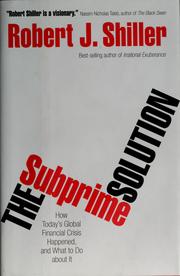
The Subprime Solution

The Subprime Solution

Robert J. Shiller
2008
T4 196 pages · about 3h 16m to read Open Librarygoodreads

Summary

Robert Shiller wrote this in early 2008, as the mortgage crisis was developing, and it is both a diagnosis and a proposal. His diagnosis is that the housing bubble was a social phenomenon driven by a shared story about house prices, not a failure of any particular institution.

His argument is that a widely held belief that house prices always rise became self-confirming for a period, that this belief spread through media and through observation of neighbours rather than through any analysis, and that the financial instruments built on top of it were consequences rather than causes. He supports this with his own survey data on homebuyer expectations and with the long-run house price series he constructed with Karl Case, which shows real prices roughly flat over a century before the 2000s.

His proposals divide into short-term and long-term. In the short term he favours mortgage modification with a mechanism that avoids case-by-case renegotiation. In the long term he wants what he calls the democratisation of finance: continuous workout mortgages whose payments adjust automatically to the borrower's income and to local house prices, so that renegotiation is built into the contract; home equity insurance; markets in house price indices allowing homeowners to hedge; better financial advice available to ordinary people; improved financial information infrastructure; and new units of account indexed to inflation. Shiller's proposals have largely not been adopted, and the practical obstacles, including basis risk and adverse selection, are addressed only briefly. The diagnosis is more persuasive than the prescription.

Key takeaways 7

  1. The housing bubble was driven by a shared belief that house prices always rise, which became self-confirming for a period.
  2. Real American house prices were roughly flat over the century before the 2000s, which contradicted the belief the bubble rested on.
  3. Financial instruments built on the bubble were consequences of the belief rather than causes of it.
  4. Continuous workout mortgages would adjust payments automatically to income and local prices, removing the need for case-by-case renegotiation.
  5. Homeowners cannot hedge house price exposure, which is the largest unhedged position most households hold.
  6. Shiller argues that financial innovation should be expanded to serve households rather than restricted after each crisis.
  7. The practical obstacles to his proposals, including basis risk and adverse selection, are addressed only briefly.

Who should read it

Investors and policy readers who want the behavioural diagnosis of the housing bubble and a specific programme for what household finance could look like instead.

About Robert J. Shiller

Sterling Professor of Economics Emeritus, Yale University; co-creator of the Case-Shiller home price indices; Nobel laureate in economics 2013

Excess-volatility work and Irrational Exuberance are the primary sources for the empirical case that asset prices move far more than fundamentals justify.

Yale University

Similar books 6

Chosen by shared topics, the entries that hold them, and the people who recommended both.
Bethany McLean, Joe Nocera · 2010

The 2008 crisis traced back 25 years to mortgage bonds, Fannie Mae and subprime.
Paul Muolo, Mathew Padilla · 2008

Closest coverage: Countrywide is a central thread in the trade-press account of the industry.

Gillian Tett · 2009

How a JPMorgan team invented credit default swaps that other banks then misused.

Michael Lewis · 2008

Journalism written during four crises, from the 1987 crash to LTCM's collapse.

Recommended by: Mohnish Pabrai, Seth Klarman

Gary Gorton · 2010

Papers explaining the 2007 crisis as a run on the repo and securitisation system.

Where it sits in the reference 2

Academics
Financial panics

Topics

Finance and MarketsFinancial History