Updates

  1. Person pages list letters, writing, profiles and links as sortable tables with filters, and show each person's companies as links; Fund letters show each letter's description in its own column.
  2. Experts show a checked job title and a short description of each person; 30 more people have photographs.
  3. Every company, fund, university and publication the experts work for has a page listing the people there.
  4. Fund letters show each letter's thesis and filter by it; 225 person pages list the essays, columns and newsletter issues the person wrote.
  5. Person pages list every essay and newsletter issue a person wrote, and their own books as a table in List view.
  6. Recommends shows the five largest kinds of book and the rest under More; browse pictures load sooner.
  7. Podcasts and talks link the original episode, filter by Audio and video or Press, and list each publisher once.
  8. Pages are wider, Recommends has List and Grid, and a filter clicked again turns off.
  9. Book cards sit in a ruled grid with Open Library and Goodreads links and each book's one-line note.
  10. Funds is now Investors; each investor's styles are buttons that filter the table.
  11. Podcasts and talks on a person's page filter by year and publisher and show as a list or a grid of pictures.
  12. Quotes show only people's own words: 472 summaries written by list sites are gone.
  13. Country pages open from Browse again, and every link on the shelf lands on a page.
  14. Subject and person pages show their sections as tabs, and each book appears once on a person's page.
  15. Book cards show the quote, who said it and the source; grids show five cards to a row.
  16. On a phone, a menu holds the sections, search, Updates, Feedback and dark mode.
  17. Feedback takes a screenshot of the page with no browser prompt, opens a screenshot full size when you click it, and clears itself once sent.
  18. Book cards are centred, search names the topic each book sits in, and any text cut short shows whole on hover.
  19. Search groups its results by kind: people, companies, geographies, subjects, topics, books, funds, fund letters and papers.
  20. The Books table lists who recommended each book by name, and the browser tab names the section you are in.
  21. Feedback can take a screenshot of the page, or one you paste or choose, and opens in the corner beside Updates.
  22. Each rail button reopens its section where you left it, and Browse, Table and People show on every book and subject page.
  23. Filters grey out choices that hold nothing instead of hiding them, and Books › People filters by authors or recommenders.
  24. Feedback takes a subject line and up to three screenshots.
  25. Biographies are grouped by the person they are about: 41 new pages, from Abraham Lincoln to Lee Kuan Yew.
  26. Sport splits into 23 sports, and Religion into one topic per faith.
  27. Book lists show as cards: the cover, one recommendation quote and every recommender by name.
  28. Seventeen subjects that had two or three pages under different names now have one page each.
  29. Every page lists its Experts as authors and recommenders, with a link to them on the Experts tab.
  30. Economics, Financial history, Financial panics and Accounting are subjects of their own, with one page per financial crisis.
  31. Book, person and subject pages open inside the app, so the tabs stay in view.
  32. 996 more book covers, and photographs or logos for 227 more people and companies.
  33. Books › Browse shows every subject as cards, and the rail holds Fund letters, Papers, Experts, Books and Funds.
  34. Every topic over 150 books splits into narrower topics, each with a page of its own.

Send feedback

What is it?
Screenshots, up to 3 (optional)
or paste one with Ctrl+V

We use your email only to reply to you.

The Theory of Investment Value

The Theory of Investment Value

John Burr Williams
1938
T4 613 pages · about 10h 13m to read Open Librarygoodreads

Summary

Williams wrote this as his Harvard doctoral thesis and it is the origin of the dividend discount model and, more broadly, of the proposition that the value of any asset is the present value of the cash it will distribute to its owner. He states the principle plainly: a stock is worth the present value of all the dividends it will ever pay.

The book works out the implications with unusual care for 1938. Williams handles growth, showing what happens to the valuation when the growth rate approaches the discount rate and being explicit that a perpetually higher growth rate than the discount rate produces an infinite value and is therefore impossible. He addresses the question of retained earnings, arguing that earnings reinvested have value only through the future dividends they enable, which is the argument later restated as the difference between value-creating and value-destroying reinvestment. He also states an early version of what became the Modigliani-Miller proposition, that the total value of a firm is not changed by how its capital structure divides claims on the same cash flows, and he illustrates it with what he called the bloated bondholder argument.

The book includes extensive worked valuations of specific companies of the period, including General Motors and United States Steel, and algebraic derivations that make it heavy going. It is a foundational text rather than a practical manual, and almost every subsequent valuation method is a refinement of what it states. Its treatment of how to estimate the inputs is thin, which is the permanent problem with the method.

Key takeaways 7

  1. The value of a security is the present value of the cash it will distribute to its owner over its life, and every other valuation method is an approximation of this.
  2. Retained earnings have value only through the future distributions they make possible, so reinvestment that does not raise future distributions destroys value.
  3. A growth rate that permanently exceeds the discount rate produces an infinite value, which proves no such growth rate can be assumed.
  4. The total value of a firm does not depend on how its capital structure divides claims on the same cash flows.
  5. Book value and reported earnings are inputs to estimating future distributions rather than measures of value themselves.
  6. A common stock and a bond are valued by the same principle, differing only in the certainty and the pattern of the payments.
  7. The difficulty in valuation lies entirely in estimating the future cash flows and the appropriate discount rate, since the framework itself is straightforward.

Who should read it

Investors who want the original statement of discounted cash flow valuation and the arguments about growth, reinvestment and capital structure that follow from it.

Who recommended it 2 · 1 direct

Similar books 6

Chosen by shared topics, the entries that hold them, and the people who recommended both.
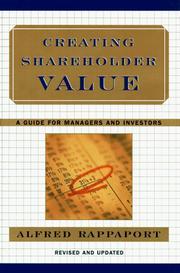
Alfred Rappaport · 1986

Value is discounted future cash flow, not earnings per share or return on equity.

“I read that book and the light bulbs all went off for me personally.” — Michael Mauboussin

Source: The Tim Ferriss Show #659 — official transcript

Recommended by: Michael Mauboussin, Mohnish Pabrai
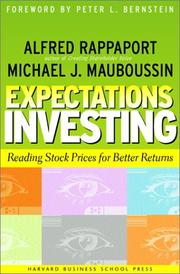
Michael Mauboussin, Alfred Rappaport · 2001

Start from the share price and ask what results it expects a company to deliver.

Recommended by: Mohnish Pabrai
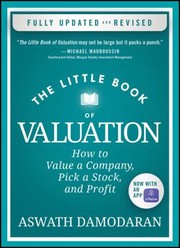
Tim Koller, Marc Goedhart, David Wessels · 1990

McKinsey's guide to discounted cash flow valuation and managing for value.

Recommended by: Mohnish Pabrai and 1 other
Where it sits in the reference 1

Mental models

Topics

InvestingFinance and Markets