Updates

  1. Person pages list letters, writing, profiles and links as sortable tables with filters, and show each person's companies as links; Fund letters show each letter's description in its own column.
  2. Experts show a checked job title and a short description of each person; 30 more people have photographs.
  3. Every company, fund, university and publication the experts work for has a page listing the people there.
  4. Fund letters show each letter's thesis and filter by it; 225 person pages list the essays, columns and newsletter issues the person wrote.
  5. Person pages list every essay and newsletter issue a person wrote, and their own books as a table in List view.
  6. Recommends shows the five largest kinds of book and the rest under More; browse pictures load sooner.
  7. Podcasts and talks link the original episode, filter by Audio and video or Press, and list each publisher once.
  8. Pages are wider, Recommends has List and Grid, and a filter clicked again turns off.
  9. Book cards sit in a ruled grid with Open Library and Goodreads links and each book's one-line note.
  10. Funds is now Investors; each investor's styles are buttons that filter the table.
  11. Podcasts and talks on a person's page filter by year and publisher and show as a list or a grid of pictures.
  12. Quotes show only people's own words: 472 summaries written by list sites are gone.
  13. Country pages open from Browse again, and every link on the shelf lands on a page.
  14. Subject and person pages show their sections as tabs, and each book appears once on a person's page.
  15. Book cards show the quote, who said it and the source; grids show five cards to a row.
  16. On a phone, a menu holds the sections, search, Updates, Feedback and dark mode.
  17. Feedback takes a screenshot of the page with no browser prompt, opens a screenshot full size when you click it, and clears itself once sent.
  18. Book cards are centred, search names the topic each book sits in, and any text cut short shows whole on hover.
  19. Search groups its results by kind: people, companies, geographies, subjects, topics, books, funds, fund letters and papers.
  20. The Books table lists who recommended each book by name, and the browser tab names the section you are in.
  21. Feedback can take a screenshot of the page, or one you paste or choose, and opens in the corner beside Updates.
  22. Each rail button reopens its section where you left it, and Browse, Table and People show on every book and subject page.
  23. Filters grey out choices that hold nothing instead of hiding them, and Books › People filters by authors or recommenders.
  24. Feedback takes a subject line and up to three screenshots.
  25. Biographies are grouped by the person they are about: 41 new pages, from Abraham Lincoln to Lee Kuan Yew.
  26. Sport splits into 23 sports, and Religion into one topic per faith.
  27. Book lists show as cards: the cover, one recommendation quote and every recommender by name.
  28. Seventeen subjects that had two or three pages under different names now have one page each.
  29. Every page lists its Experts as authors and recommenders, with a link to them on the Experts tab.
  30. Economics, Financial history, Financial panics and Accounting are subjects of their own, with one page per financial crisis.
  31. Book, person and subject pages open inside the app, so the tabs stay in view.
  32. 996 more book covers, and photographs or logos for 227 more people and companies.
  33. Books › Browse shows every subject as cards, and the rail holds Fund letters, Papers, Experts, Books and Funds.
  34. Every topic over 150 books splits into narrower topics, each with a page of its own.

Send feedback

What is it?
Screenshots, up to 3 (optional)
or paste one with Ctrl+V

We use your email only to reply to you.

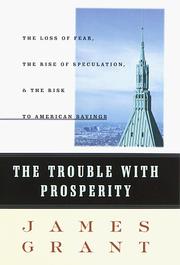
The Trouble with Prosperity: The Loss of Fea

The Trouble with Prosperity: The Loss of Fear, the Rise of Speculation, and the Risk to American Savings

James Grant
1996
T4 348 pages · about 5h 48m to read Open Librarygoodreads

title listed on grantspub.com books page

Summary

Grant, the founder of Grant's Interest Rate Observer, argues that prosperity produces the conditions for its own reversal. His mechanism is straightforward: sustained good times reduce the memory of loss, which reduces the risk premium investors demand, which lowers the cost of capital, which funds investment and speculation that would not survive normal conditions.

He develops the argument through financial history rather than through models. The extended cases include the American 1920s and the deflation that followed, the postwar decades, the Japanese bubble of the late 1980s and its collapse, the American real estate and savings and loan episode, and the state of markets in the mid-1990s. He pays particular attention to credit, arguing that the price of money and the willingness of lenders to lend govern asset cycles more directly than earnings do, and that the accumulation of debt during good times is what makes the reversal violent.

Grant also argues against the belief, which he saw forming in the mid-1990s, that central banks and improved policy had ended the cycle. He treats confidence in policy as itself a component of the bubble.

The forecast was early and, as a market call, wrong. Grant was bearish through a period when American equities rose substantially, and readers should treat his timing accordingly. The historical analysis has aged much better than the prediction, and the credit-cycle framework anticipates a great deal of what was written after 2008. The book is dense with financial detail and Grant's style is allusive, which makes it slower reading than its length suggests.

Key takeaways 7

  1. Prosperity destroys the memory of loss, and the falling risk premium that follows is what finances the next excess.
  2. Credit conditions drive asset cycles more directly than earnings or economic growth do.
  3. Debt accumulated during expansions is the mechanism that turns an ordinary downturn into a violent one.
  4. Confidence that policymakers have abolished the cycle is itself a reliable indicator of a late-stage cycle.
  5. Japan's bubble and collapse in the 1980s and 1990s followed the same credit dynamics as the American 1920s.
  6. Falling interest rates raise asset prices while simultaneously reducing the compensation investors receive for risk.
  7. Financial history is the only available laboratory for economics, because the experiments cannot be run any other way.

Who should read it

Investors who want a credit-cycle framework built from financial history, with the warning that Grant's market timing in this book was wrong for years.

About James Grant

Founder and editor, Grant's Interest Rate Observer (since 1983); financial historian and biographer

Grant's Interest Rate Observer is a primary source other investors read and quote, and Money of the Mind is a standard credit history.

Grant's Interest Rate Observer

Who recommended it 1 · 1 direct

Similar books 6

Chosen by shared topics, the entries that hold them, and the people who recommended both.

James Grant · 2014

The 1920-21 depression: severe, yet over in eighteen months without stimulus.

Robert J. Shiller · 2000

How psychology, not fundamentals, drove the stock and housing booms of 2000 and 2005.

James Grant · 2008

Collected Grant's essays; title listed on grantspub.com books page

Recommended by: Mohnish Pabrai

Where it sits in the reference 2

Investors
Financial panics

Topics

Financial HistoryEconomics