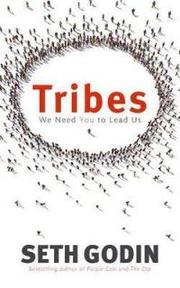
Tribes
The internet makes it cheap to gather people around a shared interest; lead them.
Summary
Godin argues that the internet made it cheap to connect people who share an interest, that groups so connected want leadership, and that most people decline to provide it. He defines a tribe as a group with a shared interest and a way of communicating, and says the two missing ingredients are usually a leader and a means for members to reach each other rather than only the centre.
His prescriptions are short and repeated. Leadership is distinct from management: management directs people to accomplish known tasks, leadership creates change people want to be part of. Anyone can lead, and the barrier is not permission but willingness. Leaders should be heretics, meaning they should challenge the status quo of their industry rather than seeking consensus. A leader should aim to move a small committed group rather than to reach a mass audience indifferent to the message. Faith in the destination is required, and criticism is evidence of having said something.
The book is a hundred and fifty short pages assembled from brief sections, with examples drawn from businesses and non-profits rather than from systematic evidence.
There is no research base and Godin does not claim one. The argument is exhortation. Its practical content is thin relative to its length, and the specific examples of internet-enabled movements are now dated. What has held up is the structural point that connecting members to each other, rather than only to the organisation, is what turns an audience into a group that sustains itself.
Key takeaways 7
- A tribe requires members to be connected to each other, not merely to a central organisation broadcasting at them.
- Leadership creates change that people choose to follow, while management directs people toward outcomes already decided.
- The barrier to leading is willingness rather than permission or position.
- A leader should aim to move a small committed group rather than to reach a large indifferent audience.
- Challenging the conventions of an industry generates the attention that consensus-seeking cannot.
- Organisations suppress tribe formation because connected members are harder to control than isolated ones.
- Criticism is evidence that a message was specific enough to disagree with, and its absence indicates the message said nothing.
Who should read it
Founders and marketers who need a short argument for building a committed community rather than an audience, and who do not need evidence to act on it.
About Seth Godin
American marketing writer, founder of Yoyodyne and Squidoo, who has published a daily marketing blog for two decades.
Permission Marketing argued for earning attention through opt-in years before that became the default of email and content marketing, and Purple Cow made remarkability the product's job rather than the advertising budget's. The Dip supplies a decision rule for when to quit a market and when the difficulty itself is the barrier worth pushing through.
Who recommended it 2 · 1 direct
“Inspiring look at what it takes to organize and mobilize groups of people.”
Similar books 6
Chosen by shared topics, the entries that hold them, and the people who recommended both.

Execution is a discipline the CEO must lead, linking people, strategy and operations.
“In-depth look at the dirty discipline of getting things done in a large organization.” — Derek Sivers
Source: Derek Sivers book notes (primary, rated list) · Rating: 3/10
Recommended by: Derek Sivers, Michael Mauboussin and 2 others

The small flaws in behaviour that keep capable executives from reaching the top.
“Aimed at already-successful people. The personality traits that brought you to success (personal discipline, saying yes to everything, over-confidence) are the same traits that hold you back from going further! (Where you need to listen to lead, and don't let over-confidence make you over-commit.) Stinging counter-intuitive insights that hit very close to home for me. Great specific suggestions for how to improve.” — Derek Sivers
Source: Derek Sivers book notes (primary, rated list) · Rating: 9/10
Recommended by: Derek Sivers, Alfred Lin

Five levels of leadership, from holding a position to developing other people.
Recommended by: Julie Stevanja

Gandhi's life and principles restated as a standard for executives.
Recommended by: Mohnish Pabrai

How leaders drive hypergrowth by raising standards, focus and urgency.
Recommended by: Jason Calacanis, Terrance McArthur
Profiles of business leaders from Investor's Business Daily's column.