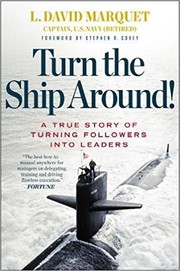
Turn the Ship Around!
How a submarine captain replaced leader-follower command with leader-leader.
Marquet's account of transforming the USS Santa Fe from the worst-performing submarine in the Navy to the best. The specific mechanism — moving from leader-follower to leader-leader by pushing control down while moving competence and clarity up — is one of the most rigorously documented leadership case studies in print.
Summary
Marquet commanded the USS Santa Fe, a nuclear submarine ranked last in its fleet, and describes how he changed its performance by removing the leader-follower structure and replacing it with what he calls leader-leader. The origin of the change was a failure. Marquet gave an order that could not be executed because he had trained on a different class of submarine, and the crew attempted to carry it out anyway. He concluded that a structure in which everyone waits for the captain's instruction fails whenever the captain is wrong, and that the only alternative is distributing the decision.
His central mechanism is the phrase I intend to. Rather than asking permission, subordinates state what they intend to do and the reasoning behind it, and the officer either assents or intervenes. This shifts the cognitive work to the person closest to the situation while preserving the check.
His supporting practices include ensuring that people have the technical competence to make the decisions being pushed to them, since authority without competence produces errors; ensuring organisational clarity about the objective so that decisions are made against the right criterion; deliberate action, meaning a pause and a vocalisation before any operation so that errors are caught before execution; and resisting the urge to provide answers when asked.
He documents the results, including the ship's ranking and its subsequent record of promoting officers to command. The environment is a nuclear submarine with extensive procedural training, which supplies the competence his model requires and which most organisations lack. Marquet acknowledges this. The intent-based language is the transferable mechanism and works immediately.
Key takeaways 8
- A structure in which everyone waits for the leader's instruction fails whenever the leader is wrong or absent.
- Subordinates should state what they intend to do and their reasoning rather than asking for permission, which shifts the thinking to the person closest to the situation.
- Distributing authority requires that people have the technical competence to use it, or the errors increase rather than the outcomes improving.
- Distributing authority also requires clarity about the objective, since decisions made against the wrong criterion are worse than no decisions.
- Pausing and stating an action aloud before performing it catches errors before execution rather than after.
- A leader who provides answers when asked trains the organisation to keep asking, which reproduces the structure they are trying to remove.
- The measure of a leader is what happens after they leave, which Marquet applies to his own succession.
- The environment supplied extensive technical competence through training, which most organisations lack and must build before distributing authority.
Who should read it
Leaders trying to distribute decision-making who need a specific verbal mechanism and the preconditions it requires.
Who recommended it 3
Similar books 6
Chosen by shared topics, the entries that hold them, and the people who recommended both.
Combat leadership lessons from the battle of Ramadi, applied to running teams.
Recommended by: Nat Eliason, Tom Bilyeu, Alfred Lin and 9 others
What eleven companies did to turn fifteen ordinary years into fifteen great ones.
“(We invite you to read the chapter devoted to the company in the book “Good to Great”).” — Francois Rochon
Source: Giverny Capital Annual Letter to Partners 2006, page 7
Recommended by: Brian Armstrong, Francois Rochon and 20 others
Management as production: a manager's output is the output of the team they lead.
“Also read and re-read High Output Management by Andy Grove.” — Andrew Chen
Source: What do you look for an investment? How long should a founder be without salary? And other Q&A
Recommended by: Andrew Chen, Ben Horowitz, David Cancel and 24 others
Leadership and strategy lessons drawn from Alexander the Great's campaigns.
Recommended by: Mohnish Pabrai
A general and former defence secretary on learning to lead in a chaotic world.
Recommended by: Ryan Holiday

Leading the Chicago Bulls and Los Angeles Lakers to eleven championships.
“My vacation reading this year included Eleven Rings: The Soul of Success by Phil Jackson.” — Bill Nygren
Source: Bill Nygren Market Commentary | 1Q14
Recommended by: Bill Nygren, Jim Collins, Tom Bilyeu
Where it sits in the reference 3
Topics 1
As an Amazon Associate I earn from qualifying purchases.