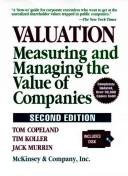
Valuation: Measuring and Managing the Value of Companies
McKinsey's guide to discounted cash flow valuation and managing for value.
The McKinsey standard reference on value creation and ROIC.
Summary
This is the McKinsey valuation textbook, now in many editions, and it is the standard professional reference for discounted cash flow valuation and for value-based management. The conceptual foundation is that value is created by earning returns on invested capital above the cost of capital, and that growth creates value only when this condition holds. The authors state this as the value driver formula, in which value depends on return on invested capital, growth, and the cost of capital, and they use it throughout to distinguish decisions that create value from those that do not.
The analytical section covers the reorganisation of financial statements into invested capital and net operating profit after tax, which separates operating performance from financing decisions; the calculation and interpretation of return on invested capital and of free cash flow; the analysis of historical performance; forecasting; estimating the cost of capital; calculating continuing value; and calculating and interpreting the result.
The advanced sections cover valuing companies with non-standard characteristics including high growth, cyclicality, multiple business units, emerging markets, banks and flexible investment opportunities, and cover alternative approaches including multiples and economic profit. The management sections cover portfolio decisions, mergers and acquisitions, divestitures, capital structure and investor communication.
The book is a textbook, long and technical, and requires accounting knowledge. It is written by consultants and reflects a specific institutional approach. Its treatment of terminal value, which frequently constitutes most of a valuation, is more careful than most sources. It is the reference professionals use rather than a book to read through.
Key takeaways 8
- Value is created by earning returns on invested capital above the cost of capital, and growth creates value only when that condition holds.
- Growth in a business earning below its cost of capital destroys value, which means growth is not a goal independent of returns.
- Financial statements must be reorganised into invested capital and operating profit to separate operating performance from financing decisions.
- Return on invested capital and growth together determine free cash flow, which is what a valuation actually discounts.
- Continuing value frequently constitutes most of a discounted cash flow valuation, which makes its assumptions the most consequential in the model.
- Multiples are a form of discounted cash flow with the assumptions concealed, and they should be reconciled to explicit assumptions.
- Accounting figures must be adjusted for operating leases, pensions, capitalised expenses and other items before ratios mean anything.
- Market values reflect long-run cash flow expectations rather than short-term earnings, which is why earnings management does not move prices durably.
Who should read it
Analysts and finance professionals who need the standard technical reference for discounted cash flow valuation and value-based management.
About Tim Koller
Partner at McKinsey & Company and lead author of the firm's valuation textbook.
Valuation: Measuring and Managing the Value of Companies sets out discounted cash flow practice end to end - forecasting, return on invested capital and growth as the two drivers of value, cost of capital, and the treatment of non-operating items - and is the text most corporate finance training runs on. Value: The Four Cornerstones condenses the same framework into the few principles that hold when accounting rules and buyback fashions change.
Who recommended it 3 · 3 direct
“For an excellent discussion of valuing banks, see Koller, Goedhart, and Wessels, Valuation, 733-758.”
Similar books 6
Chosen by shared topics, the entries that hold them, and the people who recommended both.
Value is discounted future cash flow, not earnings per share or return on equity.
“Alfred Rappaport, a professor emeritus at the Kellogg School of Management at Northwestern University, made this point clearly in his seminal book, Creating Shareholder Value.” — Michael Mauboussin
Source: Market Share: Understanding Competitive Advantage Through Market Power, page 1
Recommended by: Michael Mauboussin, Mohnish Pabrai
Four principles of corporate value, from McKinsey's valuation work, for executives.

Why an asset's value is the present value of the cash it will pay its owners.
“That a company’s value is the present value of its future free cash flows is familiar to most investors, and was set forth in The Theory of Investment Value, a seminal book written by John Burr Williams in 1938.” — Michael Mauboussin
Source: Where’s the Bar? Introducing Market-Expected Return on Investment (MEROI), page 6
Recommended by: Michael Mauboussin, Mohnish Pabrai and 1 other
Advanced valuation for the cases where the standard methods break down.
“We adapted this from Aswath Damodaran, Damodaran on Valuation (New York: John Wiley & Sons, 1994), 56-58” — Michael Mauboussin
Source: M&M on Valuation, page 13
Recommended by: Michael Mauboussin
Start from the share price and ask what results it expects a company to deliver.
Recommended by: Mohnish Pabrai
Why a valuation needs both a business story and numbers, and how to join them.
“Aswath Damodaran, Narrative and Numbers: The Value of Stories in Business (New York: Columbia Business School Publishing, 2017)” — Michael Mauboussin
Source: Trading Stages in the Company Life Cycle, page 18
Recommended by: Michael Mauboussin