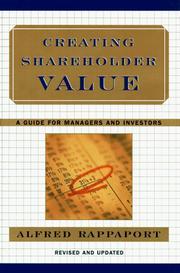
Creating Shareholder Value: A Guide for Managers and Investors
Value is discounted future cash flow, not earnings per share or return on equity.
Summary
Rappaport wrote the foundational text on shareholder value analysis, arguing that accounting measures including earnings per share and return on equity do not measure value creation, and that the correct measure is discounted future free cash flow. His argument against accounting measures is specific. Earnings can be increased by investments earning below the cost of capital, since earnings do not charge for equity capital. Accounting policies including depreciation methods, inventory valuation and revenue recognition alter reported earnings without changing cash. Earnings ignore the timing of cash flows and the investment required to produce them.
His framework identifies value drivers: sales growth rate, operating profit margin, incremental investment in working capital and fixed capital, the cash tax rate, the cost of capital and the value growth duration, meaning the period over which a company can invest above the cost of capital. Any strategy or decision can be evaluated by its effect on these.
He applies the framework to corporate strategy evaluation, merger and acquisition analysis, performance measurement and executive compensation, arguing that incentive schemes based on accounting measures reward exactly the behaviour that destroys value. The second edition addresses criticisms of shareholder value that emerged in the 1990s.
The framework has been substantially blamed for corporate short-termism, which Rappaport disputes on the grounds that discounted cash flow is inherently long-term and that the failure was in using accounting proxies and stock prices instead. That defence is correct about his method and does not address how the concept was implemented. The value driver framework remains the standard analytical structure for valuation.
Key takeaways 8
- Earnings per share and return on equity do not measure value creation, since earnings do not charge for the equity capital employed.
- Value equals discounted future free cash flow, which means the timing of cash and the investment required to produce it both matter.
- Accounting policies alter reported earnings without changing cash, which makes reported figures unreliable for measuring performance.
- Any decision can be evaluated through its effect on seven value drivers including growth, margin, investment requirements, tax and the cost of capital.
- The period over which a company can invest above its cost of capital determines a large share of its value and is usually the least examined assumption.
- Growth destroys value when the return on incremental investment is below the cost of capital, which accounting measures conceal.
- Compensation schemes based on accounting measures reward the behaviour that destroys value, which makes incentive design a valuation problem.
- Rappaport disputes the blame placed on shareholder value for short-termism, arguing that the failure was in using accounting proxies rather than his method.
Who should read it
Investors and executives who want the original statement of value drivers and the case against accounting measures of performance.
About Alfred Rappaport
Professor emeritus at the Kellogg School of Management, Northwestern University; originated shareholder value analysis.
Creating Shareholder Value demonstrated that reported earnings and accounting growth do not measure value creation, and identified the cash flow drivers that do - a framework corporate finance departments still run on. Expectations Investing, written with Michael Mauboussin, inverts the exercise: read the expectations already priced into a stock, then judge whether the business can beat them.
Who recommended it 2 · 2 direct
“Alfred Rappaport, a professor emeritus at the Kellogg School of Management at Northwestern University, made this point clearly in his seminal book, Creating Shareholder Value.”
Similar books 6
Chosen by shared topics, the entries that hold them, and the people who recommended both.
Every Berkshire annual letter since 1965, in order, as the company grew.
“…books I've recommended, highlighted to death, or forced on friends.” — Andrew Wilkinson
Source: Andrew Wilkinson's Bookshelf, neverenough.com
Recommended by: Andrew Wilkinson, Arnold Van Den Berg and 5 others
How the chase for short-term share prices corrupted shareholder value, and fixes.
“Alfred Rappaport, Saving Capitalism from Short-Termism: How to Build Long-Term Value and Take Back Our Financial Future (New York: McGraw Hill, 2011), 69-88” — Michael Mauboussin
Source: The Importance of Expectations: The Question that Bears Repeating: What’s Priced in?, page 14
Recommended by: Michael Mauboussin, Patrick O'Shaughnessy
Berkshire's shareholder letters arranged by topic: governance, valuation, mergers.
“The resource is as valuable as Larry Cunningham's The Essays of Warren Buffett, which similarly organizes by subject matter” — Christopher Bloomstran
Source: Semper Augustus 2024 Letter to Clients, 'Books and Tunes for Walking', p. 96
Recommended by: Christopher Bloomstran, Francois Rochon and 11 others
Eight CEOs who beat the market by allocating capital, not by running operations.
“…books I've recommended, highlighted to death, or forced on friends.” — Andrew Wilkinson
Source: Andrew Wilkinson's Bookshelf, neverenough.com
Recommended by: Andrew Wilkinson, Dan Loeb, Francois Rochon and 12 others
How a company's life-cycle stage decides how to read, value and manage it.
“Habib and Mostafa Monzur Hasan, “Corporate Life Cycle Research in Accounting, Finance and Corporate Governance: A Survey, and Directions for Future Research,” International Review of Financial Analysis, Vol. 61, January 2019, 188-201 and Aswath Damodaran, The Corporate Life Cycle: Business, Investment, and Management Implications (New York: Portfolio, 2024)” — Michael Mauboussin
Source: Trading Stages in the Company Life Cycle, page 17
Recommended by: Michael Mauboussin
How managers and middlemen took value from the owners of American companies.
“Bogle, John C., The Battle for the Soul of Capitalism (New Haven: Yale University Press, 2005)” — Michael Mauboussin
Recommended by: Michael Mauboussin, Mohnish Pabrai and 1 other
Where it sits in the reference 6
Topics 3
As an Amazon Associate I earn from qualifying purchases.