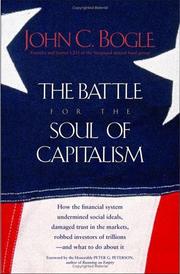
The Battle for the Soul of Capitalism
How managers and middlemen took value from the owners of American companies.
Summary
Bogle argues that American capitalism has been transformed from a system in which owners controlled companies into one in which managers and financial intermediaries extract value from both companies and investors, and that the failure of institutional owners to act as owners is the central mechanism.
His analysis of corporate America covers the growth of executive compensation relative to worker pay and to company performance, the use of stock options which reward share price movement rather than value creation and which were unexpensed for decades, the earnings management practices that produce reported results matching guidance, the failure of boards and compensation committees to act as agents of shareholders, and the conflicts of accounting firms earning consulting fees from audit clients.
His analysis of investment America covers the transformation of fund management from a profession into a marketing business, the growth of costs relative to returns, the conflict between fund company profitability and fund shareholder returns, and the failure of fund managers to vote proxies or engage with the companies they own on behalf of their investors.
His analysis of mutual fund America covers the ownership structure of fund management companies and the argument for the mutual structure Vanguard uses. His proposed remedies centre on requiring institutional owners to act as owners, on disclosure of proxy voting, and on a federal standard of fiduciary duty. The book repeats arguments from his other work and the moralising register is heavy. Written in 2005, it anticipated several of the governance failures that the financial crisis exposed. The analysis of why institutional owners do not act as owners is the most durable part.
Key takeaways 8
- American capitalism has moved from owners controlling companies to managers and intermediaries extracting value from both companies and investors.
- Institutional owners hold most corporate equity and do not act as owners, which leaves managers effectively unsupervised.
- Stock options reward share price movement rather than value creation, and were unexpensed for decades which concealed their cost.
- Earnings management produces reported results that match guidance, which means the guidance rather than the business determines the reported numbers.
- Boards and compensation committees do not function as agents of shareholders, and the mechanisms by which they fail are structural rather than personal.
- Accounting firms earning consulting fees from audit clients cannot function as an independent check.
- Fund management changed from a profession into a marketing business, which changed the objective from returns to asset gathering.
- Fund managers do not vote proxies or engage with companies on behalf of their investors, which removes the last available owner.
Who should read it
Investors and trustees who want a systematic account of why the ownership chain fails to supervise corporate managers.
About John C. Bogle
Founder and CEO, The Vanguard Group 1974-1996; creator of the first retail index mutual fund
He built the institution and wrote the primary-source case for low-cost indexing that every later index advocate builds on.
Who recommended it 3 · 2 direct
“Bogle, John C., The Battle for the Soul of Capitalism (New Haven: Yale University Press, 2005)”
Similar books 6
Chosen by shared topics, the entries that hold them, and the people who recommended both.
Value is discounted future cash flow, not earnings per share or return on equity.
“Alfred Rappaport, a professor emeritus at the Kellogg School of Management at Northwestern University, made this point clearly in his seminal book, Creating Shareholder Value.” — Michael Mauboussin
Source: Market Share: Understanding Competitive Advantage Through Market Power, page 1
Recommended by: Michael Mauboussin, Mohnish Pabrai
Post-mortems on value-destroying mergers, from AOL Time Warner to Quaker and Snapple.
“Robert F. Bruner, Deals from Hell: M&A Lessons That Rise Above the Ashes (Hoboken, N.J.: John Wiley & Sons, 2005)” — Michael Mauboussin
Source: Share Repurchase from All Angles: Assessing Buybacks, No Matter Where You Sit, page 14
Recommended by: Michael Mauboussin
Why American executive pay is not set by arm's-length bargaining for shareholders.
“For the negative case see Lucian A. Bebchuk and Jesse M. Fried, Pay Without Performance: The Unfulfilled Promise of Executive Compensation (Cambridge, MA: Harvard University Press, 2004) and Lucian A” — Michael Mauboussin
Source: Capital Allocation: Results, Analysis, and Assessment, page 65
Recommended by: Michael Mauboussin
How the chase for short-term share prices corrupted shareholder value, and fixes.
“Alfred Rappaport, Saving Capitalism from Short-Termism: How to Build Long-Term Value and Take Back Our Financial Future (New York: McGraw Hill, 2011), 69-88” — Michael Mauboussin
Source: The Importance of Expectations: The Question that Bears Repeating: What’s Priced in?, page 14
Recommended by: Michael Mauboussin, Patrick O'Shaughnessy
How a company's life-cycle stage decides how to read, value and manage it.
“Habib and Mostafa Monzur Hasan, “Corporate Life Cycle Research in Accounting, Finance and Corporate Governance: A Survey, and Directions for Future Research,” International Review of Financial Analysis, Vol. 61, January 2019, 188-201 and Aswath Damodaran, The Corporate Life Cycle: Business, Investment, and Management Implications (New York: Portfolio, 2024)” — Michael Mauboussin
Source: Trading Stages in the Company Life Cycle, page 17
Recommended by: Michael Mauboussin
Why acquirers overpay: the premium is a promise of gains most never deliver.
“Mark L. Sirower, The Synergy Trap: How Companies Lose the Acquisition Game (New York: Free Press, 1997)” — Michael Mauboussin
Source: Cost of Capital and Capital Allocation: Investment in the Era of "Easy Money", page 15
Recommended by: Michael Mauboussin