The Corporate Life Cycle: Business, Investment, and Management Implications
How a company's life-cycle stage decides how to read, value and manage it.
Summary
Aswath Damodaran organises this around the claim that a company's position in its life cycle determines what its financial statements mean, how it should be valued, what management practices suit it, and what kind of investor should hold it.
He describes six stages from start-up through young growth, high growth, mature growth, mature stable and decline. For each he sets out the characteristic financial profile: negative earnings and cash flow with growth in users or revenue early, then margin expansion, then reinvestment falling and cash returns rising, then declining revenue with divestiture. He argues that applying the same metrics across stages is the standard analytical error, since earnings multiples are meaningless for companies without earnings and revenue growth is a poor guide for mature firms.
The management argument is that different stages require different skills, and that chief executives who suit one stage usually fail at another. Founders who build a business rarely make good managers of a mature one, and managers of mature firms rarely handle decline, which requires shrinking deliberately and returning capital. He is direct that most companies in decline destroy value by pursuing growth they cannot achieve, and that the correct response to decline is orderly liquidation of capital rather than acquisition. The framework is clear and the valuation material draws on his other work. The stage classification is easier to apply retrospectively than in advance, which the book acknowledges only partly.
Key takeaways 7
- A company's life cycle stage determines which financial metrics carry information and which are meaningless.
- Earnings multiples cannot value companies without earnings, and revenue growth does not inform valuation of mature firms.
- Different life cycle stages require different management skills, and executives who suit one stage usually fail in another.
- Companies in decline destroy value by pursuing growth, and the correct response is orderly return of capital.
- Corporate governance and compensation structures should differ by stage, since the same incentives produce different behaviour.
- Damodaran argues that most acquisitions by declining companies are attempts to avoid the shareholders' correct conclusion.
- Investors should match their own approach to the life cycle stage they can actually analyse rather than holding across all of them.
Who should read it
Investors and directors who want a framework for matching valuation methods, management skills and capital policy to a company's stage of development.
About Aswath Damodaran
Kerschner Family Chair Professor of Finance, NYU Stern School of Business
His valuation textbooks and freely published datasets are the default reference used across academia, banking and investing.
Who recommended it 1 · 1 direct
“Habib and Mostafa Monzur Hasan, “Corporate Life Cycle Research in Accounting, Finance and Corporate Governance: A Survey, and Directions for Future Research,” International Review of Financial Analysis, Vol. 61, January 2019, 188-201 and Aswath Damodaran, The Corporate Life Cycle: Business, Investment, and Management Implications (New York: Portfolio, 2024)”
Similar books 6
Chosen by shared topics, the entries that hold them, and the people who recommended both.
Value is discounted future cash flow, not earnings per share or return on equity.
“Alfred Rappaport, a professor emeritus at the Kellogg School of Management at Northwestern University, made this point clearly in his seminal book, Creating Shareholder Value.” — Michael Mauboussin
Source: Market Share: Understanding Competitive Advantage Through Market Power, page 1
Recommended by: Michael Mauboussin, Mohnish Pabrai
Post-mortems on value-destroying mergers, from AOL Time Warner to Quaker and Snapple.
“Robert F. Bruner, Deals from Hell: M&A Lessons That Rise Above the Ashes (Hoboken, N.J.: John Wiley & Sons, 2005)” — Michael Mauboussin
Source: Share Repurchase from All Angles: Assessing Buybacks, No Matter Where You Sit, page 14
Recommended by: Michael Mauboussin
Why American executive pay is not set by arm's-length bargaining for shareholders.
“For the negative case see Lucian A. Bebchuk and Jesse M. Fried, Pay Without Performance: The Unfulfilled Promise of Executive Compensation (Cambridge, MA: Harvard University Press, 2004) and Lucian A” — Michael Mauboussin
Source: Capital Allocation: Results, Analysis, and Assessment, page 65
Recommended by: Michael Mauboussin
How the chase for short-term share prices corrupted shareholder value, and fixes.
“Alfred Rappaport, Saving Capitalism from Short-Termism: How to Build Long-Term Value and Take Back Our Financial Future (New York: McGraw Hill, 2011), 69-88” — Michael Mauboussin
Source: The Importance of Expectations: The Question that Bears Repeating: What’s Priced in?, page 14
Recommended by: Michael Mauboussin, Patrick O'Shaughnessy
How managers and middlemen took value from the owners of American companies.
“Bogle, John C., The Battle for the Soul of Capitalism (New Haven: Yale University Press, 2005)” — Michael Mauboussin
Recommended by: Michael Mauboussin, Mohnish Pabrai and 1 other
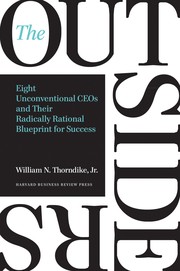
Eight CEOs who beat the market by allocating capital, not by running operations.
“…books I've recommended, highlighted to death, or forced on friends.” — Andrew Wilkinson
Source: Andrew Wilkinson's Bookshelf, neverenough.com
Recommended by: Andrew Wilkinson, Dan Loeb, Francois Rochon and 12 others