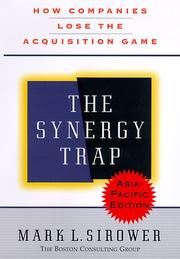
The Synergy Trap
Why acquirers overpay: the premium is a promise of gains most never deliver.
Why the premium usually exceeds the synergy.
Summary
Sirower, an academic and consultant, examines why acquirers pay premiums they cannot recover, and argues that the acquisition premium is a performance obligation that most acquirers never quantify.
His central analytical move is to treat the premium as an upfront payment for performance improvements that must be delivered. He points out that the premium must be earned in present value terms, that competitors will respond to whatever the acquirer attempts, and that the required improvement compounds because delays raise the amount that must eventually be delivered. He introduces the synergy limitation problem: the acquirer must not only improve the target but improve it beyond what the market already expected, since the pre-bid share price already impounds expected performance.
He derives what he calls the shareholder value at risk, meaning the premium expressed as a percentage of the acquirer's own market value, which quantifies how much of the acquirer's equity is being wagered on the synergy case.
His empirical work examines a sample of large acquisitions and finds that acquirer returns are systematically negative and that the size of the premium predicts the size of the underperformance.
The book is written for practitioners with an academic foundation and includes the modelling. Its argument is now conventional, which is a measure of its influence. Later empirical work has refined the return findings, and the aggregate picture is more nuanced than Sirower's sample suggests, but the framing of the premium as a performance obligation with a compounding required return remains the most useful way to assess a proposed deal.
Key takeaways 7
- An acquisition premium is an upfront payment for performance improvements that must be delivered, and it should be modelled as a required return rather than as a price.
- The required improvement compounds over time, so each year of delay raises the total that must eventually be delivered.
- Synergies must exceed what the market already expected of the target, since the pre-bid price already impounds expected performance.
- Competitors respond to whatever an acquirer attempts, which means synergy estimates must be net of competitive response rather than gross.
- The premium expressed as a percentage of the acquirer's own market value quantifies how much of the acquirer's equity is being wagered on the synergy case.
- Acquirer shareholder returns are systematically negative in large acquisitions, and the premium size predicts the degree of underperformance.
- Cost synergies are more reliably achieved than revenue synergies, and deals justified primarily on revenue synergies fail at much higher rates.
Who should read it
Corporate development teams, directors and investors who need a rigorous way to test whether an acquisition premium can be recovered.
Who recommended it 1 · 1 direct
“Mark L. Sirower, The Synergy Trap: How Companies Lose the Acquisition Game (New York: Free Press, 1997)”
Similar books 6
Chosen by shared topics, the entries that hold them, and the people who recommended both.
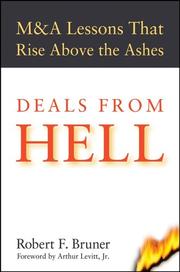
Post-mortems on value-destroying mergers, from AOL Time Warner to Quaker and Snapple.
“Robert F. Bruner, Deals from Hell: M&A Lessons That Rise Above the Ashes (Hoboken, N.J.: John Wiley & Sons, 2005)” — Michael Mauboussin
Source: Share Repurchase from All Angles: Assessing Buybacks, No Matter Where You Sit, page 14
Recommended by: Michael Mauboussin
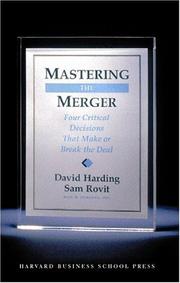
Bain's study of 1,700 companies on the four decisions that make acquisitions work.
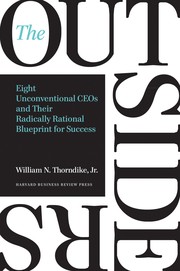
Eight CEOs who beat the market by allocating capital, not by running operations.
“…books I've recommended, highlighted to death, or forced on friends.” — Andrew Wilkinson
Source: Andrew Wilkinson's Bookshelf, neverenough.com
Recommended by: Andrew Wilkinson, Dan Loeb, Francois Rochon and 12 others
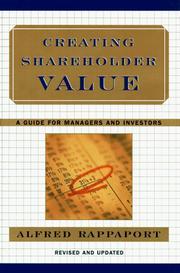
Value is discounted future cash flow, not earnings per share or return on equity.
“Alfred Rappaport, a professor emeritus at the Kellogg School of Management at Northwestern University, made this point clearly in his seminal book, Creating Shareholder Value.” — Michael Mauboussin
Source: Market Share: Understanding Competitive Advantage Through Market Power, page 1
Recommended by: Michael Mauboussin, Mohnish Pabrai
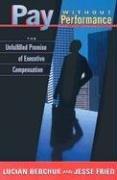
Why American executive pay is not set by arm's-length bargaining for shareholders.
“For the negative case see Lucian A. Bebchuk and Jesse M. Fried, Pay Without Performance: The Unfulfilled Promise of Executive Compensation (Cambridge, MA: Harvard University Press, 2004) and Lucian A” — Michael Mauboussin
Source: Capital Allocation: Results, Analysis, and Assessment, page 65
Recommended by: Michael Mauboussin
How the chase for short-term share prices corrupted shareholder value, and fixes.
“Alfred Rappaport, Saving Capitalism from Short-Termism: How to Build Long-Term Value and Take Back Our Financial Future (New York: McGraw Hill, 2011), 69-88” — Michael Mauboussin
Source: The Importance of Expectations: The Question that Bears Repeating: What’s Priced in?, page 14
Recommended by: Michael Mauboussin, Patrick O'Shaughnessy