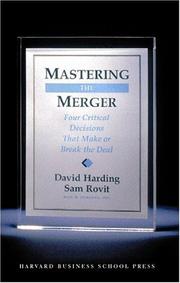
Mastering the Merger
Bain's study of 1,700 companies on the four decisions that make acquisitions work.
Bain's evidence that frequent small deals beat occasional large ones.
Summary
Harding and Rovit, Bain consultants, examined a large sample of acquisitions and identify four decisions that separate successful acquirers from unsuccessful ones. Their empirical finding is that frequent acquirers who buy consistently through cycles outperform both non-acquirers and infrequent large acquirers.
The four decisions are: whether to pursue a deal at all, which requires knowing the specific investment thesis before any target is identified; how much diligence to do and on what, which they argue should concentrate on the few assumptions the thesis depends on rather than on comprehensive review; what price to pay and when to walk away, which requires setting the maximum before negotiation begins and having a mechanism for enforcing it; and how to integrate, which they argue should be planned around the thesis rather than executed as a standard programme.
Their most useful specific finding is about deal frequency and size. Companies that made many small acquisitions relative to their size, repeatedly, outperformed companies that made occasional transformational deals. They attribute this to accumulated organisational capability in acquiring and integrating, which is learned rather than innate.
The research is Bain proprietary work and is not independently verifiable, and consultants writing about a service they sell should be read with that in mind. The finding about frequent small acquisitions has been supported by later academic work. The integration material is conventional and the book is stronger on the decision to acquire than on what happens afterward.
Key takeaways 7
- Companies that acquire frequently and in small amounts relative to their size outperform both non-acquirers and infrequent large acquirers.
- Acquisition capability is learned through repetition, which is why frequency rather than deal quality explains most of the performance difference.
- An investment thesis stating specifically how the deal creates value must exist before any target is identified, not constructed to justify one.
- Diligence should concentrate on the few assumptions the thesis depends on rather than on comprehensive review of everything.
- The maximum price must be set before negotiation begins along with a mechanism for enforcing the walk-away, since deal momentum defeats judgement.
- Integration should be designed around the specific investment thesis rather than executed as a standard programme.
- Acquisitions made during downturns outperform those made at cycle peaks, and the acquirers who can do this are those with capacity and prepared theses.
Who should read it
Corporate development teams and executives building an acquisition programme who want the evidence on deal frequency, thesis discipline and diligence focus.
Similar books 6
Chosen by shared topics, the entries that hold them, and the people who recommended both.
Post-mortems on value-destroying mergers, from AOL Time Warner to Quaker and Snapple.
“Robert F. Bruner, Deals from Hell: M&A Lessons That Rise Above the Ashes (Hoboken, N.J.: John Wiley & Sons, 2005)” — Michael Mauboussin
Source: Share Repurchase from All Angles: Assessing Buybacks, No Matter Where You Sit, page 14
Recommended by: Michael Mauboussin
Why acquirers overpay: the premium is a promise of gains most never deliver.
“Mark L. Sirower, The Synergy Trap: How Companies Lose the Acquisition Game (New York: Free Press, 1997)” — Michael Mauboussin
Source: Cost of Capital and Capital Allocation: Investment in the Era of "Easy Money", page 15
Recommended by: Michael Mauboussin
Eight CEOs who beat the market by allocating capital, not by running operations.
“…books I've recommended, highlighted to death, or forced on friends.” — Andrew Wilkinson
Source: Andrew Wilkinson's Bookshelf, neverenough.com
Recommended by: Andrew Wilkinson, Dan Loeb, Francois Rochon and 12 others
The case that many conglomerates destroy value and should break themselves up.
Value is discounted future cash flow, not earnings per share or return on equity.
“Alfred Rappaport, a professor emeritus at the Kellogg School of Management at Northwestern University, made this point clearly in his seminal book, Creating Shareholder Value.” — Michael Mauboussin
Source: Market Share: Understanding Competitive Advantage Through Market Power, page 1
Recommended by: Michael Mauboussin, Mohnish Pabrai
Why American executive pay is not set by arm's-length bargaining for shareholders.
“For the negative case see Lucian A. Bebchuk and Jesse M. Fried, Pay Without Performance: The Unfulfilled Promise of Executive Compensation (Cambridge, MA: Harvard University Press, 2004) and Lucian A” — Michael Mauboussin
Source: Capital Allocation: Results, Analysis, and Assessment, page 65
Recommended by: Michael Mauboussin