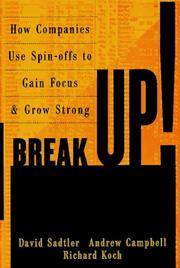
Breakup!
The case that many conglomerates destroy value and should break themselves up.
The case for demerger argued from the parent company's side.
Summary
The reference has not verified this book in detail; the summary states only what the title, author and subject establish.
Sadtler, Campbell and Koch, associated with Ashridge Strategic Management Centre, argued that many multi-business companies destroy value by holding businesses together and should break themselves up.
The reference has not verified the book's detailed contents. The argument as the Ashridge group developed it rests on the concept of parenting advantage. A corporate parent adds value to a business only if it can do something for that business that other potential owners cannot do as well: supplying capital on better terms, providing capabilities the business lacks, imposing better governance, or creating linkages with other businesses in the portfolio. If the parent cannot do this, its overhead and its constraints subtract value, and the business would be worth more owned by someone else or standing alone.
The practical test they propose is to ask, for each business in a portfolio, whether the parent is the best owner. The answer is frequently no, and the authors argue that conglomerates persist because breaking up destroys the corporate centre's own position rather than because the structure creates value.
The evidence in this literature includes the diversification discount, meaning that multi-business firms trade at lower valuations than the sum of comparable standalone businesses, and the returns to announced demergers and spin-offs, which have generally been positive.
The argument was made during a period of active corporate restructuring in the 1990s. The conclusion is contested: the diversification discount may reflect selection, since firms that diversify may be those with poor prospects in their core, and internal capital markets have advantages in settings where external financing is expensive. The subsequent decades produced both continued breakups and the growth of technology conglomerates that appear to contradict the argument. Readers should verify the book's specific evidence.
Key takeaways 7
- A corporate parent adds value only if it can do something for a business that other potential owners cannot do as well.
- Where a parent has no such advantage, its overhead and constraints subtract value from the business it owns.
- The practical test for every business in a portfolio is whether the current parent is the best available owner.
- Multi-business firms have generally traded at a discount to the sum of comparable standalone businesses.
- Announced demergers and spin-offs have generally produced positive returns, which supports the breakup argument empirically.
- Conglomerates persist because breaking up eliminates the corporate centre's own position rather than because the structure creates value.
- Internal capital markets have advantages where external financing is expensive, which is the strongest argument against general breakup.
Who should read it
Directors and investors assessing whether a multi-business company should be broken up, who should verify the book's specific evidence.
Similar books 6
Chosen by shared topics, the entries that hold them, and the people who recommended both.
Eight activist letters over a century, from Graham in 1927, and what lay behind them.
Recommended by: Mohnish Pabrai
Value is discounted future cash flow, not earnings per share or return on equity.
“Alfred Rappaport, a professor emeritus at the Kellogg School of Management at Northwestern University, made this point clearly in his seminal book, Creating Shareholder Value.” — Michael Mauboussin
Source: Market Share: Understanding Competitive Advantage Through Market Power, page 1
Recommended by: Michael Mauboussin, Mohnish Pabrai
Post-mortems on value-destroying mergers, from AOL Time Warner to Quaker and Snapple.
“Robert F. Bruner, Deals from Hell: M&A Lessons That Rise Above the Ashes (Hoboken, N.J.: John Wiley & Sons, 2005)” — Michael Mauboussin
Source: Share Repurchase from All Angles: Assessing Buybacks, No Matter Where You Sit, page 14
Recommended by: Michael Mauboussin
Bain's study of 1,700 companies on the four decisions that make acquisitions work.
Why American executive pay is not set by arm's-length bargaining for shareholders.
“For the negative case see Lucian A. Bebchuk and Jesse M. Fried, Pay Without Performance: The Unfulfilled Promise of Executive Compensation (Cambridge, MA: Harvard University Press, 2004) and Lucian A” — Michael Mauboussin
Source: Capital Allocation: Results, Analysis, and Assessment, page 65
Recommended by: Michael Mauboussin
How the chase for short-term share prices corrupted shareholder value, and fixes.
“Alfred Rappaport, Saving Capitalism from Short-Termism: How to Build Long-Term Value and Take Back Our Financial Future (New York: McGraw Hill, 2011), 69-88” — Michael Mauboussin
Source: The Importance of Expectations: The Question that Bears Repeating: What’s Priced in?, page 14
Recommended by: Michael Mauboussin, Patrick O'Shaughnessy