
The Theory of Investment Value
Why an asset's value is the present value of the cash it will pay its owners.
Summary
Williams wrote this as his Harvard doctoral thesis and it is the origin of the dividend discount model and, more broadly, of the proposition that the value of any asset is the present value of the cash it will distribute to its owner. He states the principle plainly: a stock is worth the present value of all the dividends it will ever pay.
The book works out the implications with unusual care for 1938. Williams handles growth, showing what happens to the valuation when the growth rate approaches the discount rate and being explicit that a perpetually higher growth rate than the discount rate produces an infinite value and is therefore impossible. He addresses the question of retained earnings, arguing that earnings reinvested have value only through the future dividends they enable, which is the argument later restated as the difference between value-creating and value-destroying reinvestment. He also states an early version of what became the Modigliani-Miller proposition, that the total value of a firm is not changed by how its capital structure divides claims on the same cash flows, and he illustrates it with what he called the bloated bondholder argument.
The book includes extensive worked valuations of specific companies of the period, including General Motors and United States Steel, and algebraic derivations that make it heavy going. It is a foundational text rather than a practical manual, and almost every subsequent valuation method is a refinement of what it states. Its treatment of how to estimate the inputs is thin, which is the permanent problem with the method.
Key takeaways 7
- The value of a security is the present value of the cash it will distribute to its owner over its life, and every other valuation method is an approximation of this.
- Retained earnings have value only through the future distributions they make possible, so reinvestment that does not raise future distributions destroys value.
- A growth rate that permanently exceeds the discount rate produces an infinite value, which proves no such growth rate can be assumed.
- The total value of a firm does not depend on how its capital structure divides claims on the same cash flows.
- Book value and reported earnings are inputs to estimating future distributions rather than measures of value themselves.
- A common stock and a bond are valued by the same principle, differing only in the certainty and the pattern of the payments.
- The difficulty in valuation lies entirely in estimating the future cash flows and the appropriate discount rate, since the framework itself is straightforward.
Who should read it
Investors who want the original statement of discounted cash flow valuation and the arguments about growth, reinvestment and capital structure that follow from it.
Who recommended it 3 · 3 direct
“That a company’s value is the present value of its future free cash flows is familiar to most investors, and was set forth in The Theory of Investment Value, a seminal book written by John Burr Williams in 1938.”
“In The Theory of Investment Value, written over 50 years ago, John Burr Williams set forth the equation for value, which we condense here: The value of any stock, bond or business today is determined by the cash inflows and outflows - discounted at an appropriate interest rate - that can be expected to occur during the remaining life of the asset.”
Similar books 6
Chosen by shared topics, the entries that hold them, and the people who recommended both.
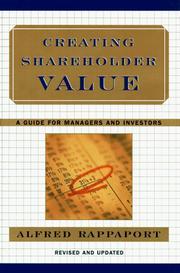
Value is discounted future cash flow, not earnings per share or return on equity.
“Alfred Rappaport, a professor emeritus at the Kellogg School of Management at Northwestern University, made this point clearly in his seminal book, Creating Shareholder Value.” — Michael Mauboussin
Source: Market Share: Understanding Competitive Advantage Through Market Power, page 1
Recommended by: Michael Mauboussin, Mohnish Pabrai
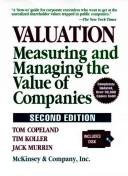
McKinsey's guide to discounted cash flow valuation and managing for value.
“For an excellent discussion of valuing banks, see Koller, Goedhart, and Wessels, Valuation, 733-758.” — Michael Mauboussin
Source: Return on Invested Capital: How to Calculate ROIC and Handle Common Issues, page 38
Recommended by: Michael Mauboussin, Mohnish Pabrai and 1 other
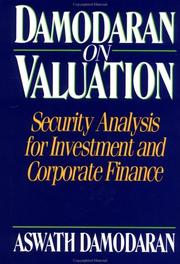
Advanced valuation for the cases where the standard methods break down.
“We adapted this from Aswath Damodaran, Damodaran on Valuation (New York: John Wiley & Sons, 1994), 56-58” — Michael Mauboussin
Source: M&M on Valuation, page 13
Recommended by: Michael Mauboussin
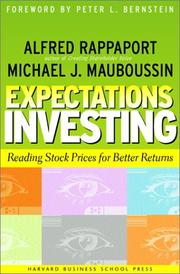
Start from the share price and ask what results it expects a company to deliver.
Recommended by: Mohnish Pabrai
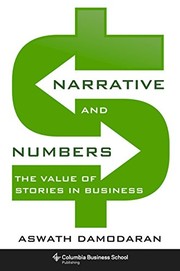
Why a valuation needs both a business story and numbers, and how to join them.
“Aswath Damodaran, Narrative and Numbers: The Value of Stories in Business (New York: Columbia Business School Publishing, 2017)” — Michael Mauboussin
Source: Trading Stages in the Company Life Cycle, page 18
Recommended by: Michael Mauboussin
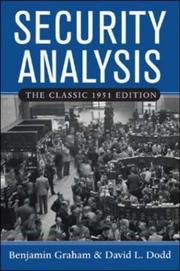
How to read financial statements sceptically and value bonds and stocks.
“I am reminded once again of the quote that sits in the front of Ben Graham’s Security Analysis, from Horace’s Ars Poetica: “Many shall be restored that now are fallen and many shall fall that now are in honor.” — Bill Miller
Source: 2007 Q3 Market Commentary
Recommended by: Bill Miller, Christopher Bloomstran and 18 others
Where it sits in the reference 1
Topics 2
As an Amazon Associate I earn from qualifying purchases.