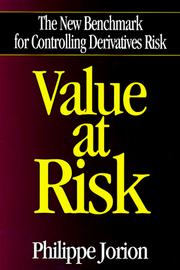
Value at Risk
How value at risk sums up a portfolio's possible loss in one number, and its limits.
The standard technical reference for the measure and its limits.
Summary
Philippe Jorion wrote the standard reference on value at risk, the measure that summarises a portfolio's potential loss as a single number: the loss that will not be exceeded over a specified horizon with a specified probability.
The book covers the measure's construction. The three principal methods are the variance-covariance approach, which assumes normally distributed returns and computes the loss analytically from the portfolio's volatility; historical simulation, which revalues the current portfolio using historical price movements; and Monte Carlo simulation, which generates scenarios from an assumed distribution. Jorion sets out the assumptions each requires, the computational demands, and where each fails.
He is careful about the limitations, and later editions are more so. Value at risk says nothing about losses beyond the threshold, which is the region that matters in a crisis. It depends on estimated volatilities and correlations that change, and that change most when they matter most. It can be gamed by positions that concentrate risk beyond the confidence level, which is why option selling strategies report low value at risk. Jorion covers backtesting to detect model failure, stress testing as a complement, and the regulatory use of the measure under the Basel framework, which he notes creates incentives that pure risk management would not. The book also covers the applications to credit and operational risk. It is technical and assumes statistics.
Key takeaways 7
- Value at risk states the loss that will not be exceeded over a horizon at a confidence level and says nothing about losses beyond it.
- The variance-covariance method assumes normally distributed returns, which understates tail risk in every real portfolio.
- Historical simulation avoids distributional assumptions and assumes instead that the future resembles the sampled past.
- Estimated volatilities and correlations change most in exactly the conditions where the measure is relied upon.
- Strategies that concentrate risk beyond the confidence level, including option selling, report low value at risk while carrying large exposure.
- Backtesting breach frequency against the stated confidence level is how model failure is detected.
- Regulatory use of the measure under Basel creates incentives that pure risk management would not produce.
Who should read it
Risk managers and quantitative practitioners who need the standard reference on value at risk construction and, more importantly, on its failure modes.
Similar books 6
Chosen by shared topics, the entries that hold them, and the people who recommended both.
Why people mistake luck for skill, above all in markets.
“Fooled By Randomness was unquestionably the best non-fiction book I read in 2005.” — Brad Feld
Source: Book Review: Fooled By Randomness — Feld Thoughts
Recommended by: Barton Biggs, Brad Feld, Derek Sivers and 15 others
The graduate reference on extreme value theory for insurance and finance.
Recommended by: Nassim Nicholas Taleb
A risk manager's history of quantitative risk and what value-at-risk is for.
Rare, unforeseen, high-impact events drive history, explained only after the fact.
“The Black Swan U The best-known bird around today is The Black Swan, the second book from Nassim Nicolas Taleb.” — Howard Marks
Source: The Complete Collection, page 530
Recommended by: David Perell, Howard Marks, Marc Andreessen and 20 others
How a hedge fund's bond bets on borrowed money lost $4.6 billion in four months.
“Roger Lowenstein, When Genius Failed: The Rise and Fall of Long-Term Capital Management (New York: Random House, 2000), 72” — Michael Mauboussin
Source: A Tail of Two Worlds: Fat Tails and Investing, page 4
Recommended by: Bill Gurley, Michael Mauboussin and 9 others
Why big crashes build up inside markets rather than follow the news.
“In an important and fascinating book, Why Stock Markets Crash, geophysicist Didier Sornette argues that stock market distributions comprise two different populations, the body (which you can model with standard theory) and the tail (which relies on completely different mechanisms).” — Michael Mauboussin
Source: Integrating the Outliers: Two Lessons from the St. Petersburg Paradox, page 3
Recommended by: Michael Mauboussin, Nassim Nicholas Taleb
Where it sits in the reference 1
Topics 1
As an Amazon Associate I earn from qualifying purchases.