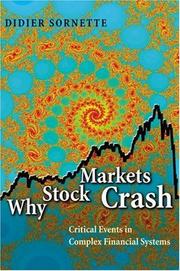
Why Stock Markets Crash
Why big crashes build up inside markets rather than follow the news.
Log-periodic power laws as a physicist's model of crash formation
Summary
Sornette, a geophysicist who applies statistical physics to financial markets, argues that large market crashes are not caused by the news that appears to trigger them but are endogenous outcomes of a cooperative process among traders, and that they are preceded by an identifiable signature.
His model treats a bubble as a system in which traders imitate one another with increasing strength, producing positive feedback. As imitation increases the system approaches a critical point, and the price path in that regime follows a specific mathematical form: faster-than-exponential growth decorated with accelerating oscillations, which he calls log-periodic power law behaviour. The oscillations arise from a discrete scale invariance in the underlying interaction structure. He argues this signature is detectable in advance and fits it to the 1929, 1987 and 2000 episodes and to several others including the 1997 Asian crisis.
The conceptual claim, that a crash is the culmination of a slow build-up of internal instability rather than a response to an external shock, is well supported by the observation that no adequate news event has ever been identified for the largest crashes.
The predictive claim is where the dispute lies. Critics have argued the log-periodic fits have too many free parameters, that the pattern can be fitted to price series with no subsequent crash, and that out-of-sample performance has been poor and selectively reported. Sornette has made public predictions with mixed results. The book requires mathematics and is written for readers comfortable with statistical physics.
Key takeaways 7
- Large market crashes are endogenous outcomes of a build-up of internal instability rather than responses to the news events that appear to trigger them.
- No adequate external cause has ever been identified for the largest crashes, which is the empirical basis for treating them as internally generated.
- Bubbles arise from traders imitating one another with increasing strength, which produces positive feedback and drives the system toward a critical point.
- Prices in a bubble regime grow faster than exponentially, which is unsustainable by construction and identifies the state independently of any valuation judgement.
- Accelerating oscillations superimposed on the price path constitute a signature that Sornette claims is detectable before the crash.
- A crash occurs when the system reaches criticality, at which point any small disturbance can trigger it, which is why the trigger appears arbitrary.
- The date of a crash is not determined by the model, only the regime, which limits what the method can be used for in practice.
Who should read it
Quantitatively inclined investors interested in the physics-based account of endogenous crashes, with the predictive claims treated as disputed.
Who recommended it 2 · 1 direct
“In an important and fascinating book, Why Stock Markets Crash, geophysicist Didier Sornette argues that stock market distributions comprise two different populations, the body (which you can model with standard theory) and the tail (which relies on completely different mechanisms).”
Similar books 6
Chosen by shared topics, the entries that hold them, and the people who recommended both.
The graduate reference on extreme value theory for insurance and finance.
Recommended by: Nassim Nicholas Taleb
Rare, unforeseen, high-impact events drive history, explained only after the fact.
“The Black Swan U The best-known bird around today is The Black Swan, the second book from Nassim Nicolas Taleb.” — Howard Marks
Source: The Complete Collection, page 530
Recommended by: David Perell, Howard Marks, Marc Andreessen and 20 others
Why people mistake luck for skill, above all in markets.
“Fooled By Randomness was unquestionably the best non-fiction book I read in 2005.” — Brad Feld
Source: Book Review: Fooled By Randomness — Feld Thoughts
Recommended by: Barton Biggs, Brad Feld, Derek Sivers and 15 others
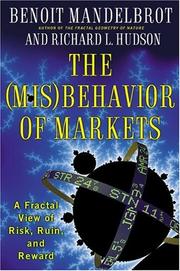
Why standard finance models understate market risk, from fractal geometry's creator.
“(Italics added.) Mandelbrot on Risk, Ruin, and Reward The abstract theories of Karl Popper and Frank Knight can be directly applied to the financial markets, which is exactly what Benoit Mandelbrot, the brilliant inventor of fractal geometry, has done with Richard Hudson in his book The (Mis)Behavior of Markets, ominously subtitled “A Fractal View of Risk, Ruin, and Reward.” — John C. Bogle
Source: Black Monday and Black Swans, page 3
Recommended by: John C. Bogle, Mohnish Pabrai and 2 others
A risk manager's history of quantitative risk and what value-at-risk is for.
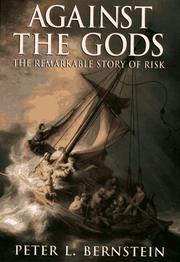
How people learned to measure risk, from early probability to portfolio theory.
“(Risk is the subject of Peter Bernstein’s wonderful new book, Against the Gods: The Remarkable Story of Risk.)” — Bill Miller
Source: 1996 Q3 Market Commentary
Recommended by: Bill Miller, Charles de Vaulx, Howard Marks and 9 others
Where it sits in the reference 3
Topics 3
As an Amazon Associate I earn from qualifying purchases.