Warren Buffett's Ground Rules
Miller reconstructs Buffett's partnership-era rules and results.
Summary
Miller worked through the letters Buffett wrote to his limited partners from 1956 to 1970, when he ran Buffett Partnership Limited rather than Berkshire Hathaway, and organised the material by subject with his own explanation attached. The partnership letters are less widely read than the Berkshire ones and describe a different operation.
The substantive content concerns method and structure. Buffett divided the portfolio into three categories. Generals were undervalued securities bought passively and held until the market recognised them. Workouts were positions in announced corporate events such as mergers, liquidations, tenders and spin-offs, where the return depended on the transaction completing rather than on market direction. Controls were positions large enough for Buffett to influence or determine what the company did, with Sanborn Map and Dempster Mill Manufacturing as the documented cases. He argued that workouts provided returns uncorrelated with the market and therefore made the partnership more resilient in falling markets, and he sized the categories according to opportunity.
The ground rules of the title are the terms he set with partners: he would not predict market direction, he would be judged against the Dow over at least three years and preferably five, he would take no fee on the first six per cent of return and a quarter of anything above it, and he would tell partners what he was doing but not what he owned. He also stated repeatedly that he expected to do better relative to the market in falling years than in rising ones.
Miller's commentary is competent but adds little to the letters, which are the real content. The material is also specific to a period when a small pool of capital could exploit inefficiencies in small and illiquid securities, and Buffett has said directly that the approach does not scale.
Key takeaways 7
- Buffett divided the partnership portfolio into undervalued securities, announced-event workouts and control positions, and sized them by available opportunity.
- Workout positions produce returns uncorrelated with the market, which is what allowed the partnership to outperform in declining years.
- Buffett committed to being measured against the Dow over rolling three-year periods rather than annually.
- His fee took nothing below a six per cent annual return and a quarter of the excess above it, which aligned him with partners.
- He refused to forecast market direction and told partners that anyone wanting such forecasts should invest elsewhere.
- Control positions let an investor force the realisation of value rather than waiting for the market to recognise it.
- The partnership's returns depended on inefficiencies in small illiquid securities that a large pool of capital cannot access.
Who should read it
Investors running small pools of capital who want Buffett's actual early method, including the event-driven component that Berkshire-era writing leaves out.
Who recommended it 2 · 2 direct
Similar books 6
Chosen by shared topics, the entries that hold them, and the people who recommended both.
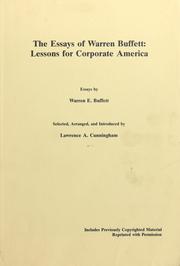
Berkshire's shareholder letters arranged by topic: governance, valuation, mergers.
“The resource is as valuable as Larry Cunningham's The Essays of Warren Buffett, which similarly organizes by subject matter” — Christopher Bloomstran
Source: Semper Augustus 2024 Letter to Clients, 'Books and Tunes for Walking', p. 96
Recommended by: Christopher Bloomstran, Francois Rochon and 11 others

Fortune's articles by and about Buffett from 1966 to 2012, with commentary.
“I hope many people, even those who think they know Warren well, will read it cover to cover.” — Bill Gates
Source: Gates Notes review of Tap Dancing to Work
Recommended by: Bill Gates, Guy Spier, Mohnish Pabrai and 2 others

Recommended by: Mohnish Pabrai

Recommended by: Mohnish Pabrai

Sprawling, repeatedly expanded compendium of Buffett material.
Recommended by: Mohnish Pabrai

An early account of Buffett's investing method, from 1987.
Recommended by: Mohnish Pabrai
Where it sits in the reference 2
Topics