Updates

  1. Person pages list letters, writing, profiles and links as sortable tables with filters, and show each person's companies as links; Fund letters show each letter's description in its own column.
  2. Experts show a checked job title and a short description of each person; 30 more people have photographs.
  3. Every company, fund, university and publication the experts work for has a page listing the people there.
  4. Fund letters show each letter's thesis and filter by it; 225 person pages list the essays, columns and newsletter issues the person wrote.
  5. Person pages list every essay and newsletter issue a person wrote, and their own books as a table in List view.
  6. Recommends shows the five largest kinds of book and the rest under More; browse pictures load sooner.
  7. Podcasts and talks link the original episode, filter by Audio and video or Press, and list each publisher once.
  8. Pages are wider, Recommends has List and Grid, and a filter clicked again turns off.
  9. Book cards sit in a ruled grid with Open Library and Goodreads links and each book's one-line note.
  10. Funds is now Investors; each investor's styles are buttons that filter the table.
  11. Podcasts and talks on a person's page filter by year and publisher and show as a list or a grid of pictures.
  12. Quotes show only people's own words: 472 summaries written by list sites are gone.
  13. Country pages open from Browse again, and every link on the shelf lands on a page.
  14. Subject and person pages show their sections as tabs, and each book appears once on a person's page.
  15. Book cards show the quote, who said it and the source; grids show five cards to a row.
  16. On a phone, a menu holds the sections, search, Updates, Feedback and dark mode.
  17. Feedback takes a screenshot of the page with no browser prompt, opens a screenshot full size when you click it, and clears itself once sent.
  18. Book cards are centred, search names the topic each book sits in, and any text cut short shows whole on hover.
  19. Search groups its results by kind: people, companies, geographies, subjects, topics, books, funds, fund letters and papers.
  20. The Books table lists who recommended each book by name, and the browser tab names the section you are in.
  21. Feedback can take a screenshot of the page, or one you paste or choose, and opens in the corner beside Updates.
  22. Each rail button reopens its section where you left it, and Browse, Table and People show on every book and subject page.
  23. Filters grey out choices that hold nothing instead of hiding them, and Books › People filters by authors or recommenders.
  24. Feedback takes a subject line and up to three screenshots.
  25. Biographies are grouped by the person they are about: 41 new pages, from Abraham Lincoln to Lee Kuan Yew.
  26. Sport splits into 23 sports, and Religion into one topic per faith.
  27. Book lists show as cards: the cover, one recommendation quote and every recommender by name.
  28. Seventeen subjects that had two or three pages under different names now have one page each.
  29. Every page lists its Experts as authors and recommenders, with a link to them on the Experts tab.
  30. Economics, Financial history, Financial panics and Accounting are subjects of their own, with one page per financial crisis.
  31. Book, person and subject pages open inside the app, so the tabs stay in view.
  32. 996 more book covers, and photographs or logos for 227 more people and companies.
  33. Books › Browse shows every subject as cards, and the rail holds Fund letters, Papers, Experts, Books and Funds.
  34. Every topic over 150 books splits into narrower topics, each with a page of its own.

Send feedback

What is it?
Screenshots, up to 3 (optional)
or paste one with Ctrl+V

We use your email only to reply to you.

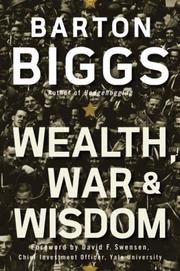
Wealth, War and Wisdom

Wealth, War and Wisdom

Barton Biggs
2008
T4 368 pages · about 6h 8m to read Open Librarygoodreads

Summary

Barton Biggs spent his career at Morgan Stanley and wrote this after retiring to run a hedge fund. It combines two subjects: whether stock markets identified the turning points of the Second World War before contemporaries did, and how wealth was preserved or destroyed through the catastrophe.

The market argument is the more original. Biggs examines the major indices around the war's decisive moments and finds that they turned close to the actual inflection points: the British market bottomed around the time of Dunkirk and the Battle of Britain, the American market around the time of Midway, and the German market peaked around the point of maximum German advance. He treats this as evidence of collective wisdom in markets that no individual commentator displayed at the time. The evidence is suggestive rather than conclusive, and readers should note that the sample is small and the turning points were identified with hindsight.

The wealth preservation material is practical and grim. Biggs examines what happened to different asset classes and holdings across the countries involved: equities generally survived better than bonds, which were destroyed by inflation everywhere; property survived where it was not destroyed or confiscated; gold and jewellery held value but could be taken; foreign holdings survived if the owner reached them; and the people who fared best had diversified across countries and asset types in advance. He argues explicitly for holding assets in multiple jurisdictions and for owning a farm. The book is discursive and the two subjects sit awkwardly together, but the historical material on wealth destruction is not available in this form elsewhere.

Key takeaways 7

  1. Major stock markets turned close to the actual military inflection points of the Second World War, ahead of contemporary commentary.
  2. Biggs treats this as evidence of collective market wisdom that no individual observer displayed at the time.
  3. Bonds were destroyed by inflation in every country involved, while equities generally preserved some real value.
  4. Property survived where it was not physically destroyed or confiscated, which varied entirely by location.
  5. Gold and portable valuables held value and could be confiscated, which makes them useful only if the holder can move them.
  6. Holdings in multiple jurisdictions were what preserved wealth for the people who fared best.
  7. The market timing evidence rests on a small sample with turning points identified in hindsight.

Who should read it

Investors thinking about wealth preservation through political catastrophe, and anyone interested in whether markets aggregate information about events.

About Barton Biggs

Chief global strategist, Morgan Stanley 1973-2003; co-founder, Traxis Partners (1932-2012)

Thirty years of Morgan Stanley global strategy plus Hedgehogging, still the most candid insider account of how hedge fund managers actually behave.

Morgan Stanley, Traxis Partners

Similar books 6

Chosen by shared topics, the entries that hold them, and the people who recommended both.

Russell Napier · 2005

What markets looked like at the US stock bottoms of 1921, 1932, 1949 and 1982.

Jason Zweig, Rodney N. Sullivan · 2010

Edited collection of Graham's own writings and interviews
Peter L. Bernstein · 1992

How Markowitz, Sharpe, Fama, Black and Scholes built the theory of modern finance.

Where it sits in the reference 2

Investors
Financial history

Topics

Financial HistoryInvestingWar and Strategy