Updates

  1. Person pages list letters, writing, profiles and links as sortable tables with filters, and show each person's companies as links; Fund letters show each letter's description in its own column.
  2. Experts show a checked job title and a short description of each person; 30 more people have photographs.
  3. Every company, fund, university and publication the experts work for has a page listing the people there.
  4. Fund letters show each letter's thesis and filter by it; 225 person pages list the essays, columns and newsletter issues the person wrote.
  5. Person pages list every essay and newsletter issue a person wrote, and their own books as a table in List view.
  6. Recommends shows the five largest kinds of book and the rest under More; browse pictures load sooner.
  7. Podcasts and talks link the original episode, filter by Audio and video or Press, and list each publisher once.
  8. Pages are wider, Recommends has List and Grid, and a filter clicked again turns off.
  9. Book cards sit in a ruled grid with Open Library and Goodreads links and each book's one-line note.
  10. Funds is now Investors; each investor's styles are buttons that filter the table.
  11. Podcasts and talks on a person's page filter by year and publisher and show as a list or a grid of pictures.
  12. Quotes show only people's own words: 472 summaries written by list sites are gone.
  13. Country pages open from Browse again, and every link on the shelf lands on a page.
  14. Subject and person pages show their sections as tabs, and each book appears once on a person's page.
  15. Book cards show the quote, who said it and the source; grids show five cards to a row.
  16. On a phone, a menu holds the sections, search, Updates, Feedback and dark mode.
  17. Feedback takes a screenshot of the page with no browser prompt, opens a screenshot full size when you click it, and clears itself once sent.
  18. Book cards are centred, search names the topic each book sits in, and any text cut short shows whole on hover.
  19. Search groups its results by kind: people, companies, geographies, subjects, topics, books, funds, fund letters and papers.
  20. The Books table lists who recommended each book by name, and the browser tab names the section you are in.
  21. Feedback can take a screenshot of the page, or one you paste or choose, and opens in the corner beside Updates.
  22. Each rail button reopens its section where you left it, and Browse, Table and People show on every book and subject page.
  23. Filters grey out choices that hold nothing instead of hiding them, and Books › People filters by authors or recommenders.
  24. Feedback takes a subject line and up to three screenshots.
  25. Biographies are grouped by the person they are about: 41 new pages, from Abraham Lincoln to Lee Kuan Yew.
  26. Sport splits into 23 sports, and Religion into one topic per faith.
  27. Book lists show as cards: the cover, one recommendation quote and every recommender by name.
  28. Seventeen subjects that had two or three pages under different names now have one page each.
  29. Every page lists its Experts as authors and recommenders, with a link to them on the Experts tab.
  30. Economics, Financial history, Financial panics and Accounting are subjects of their own, with one page per financial crisis.
  31. Book, person and subject pages open inside the app, so the tabs stay in view.
  32. 996 more book covers, and photographs or logos for 227 more people and companies.
  33. Books › Browse shows every subject as cards, and the rail holds Fund letters, Papers, Experts, Books and Funds.
  34. Every topic over 150 books splits into narrower topics, each with a page of its own.

Send feedback

What is it?
Screenshots, up to 3 (optional)
or paste one with Ctrl+V

We use your email only to reply to you.

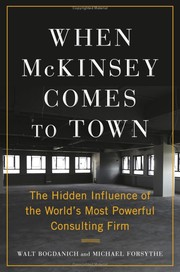
When McKinsey Comes to Town

When McKinsey Comes to Town

Walt Bogdanich, Michael Forsythe
2022
T3 624 pages · about 10h 24m to read Open Librarygoodreads

Investigative account of who pays for consulting advice.

Summary

Bogdanich and Forsythe, New York Times investigative reporters, examine McKinsey's work for specific clients and the consequences, based on internal documents, court filings and interviews with current and former partners.

The cases are the substance. The firm advised Purdue Pharma on increasing OxyContin sales, including proposals to target high-volume prescribers and to pay distributors rebates for overdoses, work for which McKinsey later paid nearly six hundred million dollars in settlements. It advised the Food and Drug Administration's drug division while also advising the pharmaceutical companies that division regulated. It advised Immigration and Customs Enforcement on detention cost reductions including cuts to food and medical care that the agency's own staff considered unsafe. It advised insurers including Allstate on claims handling in ways designed to reduce payouts to policyholders. It advised authoritarian governments including Saudi Arabia and China, in one case producing a report that identified critics of the Saudi government by name. It advised tobacco companies, coal producers and polluting industries while marketing its climate practice.

The institutional argument is that the firm's professed values and its actual conduct diverge, that the partnership's economics reward revenue generation, and that the confidentiality it maintains prevents any accountability for outcomes.

The book is adversarial and McKinsey has disputed characterisations of specific engagements. The documentary basis is strong and much of the Purdue material comes from litigation records. Read alongside Duff McDonald's more sympathetic institutional history.

Key takeaways 7

  1. McKinsey advised Purdue Pharma on increasing OxyContin sales, including targeting high-volume prescribers, and paid nearly six hundred million dollars in settlements.
  2. The firm advised the Food and Drug Administration's drug division while simultaneously advising the pharmaceutical companies that division regulated.
  3. Insurance claims handling advice was designed to reduce payouts to policyholders, which transferred value from claimants to the insurer client.
  4. The firm advises both polluting industries and climate initiatives, which it presents as serving all clients rather than as a conflict.
  5. Confidentiality prevents any external assessment of whether the firm's advice produced the outcomes claimed, which removes accountability entirely.
  6. Partnership economics reward revenue generation, which makes declining a lucrative engagement a personal cost to the partner who would decline it.
  7. Work for authoritarian governments included analysis that identified named critics of those governments, which the firm characterised as a routine social media study.

Who should read it

Directors and operators who buy consulting services and need the documented record of specific engagements and their consequences.

Similar books 6

Chosen by shared topics, the entries that hold them, and the people who recommended both.
Duff McDonald · 2013

How the modern consulting partnership was invented and priced.

Recommended by: Andrew Chen
Ethan M. Rasiel · 1999

The delivery method behind the fee.

Walter Kiechel · 2010

How BCG, Bain and McKinsey created the market for strategy itself.
David H. Maister · 1993

How firms that sell expertise set their ratio of juniors to partners, and price.
Alan Weiss · 1992

Value pricing for solo and boutique consultancies.

Recommended by: Nat Eliason, Noah Kagan

Where it sits in the reference 5

Companies
Business models
Business themes
Industries
Business themes

Topics

Company HistoriesBusiness and Management