Updates

  1. Person pages list letters, writing, profiles and links as sortable tables with filters, and show each person's companies as links; Fund letters show each letter's description in its own column.
  2. Experts show a checked job title and a short description of each person; 30 more people have photographs.
  3. Every company, fund, university and publication the experts work for has a page listing the people there.
  4. Fund letters show each letter's thesis and filter by it; 225 person pages list the essays, columns and newsletter issues the person wrote.
  5. Person pages list every essay and newsletter issue a person wrote, and their own books as a table in List view.
  6. Recommends shows the five largest kinds of book and the rest under More; browse pictures load sooner.
  7. Podcasts and talks link the original episode, filter by Audio and video or Press, and list each publisher once.
  8. Pages are wider, Recommends has List and Grid, and a filter clicked again turns off.
  9. Book cards sit in a ruled grid with Open Library and Goodreads links and each book's one-line note.
  10. Funds is now Investors; each investor's styles are buttons that filter the table.
  11. Podcasts and talks on a person's page filter by year and publisher and show as a list or a grid of pictures.
  12. Quotes show only people's own words: 472 summaries written by list sites are gone.
  13. Country pages open from Browse again, and every link on the shelf lands on a page.
  14. Subject and person pages show their sections as tabs, and each book appears once on a person's page.
  15. Book cards show the quote, who said it and the source; grids show five cards to a row.
  16. On a phone, a menu holds the sections, search, Updates, Feedback and dark mode.
  17. Feedback takes a screenshot of the page with no browser prompt, opens a screenshot full size when you click it, and clears itself once sent.
  18. Book cards are centred, search names the topic each book sits in, and any text cut short shows whole on hover.
  19. Search groups its results by kind: people, companies, geographies, subjects, topics, books, funds, fund letters and papers.
  20. The Books table lists who recommended each book by name, and the browser tab names the section you are in.
  21. Feedback can take a screenshot of the page, or one you paste or choose, and opens in the corner beside Updates.
  22. Each rail button reopens its section where you left it, and Browse, Table and People show on every book and subject page.
  23. Filters grey out choices that hold nothing instead of hiding them, and Books › People filters by authors or recommenders.
  24. Feedback takes a subject line and up to three screenshots.
  25. Biographies are grouped by the person they are about: 41 new pages, from Abraham Lincoln to Lee Kuan Yew.
  26. Sport splits into 23 sports, and Religion into one topic per faith.
  27. Book lists show as cards: the cover, one recommendation quote and every recommender by name.
  28. Seventeen subjects that had two or three pages under different names now have one page each.
  29. Every page lists its Experts as authors and recommenders, with a link to them on the Experts tab.
  30. Economics, Financial history, Financial panics and Accounting are subjects of their own, with one page per financial crisis.
  31. Book, person and subject pages open inside the app, so the tabs stay in view.
  32. 996 more book covers, and photographs or logos for 227 more people and companies.
  33. Books › Browse shows every subject as cards, and the rail holds Fund letters, Papers, Experts, Books and Funds.
  34. Every topic over 150 books splits into narrower topics, each with a page of its own.

Send feedback

What is it?
Screenshots, up to 3 (optional)
or paste one with Ctrl+V

We use your email only to reply to you.

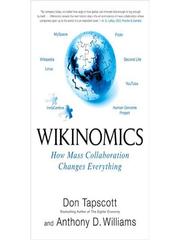
Wikinomics

Wikinomics

Don Tapscott, Anthony D. Williams
2006
T3 324 pages · about 5h 24m to read Open Librarygoodreads

Summary

Tapscott and Williams argue that falling coordination costs allow large numbers of people outside a firm to collaborate on work that firms previously did internally, and that companies which organise for this outperform those that do not. They name four principles: being open, peering, sharing and acting globally.

The cases are the substance. Goldcorp published its geological data on the internet and offered prize money for identifying drilling targets, which produced discoveries its own geologists had missed. InnoCentive posted research problems from corporate laboratories and paid outside solvers, many of whom came from adjacent disciplines. Linux and Wikipedia illustrate peer production without price signals or managerial direction. Boeing's 787 programme is presented as distributed design across partner firms. Procter and Gamble's Connect and Develop programme sourced a growing share of innovation externally. The authors also cover what they call prosumers, meaning customers who modify and extend products, and ideagoras, meaning markets for problems and solutions.

The theoretical claim rests on Coase's account of the firm: firms exist because internal coordination is cheaper than market transactions, so falling transaction costs should shrink firm boundaries and increase outsourced collaboration.

The book is heavily promotional in tone and selects successful cases without examining failures. Several examples aged badly, most notably Boeing's 787, where distributed design produced years of delay and billions in overruns. The broader prediction that peer production would displace firm-based production has not happened at the scale claimed. What did happen instead, the concentration of platform power in a small number of companies that capture the value of user contributions, is largely absent from the analysis.

Key takeaways 7

  1. Falling coordination costs move the boundary of the firm outward, so work previously done internally can be sourced from outside contributors.
  2. Publishing proprietary data can produce more value than protecting it when outside solvers hold knowledge the firm lacks.
  3. Problems posted to open markets are often solved by people from adjacent disciplines rather than by specialists in the field.
  4. Peer production communities coordinate large complex projects without prices or managerial authority.
  5. Companies should measure the share of innovation sourced externally and treat internal research as one option among several.
  6. Customers who modify products are a source of product development, and firms that suppress them lose that contribution.
  7. Distributing design work across partner firms creates integration risk that the coordination savings may not cover.

Who should read it

Executives considering open innovation or external collaboration who should read the cases critically, since the failures are omitted.

About Don Tapscott

Canadian business author and consultant, co-founder of the Blockchain Research Institute, who wrote The Digital Economy and Wikinomics.

The Digital Economy set out early how networks would redraw firm boundaries, and Wikinomics documented mass collaboration - open source, peer production, crowdsourced research - as a working production model rather than a curiosity. Blockchain Revolution extends the argument to distributed ledgers and their business applications.

Blockchain Research Institute

Who recommended it 1

Ryan Holidayreported

Similar books 6

Chosen by shared topics, the entries that hold them, and the people who recommended both.
Stan Davis, Bill Davidson · 1991

Recommended by: Mohnish Pabrai

Joe Weinman · 2012

The maths of pay-per-use versus owned capacity.

Where it sits in the reference 3

Strategists
Business themes
Business themes

Topics

Technology and ComputingBusiness and ManagementTech strategy and platform economics