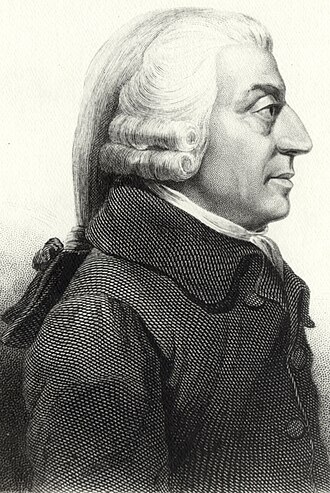
Adam Smith
Wrote The Theory of Moral Sentiments (1759) and The Wealth of Nations (1776), the book that began modern economics as a discipline; a figure of the Scottish Enlightenment. The Wealth of Nations set out how division of labour, self-interest and competitive prices coordinate production without central direction, and it supplies the vocabulary economics still argues in: specialisation, capital accumulation, natural and market price. The Theory of Moral Sentiments supplies the other half, placing exchange inside a system of sympathy and judgement.
 University of Glasgow
Start here
- The Wealth of NationsAdam Smith, 1776
- The Theory of Moral SentimentsAdam Smith, 1759
How the division of labour and free markets make a nation rich.
“In The Wealth of Nations (published in 1776) Smith noted that land prices had risen in recent decades, as interest rates declined.” — Howard Marks
Source: Easy Money
Recommended by: Howard Marks, John C. Bogle and 11 others
How moral judgement grows from sympathy and an imagined impartial spectator.
“Years before he wrote The Wealth of Nations, extolling the virtues of the invisible hand of competition and the essential nature of personal advantage and self-love in making the world’s economic system work, Adam Smith wrote The Theory of Moral Sentiments.” — John C. Bogle
Source: Business as a Calling, page 4
Recommended by: John C. Bogle, Mohnish Pabrai
Books One to Three: division of labour, money, prices, wages, profit and capital.
“Adam Smith, An Inquiry into the Nature and Causes of the Wealth of Nations (London: W. Strahan and T. Cadell, 1776)” — Michael Mauboussin
Source: Increasing Returns: Identifying Forms of Increasing Returns and What Drives Them, page 15
Recommended by: Michael Mauboussin, Mohnish Pabrai and 1 other
Books Four and Five: the case against mercantilism, and the role of the state.
Recommended by: Mohnish Pabrai
 The Wealth of Nations | How the division of labour and free markets make a nation rich. | 1776 | T1 | Howard Marks, John C. Bogle, Michael Mauboussin and 10 others |
 The Theory of Moral Sentiments | How moral judgement grows from sympathy and an imagined impartial spectator. | 1759 | T1 | John C. Bogle, Mohnish Pabrai |
 An Inquiry into the Nature and Causes of the Wealth of Nations: Volume 1 | Books One to Three: division of labour, money, prices, wages, profit and capital. | 2015 | T1 | Michael Mauboussin, Mohnish Pabrai, William J. Bernstein |
 An Inquiry into the Nature and Causes of the Wealth of Nations: Volume 2 | Books Four and Five: the case against mercantilism, and the role of the state. | 2015 | T1 | Mohnish Pabrai |
| Essays on philosophical subjects | – | 1795 | – | |
| Lectures on rhetoric and belles lettres | – | 1963 | – | |
| The correspondence of Adam Smith | – | 1977 | – | |
| Lectures on jurisprudence | – | 1978 | – |