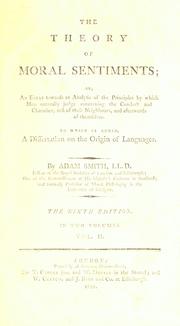
The Theory of Moral Sentiments
How moral judgement grows from sympathy and an imagined impartial spectator.
Summary
Smith published this seventeen years before The Wealth of Nations, and it was the work he revised throughout his life, producing a substantially altered sixth edition in 1790. It is a treatise on the origin of moral judgement.
The foundation is sympathy, which Smith uses to mean the capacity to imagine oneself in another's situation and to feel a corresponding sentiment. We judge others by asking whether we could enter into their feelings given their circumstances, and we judge ourselves by imagining how a disinterested observer would view our conduct. Smith calls this observer the impartial spectator, and it develops through social experience rather than existing prior to it. Moral rules are generalisations formed from many such judgements, not deductions from principle.
He distinguishes propriety, meaning whether a sentiment fits its object, from merit, meaning whether an action deserves reward. He argues that we sympathise more readily with joy than with sorrow, and more readily with the rich than with the poor, and he treats this as a moral corruption rather than a neutral fact. That argument, which he strengthened in the final edition, holds that admiration for wealth and greatness undermines moral judgement even though it also sustains social order.
The relationship between this book and The Wealth of Nations was long treated as a contradiction, the so-called Adam Smith problem, on the grounds that one rests on sympathy and the other on self-interest. Modern scholarship rejects that reading and treats them as complementary: self-interest operates within a framework of judgement and justice that this book describes. The prose is eighteenth century and demanding, and the psychology is introspective rather than empirical, though experimental work on perspective-taking has been broadly consistent with it.
Key takeaways 7
- Moral judgement originates in the imaginative act of placing oneself in another person's situation.
- We judge our own conduct by imagining an impartial spectator, and conscience is that internalised observer.
- General moral rules are induced from accumulated particular judgements rather than deduced from first principles.
- People sympathise more easily with the rich and successful than with the poor, and this corrupts moral judgement.
- The desire for approval, not the desire for wealth itself, drives most economic striving.
- Justice differs from the other virtues because society can survive without benevolence but not without justice.
- Self-interest in commerce operates inside a framework of mutual judgement, which is why the two Smith books do not contradict each other.
Who should read it
Readers who want the moral psychology underlying Smith's economics, and anyone thinking seriously about status, approval and why people work.
About Adam Smith
Scottish moral philosopher at the University of Glasgow who founded modern economics with The Wealth of Nations in 1776.
The Wealth of Nations set out how division of labour, self-interest and competitive prices coordinate production without central direction, and it supplies the vocabulary economics still argues in: specialisation, capital accumulation, natural and market price. The Theory of Moral Sentiments supplies the other half, placing exchange inside a system of sympathy and judgement.
Who recommended it 2 · 2 direct
“Years before he wrote The Wealth of Nations, extolling the virtues of the invisible hand of competition and the essential nature of personal advantage and self-love in making the world’s economic system work, Adam Smith wrote The Theory of Moral Sentiments.”
Similar books 6
Chosen by shared topics, the entries that hold them, and the people who recommended both.
Books One to Three: division of labour, money, prices, wages, profit and capital.
“Adam Smith, An Inquiry into the Nature and Causes of the Wealth of Nations (London: W. Strahan and T. Cadell, 1776)” — Michael Mauboussin
Source: Increasing Returns: Identifying Forms of Increasing Returns and What Drives Them, page 15
Recommended by: Michael Mauboussin, Mohnish Pabrai and 1 other
Books Four and Five: the case against mercantilism, and the role of the state.
Recommended by: Mohnish Pabrai
How the division of labour and free markets make a nation rich.
“In The Wealth of Nations (published in 1776) Smith noted that land prices had risen in recent decades, as interest rates declined.” — Howard Marks
Source: Easy Money
Recommended by: Howard Marks, John C. Bogle and 11 others
Essays on the Versailles treaty, the gold standard and Britain's currency.
Recommended by: Mohnish Pabrai, Warren Buffett
Capitalism runs on creative destruction, and its success may lead it to socialism.
“Joseph A Schumpeter, Capitalism, Socialism and Democracy (New York: Harper & Row, 1942)” — Michael Mauboussin
Source: Why Corporate Longevity Matters: What Index Turnover Tells Us about Corporate Results, page 14
Recommended by: Jim Collins, Michael Mauboussin, Li Lu
The first full Austrian school treatise on economics, built from individual action.
Recommended by: Charles Koch
Where it sits in the reference 2
Topics 3
As an Amazon Associate I earn from qualifying purchases.