William Poundstone
American author, columnist and skeptic who wrote the Big Secrets series and a biography of Carl Sagan. Fortune's Formula traces the Kelly criterion from Bell Labs information theory to Ed Thorp's blackjack and hedge-fund bet sizing, and it remains the standard entry point to position sizing under an edge. Priceless collects the experimental work on how buyers anchor and compare prices, which transfers straight into pricing decisions.
Start here
- Fortune's Formula: The Untold Story of the Scientific Betting System That Beat the Casinos and Wall StreetWilliam Poundstone, 2005
- PricelessWilliam Poundstone, 2010
- Prisoner's DilemmaWilliam Poundstone, 1992
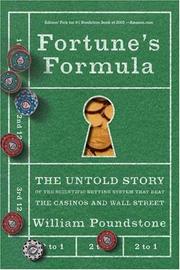
The Kelly criterion for sizing bets, from Bell Labs to casinos and hedge funds.
“For a less technical discussion, see William Poundstone, Fortune’s Formula: The Untold Story of the Scientific Betting System that Beat the Casinos and Wall Street (New York: Hill and Wang, 2005), 197-201” — Michael Mauboussin
Source: Thoughts on Dividends and Buybacks: Clearing Up Some Common Misconceptions, page 10
Recommended by: Michael Mauboussin, Mohnish Pabrai
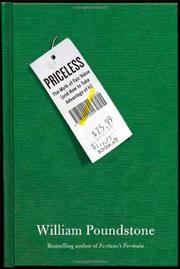
People have no fixed sense of value, so context and anchors set the prices they pay.
“For a good popular treatment of this topic, see William Poundstone, Priceless: The Myth of Fair Value (and How to Take Advantage of It) (New York: Hill and Wang” — Michael Mauboussin
Source: Blaming the Rat: Incentives, Motivation, and How They Interact, page 14
Recommended by: Michael Mauboussin, Mohnish Pabrai and 1 other
Von Neumann, game theory and the prisoner's dilemma in nuclear strategy.
“For international relations, see William Poundstone, Prisoner’s Dilemma (New York: Doubleday, 1992)” — Michael Mauboussin
Source: The Colonel Blotto Game: Transitivity and How to Win When You’re an Underdog, page 8
Recommended by: Michael Mauboussin
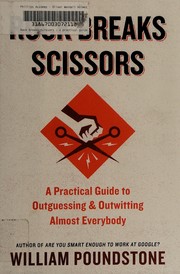
People can't act randomly, and how to exploit that in games, tests and markets.
Recommended by: Mohnish Pabrai
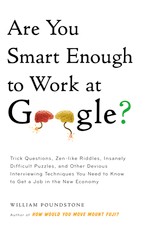
Tech firms' puzzle interview questions, and whether they pick good hires.
Recommended by: Sophie Bakalar
cosmic complexity and the limits of scientific knowledge
paradox, puzzles, and the frailty of knowledge
the uncensored truth about all sorts of stuff you are never supposed to know
Microsoft's Cult of the Puzzle -- How the World's Smartest Companies Select the Most Creative Thinkers
more than 125 things they prayed you'd never find out
more uncensored truth about all sorts of stuff you are never supposed to know
Why Elections Aren't Fair (and What We Can Do About It)
 Fortune's Formula: The Untold Story of the Scientific Betting System That Beat the Casinos and Wall Street | The Kelly criterion for sizing bets, from Bell Labs to casinos and hedge funds. | 2005 | T2 | Michael Mauboussin, Mohnish Pabrai |
 Priceless | People have no fixed sense of value, so context and anchors set the prices they pay. | 2010 | T2 | Michael Mauboussin, Mohnish Pabrai, Patrick O'Shaughnessy |
 Prisoner's Dilemma | Von Neumann, game theory and the prisoner's dilemma in nuclear strategy. | 1992 | T2 | Michael Mauboussin |
 Rock Breaks Scissors: A Practical Guide to Outguessing and Outwitting Almost Everybody | People can't act randomly, and how to exploit that in games, tests and markets. | 2014 | T2 | Mohnish Pabrai |
 Are You Smart Enough to Work at Google? | Tech firms' puzzle interview questions, and whether they pick good hires. | 2012 | T2 | Sophie Bakalar |
| How Do You Fight a Horse-Sized Duck? | – | 2021 | – | |
| The recursive universe | cosmic complexity and the limits of scientific knowledge | 1985 | – | |
| Labyrinths of reason | paradox, puzzles, and the frailty of knowledge | 1988 | – | |
| Big secrets | the uncensored truth about all sorts of stuff you are never supposed to know | 1983 | – | |
| How would you move Mount Fuji? | Microsoft's Cult of the Puzzle -- How the World's Smartest Companies Select the Most Creative Thinkers | 2003 | – | |
| Head in the cloud | – | 2016 | – | |
| Carl Sagan | a life in the cosmos | 1999 | – | |
| Bigger Secrets | more than 125 things they prayed you'd never find out | 1986 | – | |
| Doomsday Calculation | – | 2019 | – | |
| Biggest secrets | more uncensored truth about all sorts of stuff you are never supposed to know | 1993 | – | |
| Gaming the Vote | Why Elections Aren't Fair (and What We Can Do About It) | 2008 | – | |
| Are You Smart Enough to Work For Google? | – | 2012 | – |
| Interview: William Poundstone, author of Priceless, on anchoring, fairness, and the myth of “fair value” | Behavioral Science For Brands: Leveraging behavioral science in brand marketing. | 2025-10-08 | 49 min | In this episode, we talk with William Poundstone, author of Priceless, about how pricing psychology shapes behavior. From anchoring and fairness to flat-rate bias, we explore how marketers can use behavioral science to influence value perception and drive smarter pricing decisions. |
| #045 - William Poundstone (Priceless: The Myth of Fair Value and How to Take Advantage of It) | True Stories Never Die w/ Mike Fallat | 2023-12-06 | 42 min | Mike interviews William Poundstone. In this episode, we're exploring the eye-opening book, "Priceless: The Myth of Fair Value (and How to Take Advantage of It)," authored by William Poundstone. This enlightening book challenges our perceptions of value, unraveling the complex web of influences that shape our understanding of fair pricing and providing insights on how to navigate this intricate landscape. Our podcast journey begins with an exploration of the author's motivations and the fascinating premise behind "Priceless." William peels back the layers of consumer psychology and economic principles, exposing the myths surrounding the concept of fair value. The book becomes a guide, offering listeners the tools to recognize and navigate the psychological traps that influence our perceptions of pricing and value. The heart of our conversation delves into the key themes presented in "Priceless." We'll explore the psychological mechanisms at play when we make purchasing decisions and how businesses strategically leverage these factors to influence our perceptions of fairness. The book becomes a lens through which we can understand the intricacies of pricing, from the art of anchoring to the impact of contextual cues on our willingness to pay. Our discussion will also touch on the practical applications of the insights provided in the book. |
| The Pitfalls of Pricing with Author, William Poundstone | RESTAURANT STRATEGY | 2023-09-25 | 57 min | 275 - The Pitfalls of Pricing with Author, William Poundstone ***** This week's episode is brought to you by: MARGIN EDGE Take control of your costs with using MarginEdge. Best of all? No contract. No setup fee. Free and unlimited training and support. VISIT : marginedge.com/chip ***** This week's episode is brought to you by: 7SHIFTS 7shifts is the team management platform for restaurants. From hiring, to scheduling, training and retaining, they’ve got the tools you need to help you run your business with ease. Better understand your restaurant, hit your labor targets, and keep your entire team connected. Plus, 7shifts integrates with POS and payroll systems you already use and trust! Join over 30,000 restaurants using 7shifts today. Restaurant Strategy listeners get 3 months free. VISIT: https://www.7shifts.com/restaurantstrategy ***** William Poundstone is a prolific writer and journalist who wrote a book called Priceless over a decade ago... and it still still impacting the business world to this day. While others discovered the book many moons ago, I only just read it this past summer. And the first thing I did when I closed the book for the last time? I reached out to William to see if he would come onto the podcast to chat about his work. This week's interview is absolutely invaluable to anyone who sells things to people... meaning, all of us! |
| Can we really predict when doomsday will happen? – William Poundstone | Instant Genius | 2019-06-05 | 39 min | In this episode of the Science Focus Podcast, we’re going to try to guess when the end of the world will happen. Don’t worry, it’s not as gloomy as it might sound. Those people waving ‘The End is Nigh!’ placards are probably completely wrong about an immanent doomsday… Probably. There is a formula that has circulated for the last 50 years which suggests we can pinpoint the end of something with a reasonable amount of certainty. It has been used to predict any number of things, including successful stock market investments, the run of Broadway shows and even how many Harry Potter books go missing from local libraries. But since the 1990s, it has sparked considerable debate among theorists about when humanity as we know it will come to an end. We ask William Poundstone - whose new book How To Predict Everything (£12.99, Oneworld) explains the history of this enigmatic equation - how long we have left as a species on this planet, whether we can shift the odds in our favour, and how we can predict, well, pretty much everything else. How long do you think we have left, and why? Let us know on Twitter at @sciencefocus, and don’t forget to rate and review us wherever you listen to your podcasts. Listen to more episodes of the Science Focus Podcast : What if the Earth’s magnetic field died? – Jim Al-Khalili How can we save our planet? |
| AMA 180 - Why Knowing Things Still Matters When Facts Are So Easy to Look Up with William Poundstone | American Monetary Association | 2017-07-08 | 24 min | For this 10th Episode, Jason goes off topic and welcomes William Poundstone, author of the new book, Head in the Cloud: Why Knowing Things Still Matters When Facts are So Easy to Look Up. Mr. Poundstone is also the author of the New York Times best-selling books, Fortune's Formula: The Untold Story of Scientific Betting System that Beat the Casinos and Wall Street, Priceless: The Myth of Fair Value and How to Take Advantage of It and Gaming the Vote: Why Elections Aren't Fair and What We Can Do About it. Key Takeaways: [1:12] William explains the premise of his latest book, Head in the Cloud. [5:03] Having a general knowledge of baseline facts and the Dunning-Kruger effect have humbling assets. [7:28] The larger a person's vocabulary is akin to their ability to think. [11:12] How does America stack up on the map of ignorance? [13:43] Americans will vote for judges with less ethnic sounding names if they don't know the candidates. [19:51] The Kelly Formula informs a user of the optimal amount you should be putting on each bet or investment. Website: www.William-Poundstone.com |
| CW 840 - William Poundstone - Head in the Cloud, Why Knowing Things Still Matters When Facts Are So Easy to Look Up & Fortune's Formula | Creating Wealth Real Estate Investing with Jason Hartman | 2017-06-08 | 40 min | Jason is in the big apple, New York City, for this 10th episode show. He is definitely not looking for income properties as the Hartman Risk Evaluator said there were no good rent-to-value ratios to be found there. Jason's welcomes author William Poundstone to tell us about his new book, Head in the Cloud: Why Knowing Things Still Matters When Facts are So Easy to Look Up . Mr. Poundstone is also the author of the New York Times best-selling books, Fortune's Formula: The Untold Story of Scientific Betting System that Beat the Casinos and Wall Street , Priceless: The Myth of Fair Value and How to Take Advantage of It and Gaming the Vote: Why Elections Aren't Fair and What We Can Do About it . Key Takeaways: [04:11] Income property is the 'ideal' multi-dimensional asset class but there are others. [07:28] Corporate raiders would creatively acquire a company and part it out akin to income property investors today. [12:29] The upcoming Venture Alliance Mastermind in Chicago includes an appearance by Mish Shedlock. William Poundstone Interview: [17:22] William explains the premise of his latest book, Head in the Cloud . [21:13] Having a general knowledge of baseline facts and the Dunning-Kruger effect have humbling assets. [23:38] The larger a person's vocabulary is akin to their ability to think. [27:22] How does America stack up on the map of ignorance? [29:53] Americans will vote for judges with less ethnic sounding names if they don't know the candidates. |
| YW 106 - Why Knowing Things Still Matters When Facts Are So Easy to Look Up with William Poundstone | Young Wealth by The Jason Hartman Foundation | 2016-12-02 | 22 min | William Poundstone is the author of fourteen books, including Big Secrets, Prisoner's Dilemma, Fortune's Formula, and Are You Smart Enough to Work at Google? He has written for The New York Times, Harper's, Harvard Business Review, and the Village Voice, among other publications, and has adapted several of his books for ABC television. He is on the board of advisors of the Center for Election Science. Poundstone was born in Morgantown, West Virginia, and studied physics at MIT. His writing often explores the social implications of scientific or philosophic ideas—from voting methods (Gaming the Vote) to competition and cooperation (Prisoner's Dilemma) to the gambling system known as the Kelly criterion (Fortune's Formula). Amazon rated Fortune's Formula the #1 Editor's Pick for nonfiction in 2005. Poundstone won the NYSSCPA's Excellence in Financial Journalism Award in 2011. Key Takeaways: [2:15] What the American public knows and what that says about us [4:40] Why some things are just worth knowing even though you could look them up [8:35] The correlation between vocabulary and your success in life [13:00] How many elected officials most people actually know [16:25] How little we're teaching kids about sex and what impact that's having [18:56] The theory of scientific betting and how to properly use it Website Mentioned: www.william-poundstone.com |
| 039: Knowing What You Don’t Know with William Poundstone | How to Be Awesome at Your Job | 2016-07-22 | 32 min | Author William Poundstone discusses the importance of knowledge in your head the modern era. You’ll learn: 1. Why it’s important to still have general knowledge in the era of Google 2. Why those who listen to podcasts tend to be the most informed people of all 😉 3. It’s nearly impossible for humans to be unpredictable. About William William Poundstone is the author of 15 books, including Fortune’s Formula , which was named Amazon Editors’ pick for #1 Nonfiction Book of the year. He has written for The New York Times Book Review, Village Voice, Esquire, Harpers, The Believer, The Economist, and Harvard Business Review . Poundstone lives in Los Angeles. Items mentioned in the show: William’s latest book Head in the Cloud and Rock Breaks Scissors Dunning Kruger Effect The Confidence Man by Herman Melville Wizard For Statistics William’s Website View transcript, show notes, and links at https://awesomeatyourjob.com/ep39 See Privacy Policy at https://art19.com/privacy and California Privacy Notice at https://art19.com/privacy#do-not-sell-my-info . |
| 50 William Poundstone - Understanding Randomness | Inquiring Minds | 2014-09-05 | 53 min | On the show this week we talk about randomness with science writer William Poundstone, author of the new book Rock Breaks Scissors. Poundstone explains why we’re so terrible at trying to come up with random sequences ourselves—and how understanding these pitfalls can actually help you predict, with accuracy above chance, what someone else is going to do even when he or she is trying, purposefully, to act randomly. These predictions are at the core of Poundstone's book, which offers a practical guide to outguessing and outwitting almost anybody—in activities ranging from Rock, Paper, Scissors (men tend to go with rock, so you can beat them with paper) to investing in stocks. On the show this week we also talk about researchers who are growing mushrooms on diapers to help them biodegrade and Chris disagrees with Neil deGrasse Tyson about something (but still loves him). iTunes: itunes.apple.com/us/podcast/inquiring-minds/id711675943 RSS: feeds.feedburner.com/inquiring-minds Stitcher: stitcher.com/podcast/inquiring-minds Support the show: https://www.patreon.com/inquiringminds Hosted by Simplecast, an AdsWizz company. See pcm.adswizz.com for information about our collection and use of personal data for advertising. |
| Ep. 254: William Poundstone Interview with Michael Covel on Trend Following Radio | Michael Covel's Trend Following | 2014-07-06 | 37 min | My guest today is William Poundstone, an American author, columnist, and skeptic. He has written a number of books including the Big Secrets series and a biography of Carl Sagan. The topic is his book Fortune's Formula: The Untold Story of the Scientific Betting System That Beat the Casinos and Wall Street. In this episode of Trend Following Radio we discuss: Claude Shannon The connection between Al Capone The Kelly formula, bookmaking, and the telephone industry Bell Labs and information theory Why, when betting, if there's a small chance of losing everything, you will eventually lose everything Criticisms of the Kelly criterion Ed Thorp, blackjack, and card counting Long-Term Capital Management Martingale vs. Kelly Early development of the Black-Scholes formula Jump in! --- I'm MICHAEL COVEL, the host of TREND FOLLOWING RADIO, and I'm proud to have delivered 10+ million podcast listens since 2012. Investments, economics, psychology, politics, decision-making, human behavior, entrepreneurship and trend following are all passionately explored and debated on my show. To start? I'd like to give you a great piece of advice you can use in your life and trading journey… cut your losses! You will find much more about that philosophy here: https://www.trendfollowing.com/trend/ You can watch a free video here: https://www.trendfollowing.com/video/ Can't get enough of this episode? |
| Interview: William Pound-stone, author of Priceless | The Consumer Behavior Lab | |||
| Are You Smart Enough to Work at Google?: Trick… by William Poundstone · Audiobook preview | Google Play Books | |||
| Michael Shermer with William Poundstone — The Doomsday Calculation (SCIENCE SALON # 76) | Skeptic | |||
| Menu Psych - William Poundstone | Macmillan Publishers |
 BInterview: William Poundstone, author of Priceless, on anchoring, fairness, and the myth of “fair value”Behavioral Science For Brands: Leveraging behavioral science in brand marketing. · 2025-10-08
 T#045 - William Poundstone (Priceless: The Myth of Fair Value and How to Take Advantage of It)True Stories Never Die w/ Mike Fallat · 2023-12-06
 RThe Pitfalls of Pricing with Author, William PoundstoneRESTAURANT STRATEGY · 2023-09-25
 ICan we really predict when doomsday will happen? – William PoundstoneInstant Genius · 2019-06-05
 AAMA 180 - Why Knowing Things Still Matters When Facts Are So Easy to Look Up with William PoundstoneAmerican Monetary Association · 2017-07-08
 CCW 840 - William Poundstone - Head in the Cloud, Why Knowing Things Still Matters When Facts Are So Easy to Look Up & Fortune's FormulaCreating Wealth Real Estate Investing with Jason Hartman · 2017-06-08
 YYW 106 - Why Knowing Things Still Matters When Facts Are So Easy to Look Up with William PoundstoneYoung Wealth by The Jason Hartman Foundation · 2016-12-02
 H039: Knowing What You Don’t Know with William PoundstoneHow to Be Awesome at Your Job · 2016-07-22
 I50 William Poundstone - Understanding RandomnessInquiring Minds · 2014-09-05
 MEp. 254: William Poundstone Interview with Michael Covel on Trend Following RadioMichael Covel's Trend Following · 2014-07-06
 TInterview: William Pound-stone, author of PricelessThe Consumer Behavior Lab
 GAre You Smart Enough to Work at Google?: Trick… by William Poundstone · Audiobook previewGoogle Play Books
 SMichael Shermer with William Poundstone — The Doomsday Calculation (SCIENCE SALON # 76)Skeptic
 MMenu Psych - William PoundstoneMacmillan Publishers