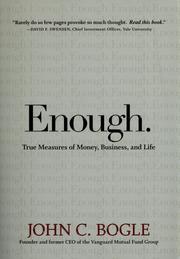
Enough: True Measures of Money, Business, and Life
Summary
Bogle wrote this after a heart transplant and in the aftermath of the financial crisis, and it is his most personal book. Its organising idea comes from a story about Kurt Vonnegut and Joseph Heller, in which Heller observes that he has something a wealthy host will never have, which is the knowledge of what is enough.
The book is structured as eight chapters, each contrasting a false measure with a true one. Too much cost and not enough value, which restates his fee argument. Too much speculation and not enough investment, which distinguishes earning returns from businesses versus from other participants. Too much complexity and not enough simplicity. Too much counting and not enough trust, which argues that finance has come to measure what is countable while the things that determine outcomes are not. Too much business conduct and not enough professional conduct, which argues that finance abandoned professional obligations for commercial ones. Too much salesmanship and not enough stewardship. Too much focus on things and not enough on commitment. And not enough of the values of the founding generation of American finance.
The argument about the financial sector's aggregate cost is the substantive core: Bogle calculates the total amount extracted by financial intermediaries annually and argues it exceeds the value they add, so the sector's growth represents a transfer from investors rather than a service.
The book is a personal statement rather than an analytical work, and it repeats material from his other books. Its distinctive contribution is the aggregate cost calculation and the argument that finance stopped being a profession.
Key takeaways 7
- The financial sector extracts more in aggregate annual costs than the value it adds, which makes its growth a transfer from investors rather than a service.
- Speculation earns returns from other participants while investment earns them from businesses, and the two have been conflated to the industry's benefit.
- Finance measures what is countable while the outcomes that matter depend on trust and conduct that no measure captures.
- The industry abandoned professional obligations, in which the client's interest comes first, for commercial ones, in which the firm's revenue does.
- Complexity in financial products serves the seller by making comparison impossible, and simplicity is therefore an investor's interest.
- Marketing and asset gathering displaced stewardship as the organising activity of fund management once the firms became publicly owned.
- Knowing what is enough is a decision that must be made deliberately, because no amount of accumulation supplies the answer.
Who should read it
Investors who want Bogle's aggregate critique of the financial sector's cost, in his most personal statement of it.
About John C. Bogle
Founder and CEO, The Vanguard Group 1974-1996; creator of the first retail index mutual fund
He built the institution and wrote the primary-source case for low-cost indexing that every later index advocate builds on.
Where it sits in the reference 2
Who recommended it 1
Similar books 6
Chosen by shared topics, the entries that hold them, and the people who recommended both.