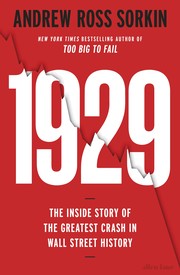
1929
The 1929 Wall Street crash: the greed and folly behind America's greatest collapse.
Summary
The reference has not verified this book in detail; the summary states only what the title, author and subject establish.
This is a 2025 book by Andrew Ross Sorkin, the New York Times financial columnist and author of Too Big to Fail, on the 1929 stock market crash. Sorkin's established method is narrative reconstruction of a financial crisis from interviews, archives and contemporaneous records, told through the decisions of named participants day by day, which is what he applied to the 2008 crisis in his previous book.
The reference has not yet verified the detail of this book's argument, sources or conclusions. Readers should confirm the specifics directly rather than rely on this entry. What the author and subject establish is the general shape: a reported, character-driven account of the events leading to October 1929 and their immediate aftermath, aimed at a general audience rather than at economists.
Key takeaways 6
- The book covers the 1929 stock market crash and the period leading to it.
- Sorkin works by narrative reconstruction from archival and contemporaneous sources, told through the decisions of named individuals.
- The intended audience is general readers rather than academic economists.
- The method is the one Sorkin applied to the 2008 crisis in Too Big to Fail, reconstructing events day by day through the participants.
- The reference has not verified the book's specific arguments or claims, and readers should check them directly.
- Readers wanting a verified account of 1929 should use Galbraith's The Great Crash 1929 or Allen's Only Yesterday alongside it.
Who should read it
Readers who want a narrative account of 1929, with the caveat that this reference has not yet verified the book's specific content.
About Andrew Ross Sorkin
New York Times columnist, founder and editor-at-large of DealBook; CNBC Squawk Box co-anchor
Too Big to Fail is the standard blow-by-blow reconstruction of the 2008 crisis and is cited across the crisis literature.
Who recommended it 2 · 2 direct
“The Lessons of 1929 The best investing book I’ve read in years, one that pulled me along from chapter to chapter, is 1929: Inside the Greatest Crash in Wall Street History – and How It Shattered a Nation, by Andrew Ross Sorkin.”
Similar books 6
Chosen by shared topics, the entries that hold them, and the people who recommended both.
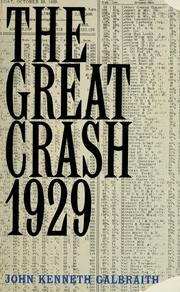
The late-1920s boom in margin loans and investment trusts, and the 1929 crash.
“One I haven’t mentioned since my memo The Long View in 2009 is the “bezzle,” a concept Galbraith introduced in his book The Great Crash 1929.” — Howard Marks
Source: Cockroaches in the Coal Mine
Recommended by: Howard Marks, Jeremy Grantham and 2 others
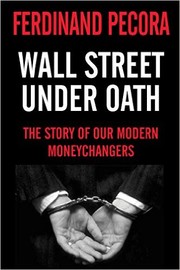
The 1933 Senate hearings exposing bankers' practices that led to securities laws.
“The combination of banking and investment banking under the same roof received a good part of the blame for the Great Crash (see one of my favorite books, Wall Street Under Oath by Ferdinand Pecora, 1939).” — Howard Marks
Source: The Long View, page 12
Recommended by: Howard Marks
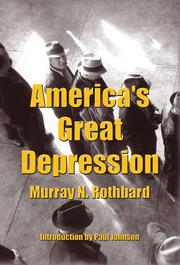
How a Fed credit boom led to the Depression, and how policy prolonged it.
“It's a timeless and timely classic.” — Christopher Bloomstran
Source: Semper Augustus 2020 Letter to Clients, 'To Read or Not to Read', p. 57
Recommended by: Christopher Bloomstran, Mohnish Pabrai
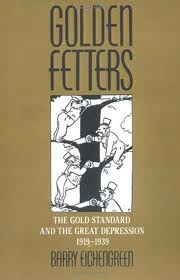
How the gold standard spread the Depression, and why leaving it early meant recovery.
“Eichengreen, Barry. Golden Fetters: The Gold Standard and the Great Depression, 1919–1939. New York: Oxford University Press, 1996” — Ray Dalio
Source: The Changing World Order — citations and bibliography, page 29
Recommended by: Ray Dalio
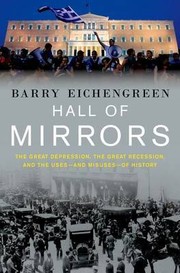
How 1930s lessons guided policy in 2008, averting a depression but adding errors.
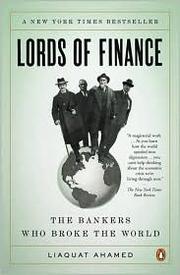
How four central bankers and the gold standard turned a slump into the Depression.
“I'm going to use "classic" again but rightfully so.” — Christopher Bloomstran
Source: Semper Augustus 2020 Letter to Clients, 'To Read or Not to Read', p. 57
Recommended by: Christopher Bloomstran, Mohnish Pabrai