Updates

  1. Person pages list letters, writing, profiles and links as sortable tables with filters, and show each person's companies as links; Fund letters show each letter's description in its own column.
  2. Experts show a checked job title and a short description of each person; 30 more people have photographs.
  3. Every company, fund, university and publication the experts work for has a page listing the people there.
  4. Fund letters show each letter's thesis and filter by it; 225 person pages list the essays, columns and newsletter issues the person wrote.
  5. Person pages list every essay and newsletter issue a person wrote, and their own books as a table in List view.
  6. Recommends shows the five largest kinds of book and the rest under More; browse pictures load sooner.
  7. Podcasts and talks link the original episode, filter by Audio and video or Press, and list each publisher once.
  8. Pages are wider, Recommends has List and Grid, and a filter clicked again turns off.
  9. Book cards sit in a ruled grid with Open Library and Goodreads links and each book's one-line note.
  10. Funds is now Investors; each investor's styles are buttons that filter the table.
  11. Podcasts and talks on a person's page filter by year and publisher and show as a list or a grid of pictures.
  12. Quotes show only people's own words: 472 summaries written by list sites are gone.
  13. Country pages open from Browse again, and every link on the shelf lands on a page.
  14. Subject and person pages show their sections as tabs, and each book appears once on a person's page.
  15. Book cards show the quote, who said it and the source; grids show five cards to a row.
  16. On a phone, a menu holds the sections, search, Updates, Feedback and dark mode.
  17. Feedback takes a screenshot of the page with no browser prompt, opens a screenshot full size when you click it, and clears itself once sent.
  18. Book cards are centred, search names the topic each book sits in, and any text cut short shows whole on hover.
  19. Search groups its results by kind: people, companies, geographies, subjects, topics, books, funds, fund letters and papers.
  20. The Books table lists who recommended each book by name, and the browser tab names the section you are in.
  21. Feedback can take a screenshot of the page, or one you paste or choose, and opens in the corner beside Updates.
  22. Each rail button reopens its section where you left it, and Browse, Table and People show on every book and subject page.
  23. Filters grey out choices that hold nothing instead of hiding them, and Books › People filters by authors or recommenders.
  24. Feedback takes a subject line and up to three screenshots.
  25. Biographies are grouped by the person they are about: 41 new pages, from Abraham Lincoln to Lee Kuan Yew.
  26. Sport splits into 23 sports, and Religion into one topic per faith.
  27. Book lists show as cards: the cover, one recommendation quote and every recommender by name.
  28. Seventeen subjects that had two or three pages under different names now have one page each.
  29. Every page lists its Experts as authors and recommenders, with a link to them on the Experts tab.
  30. Economics, Financial history, Financial panics and Accounting are subjects of their own, with one page per financial crisis.
  31. Book, person and subject pages open inside the app, so the tabs stay in view.
  32. 996 more book covers, and photographs or logos for 227 more people and companies.
  33. Books › Browse shows every subject as cards, and the rail holds Fund letters, Papers, Experts, Books and Funds.
  34. Every topic over 150 books splits into narrower topics, each with a page of its own.

Send feedback

What is it?
Screenshots, up to 3 (optional)
or paste one with Ctrl+V

We use your email only to reply to you.

Accounting for Growth

Accounting for Growth

Terry Smith
1992
T2 226 pages · about 3h 46m to read Open Librarygoodreads

Subtitled Stripping the Camouflage from Company Accounts; second edition 1996.

Summary

Terry Smith wrote this in 1992 while working as an analyst at UBS Phillips and Drew, cataloguing the accounting techniques British companies used to inflate reported profits. The firm dismissed him after its corporate clients objected, which made the book a bestseller.

The content is a systematic catalogue of twelve techniques and a scoring system applying them to large British companies. The techniques include pre-acquisition write-downs, where an acquirer takes provisions against the acquired business immediately so that future costs bypass the income statement; extraordinary and exceptional item classification, which removed costs from the earnings figure analysts used; capitalisation of interest and of development costs; the treatment of brands as balance sheet assets to support borrowing; off-balance-sheet finance through associates and joint ventures; contingent liabilities excluded from the accounts; changes in depreciation policy; currency mismatching; pension holidays taken when the fund was in surplus, which reduced the reported charge; disposals timed to produce gains; deferred consideration on acquisitions; and stock and work in progress valuation.

Smith scored companies on how many techniques they used, and published the list. Several of the companies scoring highest subsequently collapsed, which is what gave the book its reputation.

The specific techniques are largely obsolete. British accounting standards changed substantially through the 1990s, the Accounting Standards Board addressed most of what Smith identified, and the adoption of international standards changed the framework again. The general method, which is to compare reported profit against cash generation and to treat every discretionary accounting choice as a signal about management, transfers entirely and is what Smith went on to apply as a fund manager.

Key takeaways 7

  1. Companies used provisions taken against acquired businesses to move future operating costs off the income statement permanently.
  2. Classifying costs as extraordinary or exceptional removed them from the earnings figure the market used while the cash still left the business.
  3. Capitalising interest and development costs shifts current expenditure into future periods and inflates present profit.
  4. Pension contribution holidays taken during fund surpluses reduced reported costs without any change in the underlying obligation.
  5. Counting the number of aggressive accounting techniques a company uses is itself a predictor of subsequent trouble.
  6. Several companies scoring highest on the author's list collapsed within a few years of publication.
  7. The specific techniques have been closed by accounting standards, but the incentive that produced them has not changed.

Who should read it

Analysts and investors who want a documented catalogue of accounting manipulation and the scoring method that identified companies using it.

About Terry Smith

Founder and CEO, Fundsmith LLP 2010-present; previously CEO of Collins Stewart and Tullett Prebon

Accounting for Growth outlived its news cycle as a forensic-accounting primer, and the Fundsmith annual letters are a widely read quality-growth record.

Tullett Prebon, Collins Stewart

Similar books 6

Chosen by shared topics, the entries that hold them, and the people who recommended both.
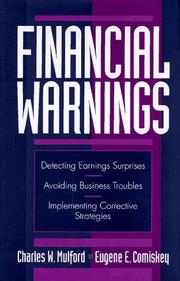
Charles W. Mulford, Eugene E. Comiskey · 2005

How operating cash flow itself gets dressed up.

Recommended by: Mohnish Pabrai
Howard M. Schilit, Jeremy Perler · 1993

The tricks companies use to inflate earnings, cash flow and key metrics, by case.

“Some of my favorites include Howard M. Schilit and Jeremy Perler, Financial Shenanigans” — Michael Mauboussin

Source: Thirty Years: Reflections on the Ten Attributes of Great Investors (Credit Suisse)

Recommended by: Michael Mauboussin, Anu Hariharan
Thornton L. O'glove · 1987

How to test whether reported earnings reflect reality, from tax books to receivables.

Charles W. Mulford, Eugene E. Comiskey · 2002
Terry Smith · 2020

Buy good companies, don't overpay, do nothing: Fundsmith's letters and columns.

Where it sits in the reference 2

Investors
Accounting

Topics

AccountingInvesting