Updates

  1. Person pages list letters, writing, profiles and links as sortable tables with filters, and show each person's companies as links; Fund letters show each letter's description in its own column.
  2. Experts show a checked job title and a short description of each person; 30 more people have photographs.
  3. Every company, fund, university and publication the experts work for has a page listing the people there.
  4. Fund letters show each letter's thesis and filter by it; 225 person pages list the essays, columns and newsletter issues the person wrote.
  5. Person pages list every essay and newsletter issue a person wrote, and their own books as a table in List view.
  6. Recommends shows the five largest kinds of book and the rest under More; browse pictures load sooner.
  7. Podcasts and talks link the original episode, filter by Audio and video or Press, and list each publisher once.
  8. Pages are wider, Recommends has List and Grid, and a filter clicked again turns off.
  9. Book cards sit in a ruled grid with Open Library and Goodreads links and each book's one-line note.
  10. Funds is now Investors; each investor's styles are buttons that filter the table.
  11. Podcasts and talks on a person's page filter by year and publisher and show as a list or a grid of pictures.
  12. Quotes show only people's own words: 472 summaries written by list sites are gone.
  13. Country pages open from Browse again, and every link on the shelf lands on a page.
  14. Subject and person pages show their sections as tabs, and each book appears once on a person's page.
  15. Book cards show the quote, who said it and the source; grids show five cards to a row.
  16. On a phone, a menu holds the sections, search, Updates, Feedback and dark mode.
  17. Feedback takes a screenshot of the page with no browser prompt, opens a screenshot full size when you click it, and clears itself once sent.
  18. Book cards are centred, search names the topic each book sits in, and any text cut short shows whole on hover.
  19. Search groups its results by kind: people, companies, geographies, subjects, topics, books, funds, fund letters and papers.
  20. The Books table lists who recommended each book by name, and the browser tab names the section you are in.
  21. Feedback can take a screenshot of the page, or one you paste or choose, and opens in the corner beside Updates.
  22. Each rail button reopens its section where you left it, and Browse, Table and People show on every book and subject page.
  23. Filters grey out choices that hold nothing instead of hiding them, and Books › People filters by authors or recommenders.
  24. Feedback takes a subject line and up to three screenshots.
  25. Biographies are grouped by the person they are about: 41 new pages, from Abraham Lincoln to Lee Kuan Yew.
  26. Sport splits into 23 sports, and Religion into one topic per faith.
  27. Book lists show as cards: the cover, one recommendation quote and every recommender by name.
  28. Seventeen subjects that had two or three pages under different names now have one page each.
  29. Every page lists its Experts as authors and recommenders, with a link to them on the Experts tab.
  30. Economics, Financial history, Financial panics and Accounting are subjects of their own, with one page per financial crisis.
  31. Book, person and subject pages open inside the app, so the tabs stay in view.
  32. 996 more book covers, and photographs or logos for 227 more people and companies.
  33. Books › Browse shows every subject as cards, and the rail holds Fund letters, Papers, Experts, Books and Funds.
  34. Every topic over 150 books splits into narrower topics, each with a page of its own.

Send feedback

What is it?
Screenshots, up to 3 (optional)
or paste one with Ctrl+V

We use your email only to reply to you.

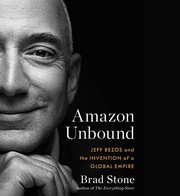
Amazon Unbound

Amazon Unbound

Brad Stone
2021
T2 496 pages · about 8h 16m to read Open Librarygoodreads

Sequel covering Alexa, AWS scale, Whole Foods and the antitrust era.

Summary

Stone's sequel to The Everything Store covers Amazon from roughly 2010 to 2020, the period in which it grew from a large retailer into one of the most valuable companies in the world.

The business material covers the development of Alexa and the Echo, which Stone documents as a Bezos-driven project pursued against internal scepticism; the growth of Amazon Web Services into the company's principal profit source; the advertising business, which became a third major profit centre without much public attention; the expansion of logistics into a delivery network that reduced dependence on carriers; the Whole Foods acquisition; the entry into film and television production; and the second headquarters competition.

The operational material covers the flywheel as Amazon uses it, the mechanics of the marketplace including the tension between third-party sellers and Amazon's own retail, and the use of seller data which became the subject of regulatory attention. Stone covers the labour conditions in fulfilment centres and the response to organising efforts more directly than the earlier book, and covers the Bezos divorce, the National Enquirer episode and the Saudi phone hacking allegation. The political material covers the antitrust attention, the conflict with Trump and the tax position.

Stone did not have Bezos' cooperation and the book relies on former employees and documents. It is longer and more diffuse than The Everything Store, since the company had become too large for a single narrative. The chapters on Alexa, on advertising and on the logistics build-out are the most substantive.

Key takeaways 8

  1. Amazon Web Services became the company's principal profit source, which funded the retail operations that made no money.
  2. The advertising business grew into a third major profit centre with far less public attention than the other two received.
  3. Alexa was pursued against internal scepticism as a founder-driven project and consumed enormous investment.
  4. Building a delivery network reduced dependence on carriers and converted a cost centre into a strategic asset.
  5. The tension between third-party sellers and Amazon's own retail operation is structural rather than incidental, since the same company competes and provides the platform.
  6. Use of third-party seller data by Amazon's retail operation became the focus of regulatory attention in multiple jurisdictions.
  7. Scale changed the company's political position, and the antitrust and tax attention became a management problem in its own right.
  8. Stone did not have Bezos' cooperation and relied on former employees and documents, which produces a less favourable account than the earlier book.

Who should read it

Investors and operators who want the second decade of Amazon, particularly the growth of the cloud, advertising and logistics businesses.

About Brad Stone

Senior executive editor for global technology at Bloomberg News who writes reported histories of Amazon, Uber and Airbnb.

The Everything Store reconstructs Amazon's first two decades from hundreds of interviews with insiders, covering the decisions on pricing, third-party sellers and infrastructure that made the model work. Amazon Unbound picks up the following decade, and The Upstarts documents the regulatory and operating fights Uber and Airbnb had to win to reach scale.

Bloomberg Businessweek, Bloomberg News

Who recommended it 1 · 1 direct

Similar books 6

Chosen by shared topics, the entries that hold them, and the people who recommended both.
Brad Stone · 2013

Amazon's first two decades, from an online bookshop to selling nearly everything.

Colin Bryar, Bill Carr · 2021

Amazon's operating mechanisms, from leadership principles to the six-page memo.

Recommended by: Jeff Bezos
Richard L. Brandt · 2011

Jeff Bezos and Amazon's early years, from D. E. Shaw to the founding in 1994.

Recommended by: Mohnish Pabrai
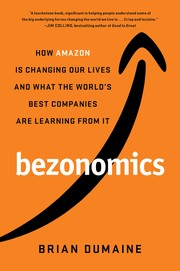
Brian Dumaine · 2020

Business-model analysis rather than a life.

Alec MacGillis · 2021

How Amazon's growth concentrated wealth in a few places and hollowed out others.
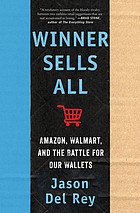
Jason Del Rey · 2023

Amazon against Walmart; the retail war told as strategy.

Where it sits in the reference 5

Journalists
Companies
Biographies
Business models
Industries

Topics

Company Histories