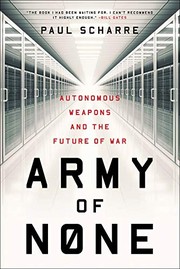
Army of None
How autonomous weapons are changing war, and what that means.
Summary
Scharre, an expert in emerging weapons technology, examines how increasingly autonomous weapons are changing warfare, starting from the observation that the technology to build weapons that hunt and destroy targets on their own already exists. He asks what happens when a Predator drone has as much autonomy as a self-driving car, and he investigates the emergence of fully autonomous weapons, the movement to ban them, and the legal and ethical questions they raise.
He draws on research and his own first-hand experience. The book traces the role of artificial intelligence in military technology across decades, from the German noise-seeking Wren torpedoes of the Second World War, which he presents as antecedents of today's armed drones, to autonomous cyber weapons. It combines military history, global policy and current science to ask what it would mean to give machines authority over the decision to kill. It was published in 2018.
Key takeaways 4
- Weapons that can select and engage targets without a human decision already exist.
- Autonomy in weapons has a long history, going back to Second World War homing torpedoes.
- The central question is whether a machine should be allowed to make a life-or-death decision.
- Autonomous cyber weapons raise the same questions as physical ones.
Who should read it
Readers in defence, technology policy or AI who want a practitioner's account of autonomous weapons and the case for and against banning them.
Who recommended it 1 · 1 direct
Similar books 6
Chosen by shared topics, the entries that hold them, and the people who recommended both.
The theory that the neocortex works through thousands of models of the world.
Recommended by: Bill Gates

Khan Academy's founder on artificial intelligence in education and parenting.
Recommended by: Bill Gates

What humanity may seek after famine, plague and war: immortality and divinity.
“Very interesting alternative perspective on life from a historian. Anti-religion, anti-humanism, pro-animal. Seems detached, but is quite opinionated. Much to think about, regardless. My notes here give a taste. A lot to think about.” — Derek Sivers
Source: Derek Sivers book notes (primary, rated list) · Rating: 6/10
Recommended by: Andrew Wilkinson, Bill Gates, Derek Sivers and 8 others
How AI could change crime, war, justice, jobs and what it means to be human.
“A deep, bold, and visionary dive into Artificial Intelligence and its many implications. One of the most interesting books I've ever read. If you haven't read much of AI yet, start with “Surviving AI” as an intro, then read this as a deep-dive. His perspective is amazingly thorough. Defining terminology was a great way to start. For example life is a “process that can retain its complexity and replicate”. Intelligence is the “ability to accomplish complex goals”. That keeps it broad enough to define future technology as alive and intelligent.” — Derek Sivers
Source: Derek Sivers book notes (primary, rated list) · Rating: 7/10
Recommended by: Andrew Wilkinson, Derek Sivers, Bill Gates and 3 others
Why AI and synthetic biology will spread fast and cheaply, and how to contain them.
“Everything is about to be changed by AI in a radical, scary way” — Andrew Wilkinson
Source: Newsletter
Recommended by: Andrew Wilkinson, Bill Gates and 1 other
Why computers must recognise and express emotion to be intelligent.
“And so I was looking for a thesis topic and my fiance at the time went on Amazon and he said, "Oh, there's this really interesting book by this MIT professor called Rosalind Picard called Affective Computing.” — Rana el Kaliouby
Recommended by: Rana el Kaliouby