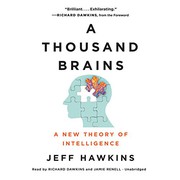
A Thousand Brains: A New Theory of Intelligence
The theory that the neocortex works through thousands of models of the world.
Summary
Hawkins, co-founder of Palm Computing and of the research company Numenta, sets out the Thousand Brains Theory of the neocortex. Building on Vernon Mountcastle's 1978 proposal that every region of the neocortex runs the same algorithm in about 150,000 cortical columns, he argues that each column learns complete models of objects using reference frames, map-like structures adapted from the grid and place cells of the old brain. Predictions happen inside neurons, as dendrite spikes; columns vote to reach a consensus, and that consensus is what we perceive. Thinking, he proposes, is a form of moving through reference frames.
The book has three parts. Part 1 presents the theory. Part 2 argues that today's AI is not intelligent because it lacks knowledge representation, and that true machine intelligence will need continuous learning, learning through movement, many models and reference frames; Hawkins also argues that machines will not develop misaligned goals on their own. Part 3 turns to human risks: false beliefs, climate change, merging brains with machines, and preserving knowledge beyond humanity. The 2021 book carries a foreword by Richard Dawkins.
Key takeaways 4
- The neocortex repeats one circuit, the cortical column, tens of thousands of times, so one algorithm may underlie vision, touch and language.
- Each column builds its own model of an object, and perception emerges from the columns voting.
- The brain constantly predicts its next input, and unexpected inputs cause far more neural activity than expected ones.
- Hawkins argues that machine intelligence requires maplike reference frames and learning through movement, which current deep learning lacks.
Who should read it
Readers interested in neuroscience and AI who want a specific, testable theory of how the neocortex produces intelligence.
Who recommended it 1 · 1 direct
Similar books 6
Chosen by shared topics, the entries that hold them, and the people who recommended both.
Computer models of how minds make analogies and create.
Recommended by: Patrick Collison
How the brain produces intelligence, and what that means for intelligent machines.
Recommended by: Keith Rabois, Patrick Collison, Ev Williams
An argument that consciousness is not algorithmic and rests on quantum mechanics.
Recommended by: Patrick Collison
A theory of how the human mind works and how thought arises.
Recommended by: Patrick Collison
How a game designer built artificial life from simple rules of biology.
Recommended by: Mohnish Pabrai, Jeff Bezos
How Hinton, LeCun and Bengio kept neural networks alive until deep learning took off.