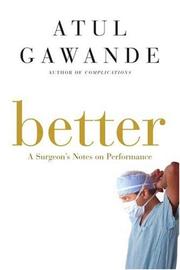
Better: A Surgeon's Notes on Performance
How doctors try to close the gap between their intentions and their performance.
Summary
The reference has not verified this book in detail; the summary states only what the title, author and subject establish.
Gawande, a surgeon, examines how physicians try to close the gap between their best intentions and their best performance in the face of obstacles. His cases include the ethics of doctors taking part in lethal injections, malpractice, and surgical errors.
The source read in this pass, a short catalogue description, gives these topics but not the book's structure or its full set of cases. It was published in 2007.
Key takeaways 3
- Good intentions in medicine do not guarantee good performance; the gap has to be closed deliberately.
- Doctors face ethical choices, such as taking part in executions, that sit outside medical training.
- Errors and malpractice are part of the record of performance that medicine must study.
Who should read it
Doctors, other professionals and general readers interested in how practitioners improve their work.
Who recommended it 2 · 1 direct
Similar books 6
Chosen by shared topics, the entries that hold them, and the people who recommended both.
True cases showing the power and the limits of medicine as it is practised.
“Gawande, Atul, Complications: A Surgeon’s Notes on an Imperfect Science (New York: Picador, 2002)” — Michael Mauboussin
Source: Are You an Expert? Experts and Markets, page 10
Recommended by: Michael Mauboussin, Mohnish Pabrai and 1 other
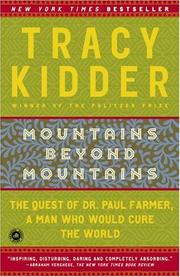
Paul Farmer, the doctor who co-founded Partners In Health, treating the poor.
Recommended by: Bill Gates, Jim Collins, Mohnish Pabrai and 3 others
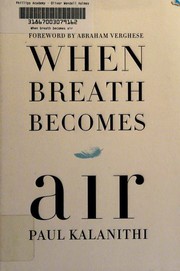
A neurosurgeon diagnosed with lung cancer at 36 asks what makes life worth living.
“Paul Kalanithi's book When Breath Becomes Air is one of the best books I've ever read.” — Brad Feld
Source: Book: When Breath Becomes Air — Feld Thoughts
Recommended by: Bill Gates, Brad Feld, Kathryn Minshew and 11 others
A neurosurgeon on how medical decisions and hospital incentives work.
Recommended by: Bill Gates

How smallpox was eradicated, told by one of the physicians who did it.
Recommended by: Bill Gates
An ethnobotanist studies with Amazon shamans to find medicines in rain-forest plants.
Recommended by: Tim Ferriss