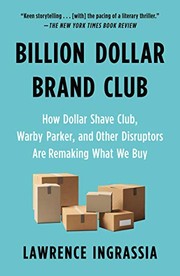
Billion Dollar Brand Club
How Dollar Shave Club, Warby Parker and other online brands took on incumbents.
Dollar Shave Club, Warby Parker and the DTC assault on incumbents.
Summary
Ingrassia, former business and economics editor and deputy managing editor of The New York Times, tells the story of the upstart brands challenging the companies that long dominated the trillion-dollar consumer economy. His cases include Dollar Shave Club and its comic marketing, Casper mattresses delivered in a box, ThirdLove's lingerie fitted to each woman, and Warby Parker mailing customers five pairs of glasses to try.
Taken one by one, each looks like a small challenger taking on a giant. Taken together, Ingrassia argues, they mark a shift in a business model that had lasted more than a century. Manufacturing, marketing, logistics and customer service have all become available to newcomers, so the walls that once protected Gillette, Sealy, Victoria's Secret and LensCrafters have fallen, and digital entrepreneurs can compete on price, value, quality, speed, convenience and service. He describes the entrepreneurs, venture capitalists and large corporations fighting over this ground.
Key takeaways 4
- Direct-to-consumer start-ups have attacked categories long held by large brands.
- Outsourced manufacturing, digital marketing and logistics lowered the barriers that protected incumbents.
- Challengers compete on price, convenience and service as well as product.
- Venture capital funded the wave of new consumer brands.
Who should read it
Investors in consumer goods who want to understand how direct-to-consumer brands eroded incumbents' advantages.
Similar books 6
Chosen by shared topics, the entries that hold them, and the people who recommended both.
How startup brands such as Casper and Allbirds built loyal customers.
Data-proven methods for sales and marketing from 4,000 product launches.
Recommended by: Mohnish Pabrai
How to position software so it clearly wins for a chosen market.
Recommended by: Nat Eliason
How companies win by inventing a new market category and dominating it.
Recommended by: Anthony Pompliano, David Cancel
How direct marketing was invented, from the Columbia Record Club to American Express.
From LinkExchange to Zappos, and the case for building a company on its culture.
Recommended by: Mohnish Pabrai, Tony Hsieh, Ev Williams and 2 others