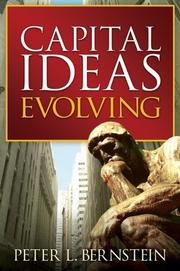
Capital Ideas Evolving
A sequel to Capital Ideas on how financial theory has developed since.
Summary
Bernstein wrote this as a sequel to Capital Ideas, which had traced the development of modern financial theory from Bachelier through Markowitz, Sharpe, Modigliani and Miller, Black, Scholes and Merton. This volume asks what happened to those ideas over the following two decades.
The structure alternates between theorists and practitioners. The theoretical chapters cover the challenges to the original framework: behavioural finance and the anomalies it documents, Andrew Lo's adaptive markets hypothesis which frames efficiency as an evolutionary outcome that varies with conditions, Robert Shiller's work on volatility and on risk-sharing institutions, and Paul Samuelson's later reflections. The practitioner chapters cover people applying the ideas: Bill Gross at PIMCO, David Swensen at Yale, Barclays Global Investors, Goldman Sachs Asset Management and others, examining how each translated theory into portfolios.
Bernstein's argument is that the theoretical framework has been modified rather than overturned. The efficient market hypothesis is not literally true, and behavioural finance has documented systematic departures, but the practical implications drawn from the original theory, including the difficulty of beating the market after costs, the value of diversification and the separation of alpha from beta, have survived and have been implemented at scale. He gives particular attention to portable alpha and to the separation of market exposure from active return, which he treats as the period's main practical innovation.
The book was published in 2007, immediately before the crisis tested several of the innovations it describes favourably, including portable alpha structures and the endowment model, both of which performed poorly in 2008. Bernstein was in his late eighties and the writing is less tight than his earlier work. Read Capital Ideas first, since this assumes it.
Key takeaways 7
- The theoretical framework of modern finance has been modified by behavioural findings rather than overturned by them.
- Separating market exposure from active return allows each to be sourced and priced independently, which is the period's main practical innovation.
- The adaptive markets hypothesis treats efficiency as an evolutionary outcome that varies with conditions rather than as a fixed property.
- Practical implications of the original theory, including the difficulty of beating the market after costs, survived the theoretical challenges.
- Institutional investors implemented academic ideas at scale in ways their originators had not anticipated.
- Portable alpha structures separate the source of active return from the market exposure a portfolio wants to hold.
- The book was published immediately before several of the innovations it describes favourably performed badly in the crisis.
Who should read it
Investors who have read Capital Ideas and want the account of how the theory developed and was implemented through 2007.
About Peter L. Bernstein
Founder, Peter L. Bernstein Inc.; founding editor of The Journal of Portfolio Management; economist and financial historian (1919-2009)
Against the Gods and Capital Ideas are the standard accounts of risk and of modern finance theory, read across the whole field.
Similar books 6
Chosen by shared topics, the entries that hold them, and the people who recommended both.

How Markowitz, Sharpe, Fama, Black and Scholes built the theory of modern finance.
“But it was in his Capital Ideas, published in 1992, that I first learned of Louis Bachelier’s 1900 dissertation, The Theory of Speculation.” — John C. Bogle
Source: Success In Investment Management: What Can We Learn From Indexing?, page 1
Recommended by: John C. Bogle, Michael Mauboussin

Research papers showing that stock prices do not follow a random walk.
“Andrew W. Lo and A. Craig MacKinlay, A Non-Random Walk Down Wall Street (Princeton, NJ: Princeton University Press, 1999), 4-5” — Michael Mauboussin
Source: Capital Ideas Revisited - Part 2: Thoughts on Beating a Mostly-Efficient Stock Market, page 9
Recommended by: Michael Mauboussin
The adaptive markets hypothesis, joining efficient markets and behavioural finance.
“Lo, Andrew W., Adaptive Markets: Financial Evolution at the Speed of Thought (Princeton, NJ: Princeton University Press, 2017)” — Michael Mauboussin
Source: Who Is On the Other Side? You Need Good BAIT to Land a Winner, page 40
Recommended by: Michael Mauboussin

How price-driven volatility explains stock-price puzzles and why few beat the market.
Recommended by: Mohnish Pabrai
Markets pay skilled active managers; a survey of the strategies they run.
“Now another outstanding Nordic researcher (and AQR partner), Lasse Heje Pedersen, presents me with the same dilemma: His new book, Efficiently Inefficient (Princeton University Press), is fantastic — almost too good at laying out how successful professional asset managers think and act.” — Clifford Asness
Source: Efficient Inefficiency: The Oxymoron That Explains the Investing World
Recommended by: Clifford Asness, Michael Mauboussin
Portfolio sorts and cross-sectional regressions: how to test what predicts returns.