Beast on Wall Street
How price-driven volatility explains stock-price puzzles and why few beat the market.
About Robert A. Haugen
Finance professor at the University of California, Irvine and a persistent critic of the efficient market hypothesis; died in 2013.
The New Finance argues that the value premium comes from investors extrapolating past growth rates too far rather than from bearing extra risk, contradicting the risk-based explanation Fama and French offered. The Inefficient Stock Market assembles the cross-sectional evidence, including the low-volatility result that factor products were later built on.
Who recommended it 1 · 1 direct
Similar books 6
Chosen by shared topics, the entries that hold them, and the people who recommended both.
Why stock returns can be predicted from firm traits, against efficient markets.
Recommended by: Mohnish Pabrai
The case against efficient markets, with the evidence on mispriced stocks.
“In fact, Robert Haugen, in The New Finance, identifies this as the source of the value premium.” — William J. Bernstein
Source: Efficient Frontier, issue 999 (1999)
Recommended by: Mohnish Pabrai, William J. Bernstein and 1 other
Research papers showing that stock prices do not follow a random walk.
“Andrew W. Lo and A. Craig MacKinlay, A Non-Random Walk Down Wall Street (Princeton, NJ: Princeton University Press, 1999), 4-5” — Michael Mauboussin
Source: Capital Ideas Revisited - Part 2: Thoughts on Beating a Mostly-Efficient Stock Market, page 9
Recommended by: Michael Mauboussin
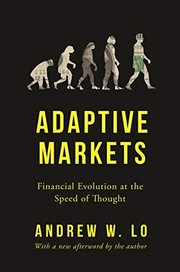
The adaptive markets hypothesis, joining efficient markets and behavioural finance.
“Lo, Andrew W., Adaptive Markets: Financial Evolution at the Speed of Thought (Princeton, NJ: Princeton University Press, 2017)” — Michael Mauboussin
Source: Who Is On the Other Side? You Need Good BAIT to Land a Winner, page 40
Recommended by: Michael Mauboussin
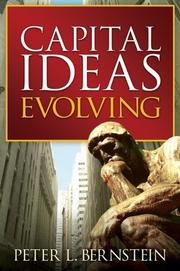
A sequel to Capital Ideas on how financial theory has developed since.
How Markowitz, Sharpe, Fama, Black and Scholes built the theory of modern finance.
“But it was in his Capital Ideas, published in 1992, that I first learned of Louis Bachelier’s 1900 dissertation, The Theory of Speculation.” — John C. Bogle
Source: Success In Investment Management: What Can We Learn From Indexing?, page 1
Recommended by: John C. Bogle, Michael Mauboussin