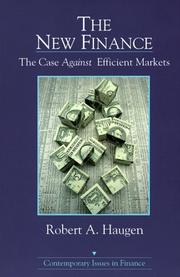
The New Finance
The case against efficient markets, with the evidence on mispriced stocks.
Summary
Haugen makes the case against efficient markets in a short volume that has gone through several editions, each updating the evidence. His subtitle in most editions calls it the case against efficient markets, and the structure follows that: state what the theory predicts, show data that contradicts it, then propose a behavioural explanation.
The central empirical claim concerns the value premium. Haugen shows that stocks with low prices relative to book value and earnings have outperformed expensive stocks over long periods and across markets. He then argues against the Fama and French interpretation that this compensates investors for distress risk, presenting evidence that cheap stocks have not been riskier by conventional measures and in some periods have been less volatile. His preferred explanation is that investors extrapolate recent earnings growth too far into the future, overpaying for companies with strong recent records and underpaying for weak ones, and that the correction happens as growth rates mean-revert faster than the market expects.
He supports this with evidence on the persistence of profitability, showing that high and low returns on equity converge more quickly than implied prices suggest, and with the low-volatility finding that also appears in his other work.
The argument was influential and much of it is now accepted, in the sense that behavioural explanations for the value premium are mainstream. The book itself is polemical, thin on the counterarguments, and dated in its data. Value's long period of underperformance after 2007 also complicates any confident claim that the effect is a permanent feature of investor psychology.
Key takeaways 7
- Cheap stocks have outperformed expensive ones across markets and long periods, which the efficient market hypothesis cannot explain without added risk factors.
- The value premium is not compensation for risk, because cheap stocks have not been more volatile or more distressed on average.
- Investors overestimate how long high growth and high profitability persist, and prices reflect that error.
- Profitability mean-reverts faster than market prices imply, which is the mechanism generating the value premium.
- The capital asset pricing model fails empirically because the relationship between beta and return is flat or negative.
- Behavioural explanations of return anomalies are testable and outperform risk-based explanations on the available data.
- Expensive growth stocks earn low returns because expectations embedded in their prices are systematically too high.
Who should read it
Investors who want the behavioural case for value investing argued against the academic risk-based interpretation, with the caveat that the data stops before value's long drawdown.
About Robert A. Haugen
Finance professor at the University of California, Irvine and a persistent critic of the efficient market hypothesis; died in 2013.
The New Finance argues that the value premium comes from investors extrapolating past growth rates too far rather than from bearing extra risk, contradicting the risk-based explanation Fama and French offered. The Inefficient Stock Market assembles the cross-sectional evidence, including the low-volatility result that factor products were later built on.
Who recommended it 3 · 2 direct
“In fact, Robert Haugen, in The New Finance, identifies this as the source of the value premium.”
Similar books 6
Chosen by shared topics, the entries that hold them, and the people who recommended both.
Why stock returns can be predicted from firm traits, against efficient markets.
Recommended by: Mohnish Pabrai
How price-driven volatility explains stock-price puzzles and why few beat the market.
Recommended by: Mohnish Pabrai

Research papers showing that stock prices do not follow a random walk.
“Andrew W. Lo and A. Craig MacKinlay, A Non-Random Walk Down Wall Street (Princeton, NJ: Princeton University Press, 1999), 4-5” — Michael Mauboussin
Source: Capital Ideas Revisited - Part 2: Thoughts on Beating a Mostly-Efficient Stock Market, page 9
Recommended by: Michael Mauboussin
Stock prices follow a random walk, so a low-cost index fund beats stock picking.
“Even earlier, in 1973, in his classic A Random Walk Down Wall Street, Burton G. Malkiel had called for such a fund, although, alas, when we started it, I had yet to read his book.” — John C. Bogle
Source: CONVERGENCE!, page 1
Recommended by: Jason Zweig, John C. Bogle and 5 others
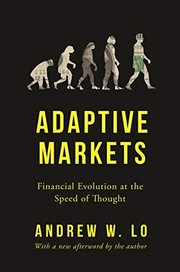
The adaptive markets hypothesis, joining efficient markets and behavioural finance.
“Lo, Andrew W., Adaptive Markets: Financial Evolution at the Speed of Thought (Princeton, NJ: Princeton University Press, 2017)” — Michael Mauboussin
Source: Who Is On the Other Side? You Need Good BAIT to Land a Winner, page 40
Recommended by: Michael Mauboussin

A sequel to Capital Ideas on how financial theory has developed since.
Where it sits in the reference 2
Topics 2
As an Amazon Associate I earn from qualifying purchases.