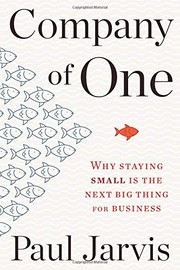
Company of One
Why a business can stay small on purpose instead of chasing growth.
Summary
Jarvis argues that growth should be treated as a deliberate choice rather than as the default objective, and that many businesses are better as small permanent operations than as companies attempting to scale. He defines a company of one as any business that questions growth, which includes solo operators and small teams inside larger organisations.
His case is that growth brings costs that are rarely counted: management overhead, financing requirements, reduced flexibility, obligations to investors, and the necessity of serving customers you would not choose. He argues that a small business can produce a high income for its owner with substantially lower risk and greater autonomy, and that the correct question is what is the minimum size at which this business works rather than how large can it get.
The operational content covers building an audience before a product, selling directly rather than through intermediaries, using existing customers as the primary growth channel, maintaining a small fixed cost base so the business survives revenue variation, and automating or outsourcing rather than hiring. He argues for resilience as the central design property, meaning the business should survive the loss of any single customer, channel or platform.
Jarvis writes from his own experience as a designer and course seller, plus interviews with other small operators. The evidence is anecdotal and the businesses profiled are mostly digital products, courses and services with low capital requirements. The model does not apply to businesses requiring capital, inventory or network effects. The book repeats itself and is thin relative to its length. The argument that growth is a choice with costs is worth stating and is the reason the book exists.
Key takeaways 8
- Growth is a choice with costs rather than a default objective, and many businesses are better at a deliberately limited size.
- The right question is the minimum size at which the business works, not the maximum size it could reach.
- Costs of growth include management overhead, financing obligations, reduced flexibility and the necessity of serving customers you would not choose.
- A small fixed cost base allows the business to survive revenue variation without external capital.
- Existing customers are the most efficient growth channel, and retention produces more than acquisition at small scale.
- Building an audience before building a product removes the distribution problem that kills most small businesses.
- Resilience means surviving the loss of any single customer, channel or platform, and should be designed for explicitly.
- The model applies to businesses with low capital requirements and does not transfer to those needing inventory, capital or network effects.
Who should read it
Solo operators and small business owners who want a stated argument for deliberately limiting size, applicable mainly to low-capital digital businesses.
Who recommended it 6 · 1 direct
Similar books 6
Chosen by shared topics, the entries that hold them, and the people who recommended both.
How to build a business that runs without its owner, so that it can be sold.
Recommended by: Mohnish Pabrai, Nat Eliason, Nick Huber
Small firms fail when technicians run them; build systems that run the business.
“Absolutely everyone who is an entrepreneur or wants to be one needs to read this book. I first read it after 10 years of successfully running my company, and was still blown away and totally humbled by its wisdom. Re-reading it today, I'm amazed how my view of business was completely changed by this one little book.” — Derek Sivers
Source: Book notes by Derek Sivers
Recommended by: Derek Sivers, Tim Ferriss, Tom Bilyeu and 6 others
Recommended by: Mohnish Pabrai
183 tips for small business owners, from hiring to finance, PR and sales.
Recommended by: Simon Sinek
Why consultants should charge for the value they create rather than their time.
“My college girlfriend's rich dad gave me this because I wanted to get rich too. He said read it and you'll be rich. Good advice.” — Noah Kagan
Source: The 25 Best Business Books I Ever Read (Out of 697)
Recommended by: Nat Eliason, Noah Kagan
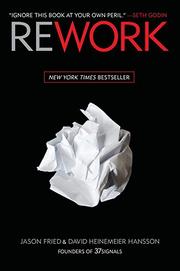
Contrarian rules for running a small, profitable company without venture capital.
“Jason Fried has written Rework with David Heinemeier Hansson, his co-founder at 37signals. The back of the book states, in part, that "planning is guessing," and "inspiration is perishable.” — Tom Peters
Source: Link Roundup #14
Recommended by: Andrew Wilkinson, Tom Peters, Jason Fried and 6 others