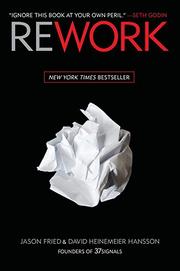
Rework
Contrarian rules for running a small, profitable company without venture capital.
Summary
Fried and Heinemeier Hansson wrote a short book of contrarian positions on running a business, drawn from building 37signals, later Basecamp, as a small profitable company that refused venture capital and refused to grow. The chapters are two or three pages each and state a position without qualification.
The arguments include: planning is guessing, so long-term plans should be replaced with decisions about what to do this week; growth for its own sake is a mistake and small can be a permanent condition rather than a stage; workaholism produces worse work and is a failure of prioritisation; meetings are toxic and should be treated as expensive; you should build half a product rather than a half-baked product; constraints are advantages because they force decisions; and you should sell your by-products, meaning the things you learn and build in the course of the work.
The marketing arguments are the most distinctive. They advocate teaching as marketing, showing the work in public, emphasising what the product deliberately does not do, and picking a fight with a competitor's approach in order to attract the customers who share the position. Their advice on hiring is to hire late, hire people who write well, and give candidates real work as the test.
The positions are stated as universal rules but derive from one specific case: a profitable bootstrapped software company with a small team and no outside investors. Much of the advice fails directly for capital-intensive businesses, for companies in winner-take-most markets and for anyone who has taken venture funding. The tone is combative and the absence of qualification is deliberate. The material on constraints, on meetings and on teaching as marketing transfers most widely.
Key takeaways 8
- Long-term business plans are guesses presented as certainty, and a company should decide what to do this week rather than what to do in five years.
- Growth is a choice rather than an obligation, and staying small can be a permanent and profitable position.
- Workaholism produces worse decisions and signals a failure to prioritise rather than commitment.
- Constraints improve products because they force the decisions that abundant resources allow a team to avoid.
- A company should build half a product rather than a half-finished one, cutting scope rather than quality.
- Teaching your customers what you know attracts them more effectively than advertising, and costs less.
- Meetings should be treated as expensive by multiplying their length by the number of attendees, and most should not happen.
- Hiring should be delayed until the pain of not hiring is acute, because a role created in anticipation defines itself around the hire rather than the need.
Who should read it
Founders of bootstrapped or capital-light businesses who want a stated alternative to the growth-and-funding default, treating the rules as positions rather than laws.
About David Heinemeier Hansson
Creator of Ruby on Rails and chief technology officer and co-owner of 37signals, which makes Basecamp and Hey.
Rework rejects the venture-funded growth sequence - outside capital, long-range plans, headcount as a measure of progress - and sets out how a small, profitable software company is run instead, from a firm that has done it for two decades. Remote, published in 2013, specifies the hiring, writing and management practices distributed teams need.
Who recommended it 9 · 2 direct
“Jason Fried has written Rework with David Heinemeier Hansson, his co-founder at 37signals. The back of the book states, in part, that "planning is guessing," and "inspiration is perishable.”
Similar books 6
Chosen by shared topics, the entries that hold them, and the people who recommended both.
Small firms fail when technicians run them; build systems that run the business.
“Absolutely everyone who is an entrepreneur or wants to be one needs to read this book. I first read it after 10 years of successfully running my company, and was still blown away and totally humbled by its wisdom. Re-reading it today, I'm amazed how my view of business was completely changed by this one little book.” — Derek Sivers
Source: Book notes by Derek Sivers
Recommended by: Derek Sivers, Tim Ferriss, Tom Bilyeu and 6 others
Fourteen companies, such as Anchor Brewing and Zingerman's, that chose to stay small.
Recommended by: Mohnish Pabrai, Noah Kagan, Tom Peters and 1 other
Recommended by: Mohnish Pabrai
How to build a business that runs without its owner, so that it can be sold.
Recommended by: Mohnish Pabrai, Nat Eliason, Nick Huber
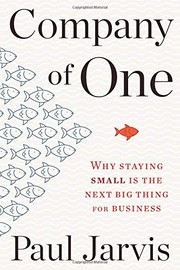
Why a business can stay small on purpose instead of chasing growth.
Recommended by: Eric Jorgenson, Cal Newport, David Hellmann and 3 others
183 tips for small business owners, from hiring to finance, PR and sales.
Recommended by: Simon Sinek