Updates

  1. Person pages list letters, writing, profiles and links as sortable tables with filters, and show each person's companies as links; Fund letters show each letter's description in its own column.
  2. Experts show a checked job title and a short description of each person; 30 more people have photographs.
  3. Every company, fund, university and publication the experts work for has a page listing the people there.
  4. Fund letters show each letter's thesis and filter by it; 225 person pages list the essays, columns and newsletter issues the person wrote.
  5. Person pages list every essay and newsletter issue a person wrote, and their own books as a table in List view.
  6. Recommends shows the five largest kinds of book and the rest under More; browse pictures load sooner.
  7. Podcasts and talks link the original episode, filter by Audio and video or Press, and list each publisher once.
  8. Pages are wider, Recommends has List and Grid, and a filter clicked again turns off.
  9. Book cards sit in a ruled grid with Open Library and Goodreads links and each book's one-line note.
  10. Funds is now Investors; each investor's styles are buttons that filter the table.
  11. Podcasts and talks on a person's page filter by year and publisher and show as a list or a grid of pictures.
  12. Quotes show only people's own words: 472 summaries written by list sites are gone.
  13. Country pages open from Browse again, and every link on the shelf lands on a page.
  14. Subject and person pages show their sections as tabs, and each book appears once on a person's page.
  15. Book cards show the quote, who said it and the source; grids show five cards to a row.
  16. On a phone, a menu holds the sections, search, Updates, Feedback and dark mode.
  17. Feedback takes a screenshot of the page with no browser prompt, opens a screenshot full size when you click it, and clears itself once sent.
  18. Book cards are centred, search names the topic each book sits in, and any text cut short shows whole on hover.
  19. Search groups its results by kind: people, companies, geographies, subjects, topics, books, funds, fund letters and papers.
  20. The Books table lists who recommended each book by name, and the browser tab names the section you are in.
  21. Feedback can take a screenshot of the page, or one you paste or choose, and opens in the corner beside Updates.
  22. Each rail button reopens its section where you left it, and Browse, Table and People show on every book and subject page.
  23. Filters grey out choices that hold nothing instead of hiding them, and Books › People filters by authors or recommenders.
  24. Feedback takes a subject line and up to three screenshots.
  25. Biographies are grouped by the person they are about: 41 new pages, from Abraham Lincoln to Lee Kuan Yew.
  26. Sport splits into 23 sports, and Religion into one topic per faith.
  27. Book lists show as cards: the cover, one recommendation quote and every recommender by name.
  28. Seventeen subjects that had two or three pages under different names now have one page each.
  29. Every page lists its Experts as authors and recommenders, with a link to them on the Experts tab.
  30. Economics, Financial history, Financial panics and Accounting are subjects of their own, with one page per financial crisis.
  31. Book, person and subject pages open inside the app, so the tabs stay in view.
  32. 996 more book covers, and photographs or logos for 227 more people and companies.
  33. Books › Browse shows every subject as cards, and the rail holds Fund letters, Papers, Experts, Books and Funds.
  34. Every topic over 150 books splits into narrower topics, each with a page of its own.

Send feedback

What is it?
Screenshots, up to 3 (optional)
or paste one with Ctrl+V

We use your email only to reply to you.

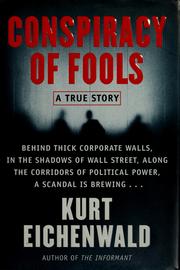
Conspiracy of Fools: A True Story

Conspiracy of Fools: A True Story

Kurt Eichenwald
2005
T1 742 pages · about 12h 22m to read Open Librarygoodreads

Narrative reconstruction from thousands of interviews.

Summary

Eichenwald reconstructs the Enron collapse as a narrative built from depositions, internal documents, emails and hundreds of interviews, written in scene-by-scene form with reconstructed dialogue. It covers the period from the mid-1990s through the bankruptcy and the criminal cases.

The account differs from the standard morality-tale version in one important respect. Eichenwald argues that the central failure was not a conspiracy of masterminds but a collapse of competence and attention across every layer that was supposed to provide a check: a board that approved conflict-of-interest waivers without understanding them, auditors at Arthur Andersen whose consulting revenue exceeded their audit fee, lawyers who signed off on structures they had not tested, banks that designed the financings and then sold Enron paper, and a chief executive in Ken Lay who did not follow what his own company did. Andrew Fastow emerges as the primary actor of self-enrichment through the LJM partnerships, while Jeff Skilling is portrayed as building a culture that made the accounting inevitable.

The technical material on mark-to-market accounting for long-dated energy contracts and on special purpose entities is explained clearly enough for a non-specialist, which is the book's main use to investors: it shows exactly how earnings can be recognised today for contracts that will never produce the assumed cash. The reconstructed-dialogue method has been criticised, since Eichenwald renders conversations he did not witness as direct speech, and readers who want the analytical version should read The Smartest Guys in the Room alongside it.

Key takeaways 7

  1. Enron's core accounting device was mark-to-market recognition of the full projected profit on long-dated contracts, which booked earnings that no cash ever validated.
  2. The special purpose entities were used to move debt off the balance sheet and to create counterparties that would take losses Enron did not want to report.
  3. Andrew Fastow's LJM partnerships enriched him personally at the company's expense, and the board explicitly waived the conflict of interest policy to permit them.
  4. Every external gatekeeper failed at once, and each failed because its fee income depended on the client rather than on the accuracy of its opinion.
  5. Ken Lay did not understand the transactions his company was executing, which made him useless as a check rather than a co-conspirator.
  6. Enron's performance review system, which forcibly ranked and fired the bottom tier each cycle, produced the reporting behaviour that made the fraud possible.
  7. Analysts and rating agencies continued to endorse the company after its filings had stopped being interpretable, because none of them wanted to be the one to break the position.

Who should read it

Investors and directors who want a detailed account of how accounting choices, incentive structures and gatekeeper conflicts combine into a corporate failure.

Who recommended it 1 · 1 direct

Similar books 6

Chosen by shared topics, the entries that hold them, and the people who recommended both.
Bethany McLean, Peter Elkind · 2003

How Enron used mark-to-market accounting and hidden deals until its 2001 bankruptcy.

Norman C. Miller · 1966

Pulitzer-winning account of the warehousing fraud that nearly broke Amex.

Recommended by: Mohnish Pabrai

Frank Partnoy · 2009

How Ivar Kreuger built a 1920s match monopoly, and the forgeries found at his death.

Recommended by: Mohnish Pabrai

Tom Wright, Bradley Hope · 2018

How Jho Low diverted billions from Malaysia's 1MDB fund into parties and politics.

Frank Partnoy · 2003

How finance used complexity to hide risk from the 1980s through Enron.
Nick Leeson, Edward Whitley · 1996

How one trader's hidden losses in Singapore brought down Barings Bank.

Where it sits in the reference 4

Companies
Industries
Business themes
Financial history

Topics

Company HistoriesFinancial History