Updates

  1. Person pages list letters, writing, profiles and links as sortable tables with filters, and show each person's companies as links; Fund letters show each letter's description in its own column.
  2. Experts show a checked job title and a short description of each person; 30 more people have photographs.
  3. Every company, fund, university and publication the experts work for has a page listing the people there.
  4. Fund letters show each letter's thesis and filter by it; 225 person pages list the essays, columns and newsletter issues the person wrote.
  5. Person pages list every essay and newsletter issue a person wrote, and their own books as a table in List view.
  6. Recommends shows the five largest kinds of book and the rest under More; browse pictures load sooner.
  7. Podcasts and talks link the original episode, filter by Audio and video or Press, and list each publisher once.
  8. Pages are wider, Recommends has List and Grid, and a filter clicked again turns off.
  9. Book cards sit in a ruled grid with Open Library and Goodreads links and each book's one-line note.
  10. Funds is now Investors; each investor's styles are buttons that filter the table.
  11. Podcasts and talks on a person's page filter by year and publisher and show as a list or a grid of pictures.
  12. Quotes show only people's own words: 472 summaries written by list sites are gone.
  13. Country pages open from Browse again, and every link on the shelf lands on a page.
  14. Subject and person pages show their sections as tabs, and each book appears once on a person's page.
  15. Book cards show the quote, who said it and the source; grids show five cards to a row.
  16. On a phone, a menu holds the sections, search, Updates, Feedback and dark mode.
  17. Feedback takes a screenshot of the page with no browser prompt, opens a screenshot full size when you click it, and clears itself once sent.
  18. Book cards are centred, search names the topic each book sits in, and any text cut short shows whole on hover.
  19. Search groups its results by kind: people, companies, geographies, subjects, topics, books, funds, fund letters and papers.
  20. The Books table lists who recommended each book by name, and the browser tab names the section you are in.
  21. Feedback can take a screenshot of the page, or one you paste or choose, and opens in the corner beside Updates.
  22. Each rail button reopens its section where you left it, and Browse, Table and People show on every book and subject page.
  23. Filters grey out choices that hold nothing instead of hiding them, and Books › People filters by authors or recommenders.
  24. Feedback takes a subject line and up to three screenshots.
  25. Biographies are grouped by the person they are about: 41 new pages, from Abraham Lincoln to Lee Kuan Yew.
  26. Sport splits into 23 sports, and Religion into one topic per faith.
  27. Book lists show as cards: the cover, one recommendation quote and every recommender by name.
  28. Seventeen subjects that had two or three pages under different names now have one page each.
  29. Every page lists its Experts as authors and recommenders, with a link to them on the Experts tab.
  30. Economics, Financial history, Financial panics and Accounting are subjects of their own, with one page per financial crisis.
  31. Book, person and subject pages open inside the app, so the tabs stay in view.
  32. 996 more book covers, and photographs or logos for 227 more people and companies.
  33. Books › Browse shows every subject as cards, and the rail holds Fund letters, Papers, Experts, Books and Funds.
  34. Every topic over 150 books splits into narrower topics, each with a page of its own.

Send feedback

What is it?
Screenshots, up to 3 (optional)
or paste one with Ctrl+V

We use your email only to reply to you.

Dethroning the King

Dethroning the King

Julie MacIntosh
2010
T3 416 pages · about 6h 56m to read Open Librarygoodreads

Anheuser-Busch: how protected distribution rights shaped the takeover.

Summary

MacIntosh, a Financial Times mergers reporter, wrote the account of InBev's 2008 acquisition of Anheuser-Busch, based on extensive access to participants on both sides.

The transaction narrative covers the approach, the initial rejection, the public campaign, the litigation threat, the raised offer and the board's acceptance, completed during the weeks when credit markets were closing.

The analysis of why the defence failed is the substance. Anheuser-Busch was family-influenced but the family's shareholding had fallen well below a blocking position. August Busch IV had become chief executive without the internal standing his father had held, and the board included directors who did not support him. The company's operating performance had lagged, its share price had underperformed for years, and its cost structure was high relative to InBev's, which gave the acquirer a credible case that it could run the business better. The Modelo stake, which might have been used defensively, was structured in a way that limited the options. The company's advisers explored alternatives including a Modelo acquisition and did not execute one in time.

MacIntosh also covers InBev's own history: the Brazilian origins of the management team, the 3G Capital partners, the culture built on zero-based budgeting, meritocratic promotion and extreme cost discipline, and the acquisition record that preceded this transaction.

The book is a detailed transaction narrative rather than an analysis of the brewing industry. It was published in 2010 and does not cover what followed, including the SABMiller acquisition and the subsequent difficulties with the debt taken on and with brand performance under the cost-reduction model.

Key takeaways 7

  1. Family influence without a blocking shareholding provides no defence against a determined acquirer.
  2. A chief executive without internal standing cannot organise a defence regardless of the board's initial preference.
  3. Years of underperformance relative to peers give an acquirer a credible case that it can run the business better.
  4. A high cost structure relative to the acquirer is itself the acquisition thesis, since the savings fund the premium.
  5. Defensive options including a counter-acquisition must be executed before a bid arrives, not explored after.
  6. InBev's management culture combined zero-based budgeting, meritocratic promotion and extreme cost discipline as a repeatable acquisition model.
  7. The transaction completed as credit markets were closing, which meant financing certainty was itself a competitive advantage.

Who should read it

Directors, founders and investors who want a detailed account of why a defence failed and what a family-influenced company needed to have done earlier.

Similar books 6

Chosen by shared topics, the entries that hold them, and the people who recommended both.

William Knoedelseder · 2012

The Busch family and the three-tier wholesaler system.

Frances Stroh · 2016

Family memoir of a brewer undone partly by its distribution position.

Bob Lutz · 2011

Insider account: Lutz on product culture versus finance control.

Recommended by: Mohnish Pabrai
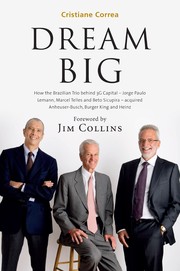
Cristiane Correa · 2013

3G Capital's meritocracy-and-zero-based-budgeting playbook, from AmBev to Heinz.

Recommended by: Warren Buffett

Les Schwab · 1986

Tire-shop founder's memoir on profit sharing and dealer economics

“If you want to read one book, read the autobiography of Les Schwab... He ran tire shops in the Midwest and made a fortune” — Charlie Munger

Source: Notes from the 2004 Berkshire Hathaway Annual Meeting, by Whitney Tilson, p. 35

Recommended by: Charlie Munger

Alfred P. Sloan Jr., Alfred D. Chandler Jr. · 1963

The decentralised structure and financial controls that ran General Motors.

Where it sits in the reference 2

Companies
Business models

Topics

Company Histories