Updates

  1. Every US-listed company has a page with its SEC filings. Company pages list their experts and their management, past and present. Fund managers sit under Investors. Each show has a page of its episodes, and an episode page names its guests and hosts. Biographies lists groups, then people. Breadcrumbs show where a page sits.
  2. Media lists every podcast episode, video, interview and talk, over 10,000, by person, company, publisher and event; each filter searches its own choices. Books opens on its table, then Browse, then Authors and Recommenders. A filter's count no longer covers its arrow.
  3. A book that no company, country or subject page lists shows its topics under Where it sits in the reference. On a phone, a page's tabs scroll sideways only. Descriptions read the same on every page. See them in the Experts tab lists every expert the page names.
  4. Every podcast episode, video and interview has its own page with a video or audio player and a link to the source. Investor pages show each company's sector and market cap; firms such as Berkshire Hathaway have one page that holds their letters and their company tabs. Letters tabs filter by company and search the theses. Companies filter by Public, Private and Defunct and link each company's website.
  5. Every tab, view and search has its own address, such as /books/table/asset or /letters/companies, so Back works and a link opens the same place. Page addresses no longer end in .html. Fund letters, Investors, Companies and Papers load about a fifth of the data they did.
  6. Fund letters has a Companies tab: every company the letters name, with its market cap, sector, country, and how many letters and investors name it. Investor pages link each investor's website. Lists in table cells end with “… and N more” at every width.
  7. 1,120 more book summaries; descriptions for 373 papers; pages for 137 more companies, each with the fund letters that discuss it; 215 official photographs; search has its own page.
  8. 411 more books have a summary; person pages list 930 more of the books they wrote; 147 people show their official photograph.
  9. Every investor has a page with its letters and the companies they discuss; company pages list the investors whose letters name them.
  10. A Companies section at the top of the rail lists every company the books, experts and fund letters name.
  11. Person pages list letters, writing, profiles and links as sortable tables with filters, and show each person's companies as links; Fund letters show each letter's description in its own column.
  12. Experts show a checked job title and a short description of each person; 30 more people have photographs.
  13. Every company, fund, university and publication the experts work for has a page listing the people there.
  14. Fund letters show each letter's thesis and filter by it; 225 person pages list the essays, columns and newsletter issues the person wrote.
  15. Person pages list every essay and newsletter issue a person wrote, and their own books as a table in List view.
  16. Recommends shows the five largest kinds of book and the rest under More; browse pictures load sooner.
  17. Podcasts and talks link the original episode, filter by Audio and video or Press, and list each publisher once.
  18. Pages are wider, Recommends has List and Grid, and a filter clicked again turns off.
  19. Book cards sit in a ruled grid with Open Library and Goodreads links and each book's one-line note.
  20. Funds is now Investors; each investor's styles are buttons that filter the table.
  21. Podcasts and talks on a person's page filter by year and publisher and show as a list or a grid of pictures.
  22. Quotes show only people's own words: 472 summaries written by list sites are gone.
  23. Country pages open from Browse again, and every link on the shelf lands on a page.
  24. Subject and person pages show their sections as tabs, and each book appears once on a person's page.
  25. Book cards show the quote, who said it and the source; grids show five cards to a row.
  26. On a phone, a menu holds the sections, search, Updates, Feedback and dark mode.
  27. Feedback takes a screenshot of the page with no browser prompt, opens a screenshot full size when you click it, and clears itself once sent.
  28. Book cards are centred, search names the topic each book sits in, and any text cut short shows whole on hover.
  29. Search groups its results by kind: people, companies, geographies, subjects, topics, books, funds, fund letters and papers.
  30. The Books table lists who recommended each book by name, and the browser tab names the section you are in.
  31. Feedback can take a screenshot of the page, or one you paste or choose, and opens in the corner beside Updates.
  32. Each rail button reopens its section where you left it, and Browse, Table and People show on every book and subject page.
  33. Filters grey out choices that hold nothing instead of hiding them, and Books › People filters by authors or recommenders.
  34. Feedback takes a subject line and up to three screenshots.
  35. Biographies are grouped by the person they are about: 41 new pages, from Abraham Lincoln to Lee Kuan Yew.
  36. Sport splits into 23 sports, and Religion into one topic per faith.
  37. Book lists show as cards: the cover, one recommendation quote and every recommender by name.
  38. Seventeen subjects that had two or three pages under different names now have one page each.
  39. Every page lists its Experts as authors and recommenders, with a link to them on the Experts tab.
  40. Economics, Financial history, Financial panics and Accounting are subjects of their own, with one page per financial crisis.
  41. Book, person and subject pages open inside the app, so the tabs stay in view.
  42. 996 more book covers, and photographs or logos for 227 more people and companies.
  43. Books › Browse shows every subject as cards, and the rail holds Fund letters, Papers, Experts, Books and Funds.
  44. Every topic over 150 books splits into narrower topics, each with a page of its own.

Send feedback

What is it?
Screenshots, up to 3 (optional)
or paste one with Ctrl+V

We use your email only to reply to you.

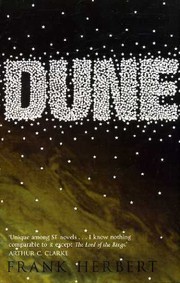
Dune

Dune

A novel of a feudal space empire fighting over a desert planet and its spice.

Frank Herbert
1965
607 pages · about 10h 7m to read Open Librarygoodreads

Summary

Herbert's 1965 novel is set in a feudal interstellar empire where computers are forbidden, having been banned after a war against thinking machines, so human specialists perform their functions. Mentats calculate, the Bene Gesserit sisterhood breeds and trains for political control, and the Spacing Guild depends on a spice found only on the desert planet Arrakis to fold space.

The plot follows Paul Atreides after his family is given control of Arrakis as a trap, is destroyed by the rival Harkonnens with imperial support, and Paul takes refuge among the Fremen, the desert population whose culture the Bene Gesserit had seeded with a messianic prophecy generations earlier. Paul uses that prophecy, becomes their leader, and takes the empire.

Herbert's stated purpose was a warning about charismatic leaders. He said the superhero is a disaster for humanity, and the novel shows Paul seeing the jihad his rise will cause, killing billions, and being unable to prevent it. Readers frequently miss this, which is why Herbert wrote Dune Messiah to make the point unavoidable. The elements most relevant to a business readership are the treatment of a single resource controlling an entire economy, the ecological argument about long-term planetary transformation, the depiction of a religion deliberately engineered as a control mechanism, and the plans within plans structure of competing factions.

The book is long, the invented vocabulary is dense, and Herbert writes internal monologue heavily. The politics are feudal by construction, and the treatment of the Fremen draws on Arab and Islamic sources in ways that have drawn criticism as an outsider's use of another culture. Read it for the resource-control and manufactured-religion arguments.

Key takeaways 8

  1. Control of a single irreplaceable resource confers control over an entire civilisation, regardless of who holds formal political power.
  2. Religion can be engineered deliberately as a control mechanism, and the Bene Gesserit seeded prophecies specifically to be exploitable later.
  3. A charismatic leader who fulfils a prophecy acquires a following that will act far beyond anything the leader intends or can stop.
  4. Herbert wrote the novel as a warning against charismatic leaders, and Paul's rise is presented as a catastrophe rather than a triumph.
  5. Ecological transformation of an environment operates on timescales longer than any political arrangement, which makes it the more powerful force.
  6. Banning a technology does not remove the need it served, and the functions get performed by trained humans at greater cost.
  7. Fear is the mechanism by which a person loses control of their own decisions, which the Bene Gesserit litany treats as a trainable response.
  8. Long-term planning across generations beats tactical advantage, which is the Bene Gesserit programme and also its failure when Paul arrives early.

Who should read it

Readers wanting a fictional treatment of resource monopoly, manufactured belief and the dangers of charismatic leadership.

Who recommended it 11 · 2 direct

Andrew Chenreported
Elon Muskreported
Ev Williamsreported
Jeff Bezosreported
Tim Ferrissreported

Similar books 6

Chosen by shared topics, the entries that hold them, and the people who recommended both.

Isaac Asimov · 1951

A novel: a mathematician foresees an empire's fall and plans to shorten the dark age.

Where it sits in the reference 3

FictionScience fictionClassic science fiction